

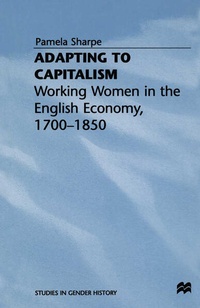
Adapting to Capitalism
Working Women in the English Economy, 1700-1850
Published on 1. January 1996
Book
Paperback/Softback
XI, 226 pages
978-1-349-24458-4 (ISBN)
Description
This book considers patterns of women's employment in the period 1700-1850. Focusing on the county of Essex, material on the worsted industry, agriculture, fashion trades, service, prostitution, and marriage and family life will shed light on contemporary debates in history such as the sexual division of labour, controversy over continuity or change in women's employment, the importance of ideas of 'separate spheres' and 'domestic ideology', and the overall effects of capitalism on women's employment.
Reviews / Votes
'Sharpe's study is one of the best, most meticulous monographs on all the ways that women worked in the early industrial period. Women indeed adapted to capitalism and it has taken decades to bring to light all the costs of that achievement'. - Deborah Valenze, American Historical Review
'the book is fascinating in itself...a model of how such studies can be done and invaluable to researchers in many fields...' - Eve Hostettler, Labour History Review
More details
Series
Edition
1996 ed.
Language
English
Place of publication
London
United Kingdom
Target group
Professional and scholarly
Product notice
Paperback (trade)
Unsewn / adhesive bound
Illustrations
XI, 226 p.
Dimensions
Height: 216 mm
Width: 139 mm
Thickness: 25 mm
Weight
321 gr
ISBN-13
978-1-349-24458-4 (9781349244584)
DOI
10.1007/978-1-349-24456-0
Schweitzer Classification
Other editions
Additional editions
Book
02/1996
Palgrave Macmillan
€160.49
Shipment within 15-20 days
Book
02/1996
Palgrave Macmillan
€176.54
Article not available at the moment
Person
PAMELA SHARPE is currently Queen Elizabeth II Research Fellow at the University of Western Australia in Perth. She was Lecturer in Social and Economic History at the University of Bristol from 1993 to 1999. The author received an MA (Hons) in Economic History from the University of Edinburgh and completed a doctorate in demographic history at the Cambridge Group for the History of Population and Social Structure, University of Cambridge, in 1989. From 1990 to 1993 she was Essex County Council Research Fellow in Local History at the University of Essex.
Content
Acknowledgements Map of Essex Prologue: Making Shift Introduction: Women Adapting to Capitalism De-industrialization and the Staple: the Worsted Industry Re-industrialization and the Fashion Trades Agriculture: the Sexual Division of Labour Shifts of Housewifery: Service as a Female Migration Experience The Economics of Body and Soul Epilogue: Continuity and Change in Women's Employment Bibliography Index