

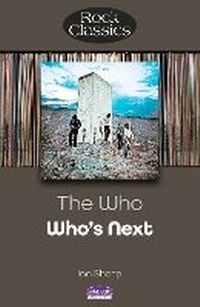
The Who: Who's Next (Rock Classics)
Book
Paperback/Softback
104 pages
978-1-78952-345-4 (ISBN)
Description
Released in
1971, Who's Next was The Who's fifth studio record. The second of three albums
recorded at their creative peak, it is widely viewed as their best work. The
task of writing a follow-up to the rock opera Tommy was a difficult one and its
origins emerged from Pete Townshend's Lifehouse, which proved to be an
over-ambitious blend of multi-media, film, a book, and audience involvement.
But what finally emerged was a great rock record.
With this release, The Who moved in new
directions, incorporating innovative use of synthesizers, piano and rootsy
violin. Roger Daltrey was at the top of his vocal game, Keith Moon was drumming
as only he could and John Entwistle was driving rock bass in new directions,
with all these factors unified in the service of brilliant songwriting.
Associate producer Glyn Johns then assembled the album, abandoning the
storyline. A number one in Britain and number four in America, the album was
hugely influential and continues to reach new audiences over fifty years later.
This book examines in detail the background,
inspiration and recording of the songs, the reception of the work as a whole,
and its legacy and influence on bands and performers to this day.
1971, Who's Next was The Who's fifth studio record. The second of three albums
recorded at their creative peak, it is widely viewed as their best work. The
task of writing a follow-up to the rock opera Tommy was a difficult one and its
origins emerged from Pete Townshend's Lifehouse, which proved to be an
over-ambitious blend of multi-media, film, a book, and audience involvement.
But what finally emerged was a great rock record.
With this release, The Who moved in new
directions, incorporating innovative use of synthesizers, piano and rootsy
violin. Roger Daltrey was at the top of his vocal game, Keith Moon was drumming
as only he could and John Entwistle was driving rock bass in new directions,
with all these factors unified in the service of brilliant songwriting.
Associate producer Glyn Johns then assembled the album, abandoning the
storyline. A number one in Britain and number four in America, the album was
hugely influential and continues to reach new audiences over fifty years later.
This book examines in detail the background,
inspiration and recording of the songs, the reception of the work as a whole,
and its legacy and influence on bands and performers to this day.
More details
Series
Language
English
Place of publication
Tewkesbury
United Kingdom
Illustrations
8 colour pages
Dimensions
Height: 198 mm
Width: 129 mm
ISBN-13
978-1-78952-345-4 (9781789523454)
Copyright in bibliographic data and cover images is held by Nielsen Book Services Limited or by the publishers or by their respective licensors: all rights reserved.
Schweitzer Classification
Person
Music has been an
obsession throughout Ian Sharp's life. His first Who concert, as a
teenager, was their legendary one-day festival at The Valley, London, in 1974.
The resulting Who obsession led him to see them live at every opportunity,
including their first performance post-Keith Moon at the Rainbow. Ian is an
author who reviews classic rock albums and writes about the psychology of music
in his online publication LP, for which he also compiles a weekly playlist of
classic and new tracks. He lives in Olney, Buckinghamshire, UK.
obsession throughout Ian Sharp's life. His first Who concert, as a
teenager, was their legendary one-day festival at The Valley, London, in 1974.
The resulting Who obsession led him to see them live at every opportunity,
including their first performance post-Keith Moon at the Rainbow. Ian is an
author who reviews classic rock albums and writes about the psychology of music
in his online publication LP, for which he also compiles a weekly playlist of
classic and new tracks. He lives in Olney, Buckinghamshire, UK.