

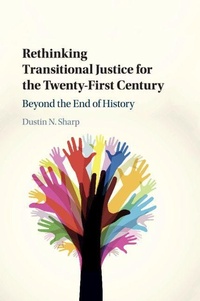
Rethinking Transitional Justice for the Twenty-First Century
Beyond the End of History
Published on 15. August 2019
Book
Paperback/Softback
208 pages
978-1-108-44270-1 (ISBN)
Description
Transitional justice is the dominant lens through which the world grapples with legacies of mass atrocity, and yet it has rarely reflected the diversity of peace and justice traditions around the world. Hewing to a largely western and legalist script, truth commissions and war crimes tribunals have become the default means of 'doing justice'. Rethinking Transitional Justice for the Twenty-First Century puts the blind spots and assumptions of transitional justice under the microscope, and asks whether the field might be re-imagined to better suit the diversity and realities of the twenty-first century. At the core of this re-imagining is an examination of the broader field of post-conflict peace building and associated critical theory, from which both caution and inspiration can be drawn. By using this lens, Dustin N. Sharp shows how we might begin to generate a more cosmopolitan and mosaic theory, and imagine more creative and context-sensitive approaches to building peace with justice.
More details
Language
English
Place of publication
Cambridge
United Kingdom
Target group
Professional and scholarly
Product notice
Paperback (trade)
Illustrations
Worked examples or Exercises
Dimensions
Height: 229 mm
Width: 152 mm
Thickness: 11 mm
Weight
286 gr
ISBN-13
978-1-108-44270-1 (9781108442701)
Copyright in bibliographic data and cover images is held by Nielsen Book Services Limited or by the publishers or by their respective licensors: all rights reserved.
Schweitzer Classification
Other editions
Additional editions
Dustin N. Sharp
Rethinking Transitional Justice for the Twenty-First Century
Beyond the End of History
Book
03/2018
Cambridge University Press
€140.30
Shipment within 15-20 days
Person
Dustin N. Sharp is an associate professor at the Joan B. Kroc School of Peace Studies at the University of San Diego. Prior to teaching, he covered Francophone West Africa for Human Rights Watch.
Content
1. Introduction: transitional justice foundations; Part I. Transitional Justice Peripheries: 2. Justice for what?; 3. Justice for whom?; 4. Justice to what ends?; Part II. Building a Better Foundation: 5. Peacebuilding and liberal post-conflict governance; 6. Transitional justice and liberal international peacebuilding; 7. Towards a more emancipatory transitional justice as peacebuilding project; 8. Conclusion: after the end of history, what should transitional justice become?