

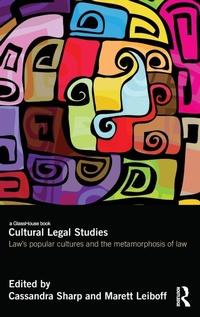
Cultural Legal Studies
Law's Popular Cultures and the Metamorphosis of Law
1st Edition
Published on 14. August 2015
Book
Hardback
322 pages
978-1-138-80106-6 (ISBN)
Description
What can law's popular cultures do for law, as a constitutive and interrogative critical practice? This collection explores such a question through the lens of the 'cultural legal studies' movement, which proffers a new encounter with the 'cultural turn' in law and legal theory. Moving beyond the 'law ands' (literature, humanities, culture, film, visual and aesthetics) on which it is based, this book demonstrates how the techniques and practices of cultural legal studies can be used to metamorphose law and the legalities that underpin its popular imaginary. By drawing on three different modes of cultural legal studies - storytelling, technology and jurisprudence - the collection showcases the intersectional practices of cultural legal studies, and law in its popular cultural mode.
The contributors to the collection deploy differentiated modes of cultural legal studies practice, adopting diverse philosophical, disciplinary, methodological and theoretical approaches and subjects of examination. The collection draws on this mix of diversity and homogeneity to thread together its overarching theme: that we must take seriously an interrogation of law as culture and in its cultural form. That is, it does not ask how a text 'represents' law; but rather how the representational nature of both law and culture intersect so that the 'juridical' become visible in various cultural manifestations. In short, it asks: how law's popular cultures actively effect the metamorphosis of law.
The contributors to the collection deploy differentiated modes of cultural legal studies practice, adopting diverse philosophical, disciplinary, methodological and theoretical approaches and subjects of examination. The collection draws on this mix of diversity and homogeneity to thread together its overarching theme: that we must take seriously an interrogation of law as culture and in its cultural form. That is, it does not ask how a text 'represents' law; but rather how the representational nature of both law and culture intersect so that the 'juridical' become visible in various cultural manifestations. In short, it asks: how law's popular cultures actively effect the metamorphosis of law.
Reviews / Votes
"Contributors to Sharp and Leiboff's collection examine how the techniques and practices of cultural legal studies can be used to metamorphose law and the legalities that underpin its popular imaginary. By drawing on three different modes of cultural legal studies-storytelling, technology, and jurisprudence-the collection seeks to showcase the intersectional practices of cultural legal studies, and law in its popular cultural mode."Law and Social Inquiry Journal
More details
Language
English
Place of publication
London
United Kingdom
Publishing group
Taylor & Francis Ltd
Target group
College/higher education
Dimensions
Height: 240 mm
Width: 161 mm
Thickness: 22 mm
Weight
652 gr
ISBN-13
978-1-138-80106-6 (9781138801066)
Copyright in bibliographic data and cover images is held by Nielsen Book Services Limited or by the publishers or by their respective licensors: all rights reserved.
Schweitzer Classification
Other editions
Additional editions
Cassandra Sharp | Marett Leiboff
Cultural Legal Studies
Law's Popular Cultures and the Metamorphosis of Law
Book
01/2018
1st Edition
Routledge
€77.00
Shipment within 15-20 days
Cassandra Sharp | Marett Leiboff
Cultural Legal Studies
Law's Popular Cultures and the Metamorphosis of Law
E-Book
07/2015
1st Edition
Routledge
€69.99
Available for download
Persons
Cassandra Sharp's research draws on a range of disciplinary methods to empirically explore individual responses to law. Her focus is the use of popular stories by individuals in challenging and constructing legal meaning and identity. She is a member of the Legal Intersections Research Centre (LIRC) at the University of Wollongong, Australia.
Marett Leiboff is a cultural legal studies and law and humanities scholar who is working on a monograph that explores theatrical jurisprudence. Her scholarship is grounded in her pre-law background in academic theatre studies. Marett is a member of the Legal Intersections Research Centre, University of Wollongong, Australia.
Marett Leiboff is a cultural legal studies and law and humanities scholar who is working on a monograph that explores theatrical jurisprudence. Her scholarship is grounded in her pre-law background in academic theatre studies. Marett is a member of the Legal Intersections Research Centre, University of Wollongong, Australia.
Content
PART I: Cultural Legal Studies - The Urgency of Method and Story 1. Cultural Legal Studies and Law's Popular Cultures, Marett Leiboff & Cassandra Sharp 2. Cultural Legal Studies as Law's Extroversion, Marett Leiboff 3. Finding Stories of Justice in the Art of Conversation: Ethnography in Cultural Legal Studies, Cassandra Sharp PART II: Cultural Legal Studies as Legal Storytelling 4. Interventions into the Feeling of Popular Justice: Australia's Stolen Generations, the Problem of Sentimentality, and Re-Encountering the Testimonial Form, Honni Van Rijswijk 5. Border Crossings: The Transnational Career of the Television Crime Drama, Sue Turnbull 6. Theatre and the Law in the 21st Century, Peter Robson PART III: Law's Technologies and Cultural Legal Studies 7. Picturing Justice in a Fraught Legal Arena: Fetus, Phantoms and Mandatory Ultrasounds, Jessica Silbey 8. Peeping: Open Justice and Law's Voyeurs, Katherine Biber 9. Irony as Method: Reframing Photographs in Cultural Legal Studies, Karen Crawley 10. Bodies, Cinema, Sovereignty: Using Visual Culture Methodologies to Think About Other Ways that Law Might Work, Kirsty Duncanson PART IV: Cultural Legal Studies as Jurisprudence 11. Popular Culture's Lex Vampirica: The Law of the Undead in True Blood, the Twilight Saga and The Passage, William Macneil 12. Reading the Law Made Strange: Cultural Legal Studies, Theology and Speculative Fiction, Timothy D Peters 13. Republicanism Meets (Dystopian) Faerie: Harry Potter and the Institutional Disaster, Luis Gomez Romero