

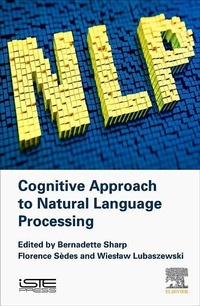
Cognitive Approach to Natural Language Processing
Published on 23. May 2017
Book
Hardback
234 pages
978-1-78548-253-3 (ISBN)
Description
As natural language processing spans many different disciplines, it is sometimes difficult to understand the contributions and the challenges that each of them presents. This book explores the special relationship between natural language processing and cognitive science, and the contribution of computer science to these two fields. It is based on the recent research papers submitted at the international workshops of Natural Language and Cognitive Science (NLPCS) which was launched in 2004 in an effort to bring together natural language researchers, computer scientists, and cognitive and linguistic scientists to collaborate together and advance research in natural language processing.The chapters cover areas related to language understanding, language generation, word association, word sense disambiguation, word predictability, text production and authorship attribution. This book will be relevant to students and researchers interested in the interdisciplinary nature of language processing.
Reviews / Votes
"All in all, for a computer scientist specializing in areas like computational linguistics, natural language processing, robotics, chatbots, navigation systems, speech recognition, and perhaps processing of sign languages, from an interdisciplinary point of view, this is an excellent starting point." --Computer ReviewsMore details
Language
English
Place of publication
United Kingdom
Target group
Professional and scholarly
College/higher education
Researchers and postgraduate students, and Industrialists working in NLP
Product notice
sewn/stitched
Cloth over boards
Dimensions
Height: 232 mm
Width: 152 mm
Thickness: 20 mm
Weight
590 gr
ISBN-13
978-1-78548-253-3 (9781785482533)
Copyright in bibliographic data and cover images is held by Nielsen Book Services Limited or by the publishers or by their respective licensors: all rights reserved.
Schweitzer Classification
Other editions
Additional editions
Bernadette Sharp | Florence Sedes | Wieslaw Lubaszewski
Cognitive Approach to Natural Language Processing
E-Book
05/2017
Elsevier
€92.95
Available for download
Persons
Bernadette Sharp is Professor of Applied Artificial Intelligence (AI) at Staffordshire University, UK. Her research interests include AI, natural language processing, and text mining. She has been Chair and Editor of the International Workshop for Natural Language Processing and Cognitive Science since 2004. Florence Sedes is a Professor of Computer Science at Paul Sabatier University, Toulouse, France. Her research focuses on data science, and she has published many books and articles and advised more than 30 PhDs. She leads various international, European and national projects on personal (meta)data privacy and management with applications to deep/machine learning for alert, spam and rumor detection, social emotion and interaction Wieslaw Lubaszewski is Professor at the Department of Computational Linguistics of the Jagiellonian University and Professor at the Computer Science Department of AGH, University of Technology, in Krakow, Poland. His research interests include natural language dictionaries, text understanding, knowledge representation, and information extraction.
Content
1. Delayed Interpretation, Shallow Processing and Constructions: the Basis of the "Interpret Whenever Possible? Principle.
2. Can the Human Association Norm Evaluate Machine-Made Association Lists?
3. How a Word of a Text Selects the Related Words in a Human Association Network.
4. The Reverse Association Task.
5. Hidden Structure and Function in the Lexicon.
6. Transductive Learning Games for Word Sense Disambiguation.
7. Use Your Mind and Learn to Write: The Problem of Producing Coherent Text.
8. Stylistic Features Based on Sequential Rule Mining for Authorship Attribution.
9. A Parallel, Cognition-oriented Fundamental Frequency Estimation Algorithm.
10. Benchmarking n-grams, Topic Models and Recurrent Neural Networks by Cloze Completions, EEGs and Eye Movements.
2. Can the Human Association Norm Evaluate Machine-Made Association Lists?
3. How a Word of a Text Selects the Related Words in a Human Association Network.
4. The Reverse Association Task.
5. Hidden Structure and Function in the Lexicon.
6. Transductive Learning Games for Word Sense Disambiguation.
7. Use Your Mind and Learn to Write: The Problem of Producing Coherent Text.
8. Stylistic Features Based on Sequential Rule Mining for Authorship Attribution.
9. A Parallel, Cognition-oriented Fundamental Frequency Estimation Algorithm.
10. Benchmarking n-grams, Topic Models and Recurrent Neural Networks by Cloze Completions, EEGs and Eye Movements.