

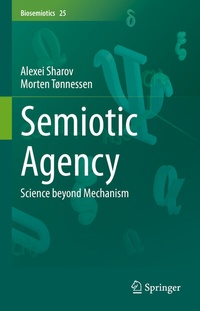
Semiotic Agency
Description
This book invites readers to embark on a journey into the world of agency encompassing humans, other organisms, cells, intracellular molecular agents, colonies, populations, ecological systems, and artificial autonomous systems. We combine mechanistic and non-mechanistic approaches in the analysis of the function and evolution of organisms, their subagents, and multi-organism systems, and in this way offer a theoretical platform for integrating biosemiotics with both natural science and the humanities/social sciences. Agents are autonomous systems that incorporate knowledge on how to make sense of their environment and use it to achieve their goals. The functions of all agents are supported by mechanisms at the lowest level; however, the explanatory power of mechanistic analysis is not sufficient for complex agents. Non-mechanistic methods rely on the goal-directedness of agents whose dynamics follow self-stabilized dynamic attractors. The properties of attractors depend on stable or slowly changing factors, and such dependencies can be interpreted as sign relations if they are adaptive in nature. Agents can replace or redirect mechanisms on demand in order to preserve their functions; for performing higher-level semiotic functions, mechanisms are thus only means. We assume that mechanism and semiosis are not mutually exclusive, and that simple agents can interpret signs mechanistically. This assumption allows us to extend semiotic analysis to all agents, including ribosomes in cells, computers, and robots. This book challenges established traditions in natural science and the humanities/social sciences: semiotics no longer appears as restricted to humans and rational thinking, and biology is no longer limited to rely exclusively on mechanistic reasoning.
More details
Other editions
Additional editions
Persons
Morten Tønnessen, Ph.D., is Professor of philosophy and Head of department at the Department of social studies, University of Stavanger, Norway. He is currently the President of the Nordic Association for Semiotic Studies (NASS), and a member of Norway´s Council for animal ethics. In the period 2013-2019, he served as an Editor-in-Chief for the journal Biosemiotics. In his biosemiotic research, Tønnessen has particularly been engaged in discussing, criticizing and applying the Umwelt theory of Jakob von Uexküll, aiming to make Umwelt theory more applicable in contemporary times. Key texts in this regard include "Umwelt ethics" (2003), "Umwelt transitions: Uexküll and environmental change" (2009), "Steps to a semiotics of being" (2010), "Umwelt trajectories" (2014) and "Introduction: The relevance of Uexküll's Umwelt theory today" (2015).
Content
2. Historical Overview of Developments of the Notion of Agency
3. Human Agency
4. Agency in Non-Human Organisms
5. Origins of Life
6. Conceptualizing Agency
7. Semiosis
8. Semiogenesis
9 Phenomenology
10. Composite Agency and Semiotics of Modularity
11. Human Agency and Ecology
12. Agentology: Crosspollination of Science and Philosophy