

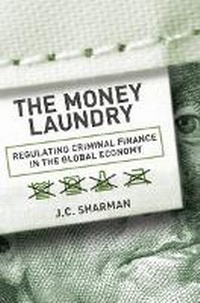
The Money Laundry
Regulating Criminal Finance in the Global Economy
Published on 15. October 2011
Book
Hardback
216 pages
978-0-8014-5018-1 (ISBN)
Description
A generation ago not a single country had laws to counter money laundering; now, more countries have standardized anti-money laundering (AML) policies than have armed forces. In The Money Laundry, J. C. Sharman investigates whether AML policy works, and why it has spread so rapidly to so many states with so little in common. Sharman asserts that there are few benefits to such policies but high costs, which fall especially heavily on poor countries. Sharman tests the effectiveness of AML laws by soliciting offers for just the kind of untraceable shell companies that are expressly forbidden by global standards. In practice these are readily available, and the author had no difficulty in buying the services of such companies. After dealing with providers in countries ranging from the Seychelles and Somalia to the United States and Britain, Sharman demonstrates that it is easier to form untraceable companies in large rich states than in small poor ones; the United States is the worst offender.
Despite its ineffectiveness, AML policy has spread via three paths. The Financial Action Task Force, the key standard-setter and enforcer in this area, has successfully implemented a strategy of blacklisting to promote compliance. Publicly identified as noncompliant, targeted states suffered damage to their reputation. Subsequently, officials from poor countries became socialized within transnational policy networks. Finally, international banks began using the presence of AML policy as a proxy for general country risk. Developing states have responded by adopting this policy as a functionally useless but symbolically valuable way of reassuring powerful outsiders. Since the financial crisis of 2008, the G20 has used the successful methods of coercive policy diffusion pioneered in the AML realm as a model for other global governance initiatives.
Despite its ineffectiveness, AML policy has spread via three paths. The Financial Action Task Force, the key standard-setter and enforcer in this area, has successfully implemented a strategy of blacklisting to promote compliance. Publicly identified as noncompliant, targeted states suffered damage to their reputation. Subsequently, officials from poor countries became socialized within transnational policy networks. Finally, international banks began using the presence of AML policy as a proxy for general country risk. Developing states have responded by adopting this policy as a functionally useless but symbolically valuable way of reassuring powerful outsiders. Since the financial crisis of 2008, the G20 has used the successful methods of coercive policy diffusion pioneered in the AML realm as a model for other global governance initiatives.
Reviews / Votes
In the context of work on the contemporary illicit, J.C. Sharman's book, The Money Laundry: Regulating Criminal Finance in the Global Economy, stands as a major contribution. Sharman sets out to look at the rapid and virtually unchallenged global diffusion of anti-money laundering (AML) policy and standards through the work of international organizations.... The book is written with an insider's insight, coupled with an academic detachment.... It will be a shame if his work does not attract a wide audience.- Tim Hall (Economic Geography) Well documented, well structured and with plenty of interesting examples, The Money Laundry takes readers through the complexity of the post-9/11 global AML policy drive.... Sharman not only provides a much needed constructive critique of anti-money laundering (AML) policy but shows how we can build on its few successful aspects.
- Loretta Napoleoni (International Affairs)
More details
Series
Language
English
Place of publication
Ithaca
United States
Target group
College/higher education
Professional and scholarly
Product notice
Paper over boards
Dimensions
Height: 235 mm
Width: 155 mm
Thickness: 22 mm
Weight
454 gr
ISBN-13
978-0-8014-5018-1 (9780801450181)
Copyright in bibliographic data and cover images is held by Nielsen Book Services Limited or by the publishers or by their respective licensors: all rights reserved.
Schweitzer Classification
Other editions
Additional editions
E-Book
10/2011
Cornell University Press
€14.49
Available for download
Person
J. C. Sharman is Professor in the Centre for Governance and Public Policy, Griffith University. He is the author of Havens in a Storm: The Struggle for Global Tax Regulation, also from Cornell, and coauthor most recently of Corruption and Money Laundering: A Symbiotic Relationship.
Content
Introduction: Policy Diffusion and Anti-Money Laundering1. Money Laundering and Anti-Money LaunderingPart One: Does Anti-Money Laundering Policy Work?
2. An Indirect Test of Effectiveness
3. A Direct Test of EffectivenessPart Two: Why Has Anti-Money Laundering Policy Diffused?
4. Blacklisting
5. Socialization and CompetitionConclusions: Implications for Scholarship and PolicyBibliography
Index
2. An Indirect Test of Effectiveness
3. A Direct Test of EffectivenessPart Two: Why Has Anti-Money Laundering Policy Diffused?
4. Blacklisting
5. Socialization and CompetitionConclusions: Implications for Scholarship and PolicyBibliography
Index