

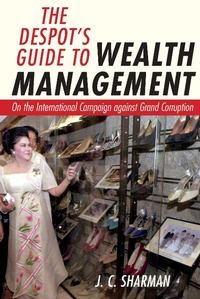
The Despot's Guide to Wealth Management
On the International Campaign Against Grand Corruption
Published on 7. March 2017
Book
Hardback
274 pages
978-1-5017-0551-9 (ISBN)
Description
An unprecedented new international moral and legal rule forbids one state from hosting money stolen by the leaders of another state. The aim is to counter grand corruption or kleptocracy ("rule by thieves"), when leaders of poorer countries-such as Marcos in the Philippines, Mobutu in the Congo, and more recently those overthrown in revolutions in the Arab world and Ukraine-loot billions of dollars at the expense of their own citizens. This money tends to end up hosted in rich countries. These host states now have a duty to block, trace, freeze, and seize these illicit funds and hand them back to the countries from which they were stolen.
In The Despot's Guide to Wealth Management, J. C. Sharman asks how this anti-kleptocracy regime came about, how well it is working, and how it could work better. Although there have been some real achievements, the international campaign against grand corruption has run into major obstacles. The vested interests of banks, lawyers, and even law enforcement often favor turning a blind eye to foreign corruption proceeds. Recovering and returning looted assets is a long, complicated, and expensive process.
Sharman used a private investigator, participated in and observed anti-corruption policy, and conducted more than a hundred interviews with key players. He also draws on various journalistic exposEs, whistle-blower accounts, and government investigations to inform his comparison of the anti-kleptocracy records of the United States, Britain, Switzerland, and Australia. Sharman calls for better policing, preventative measures, and use of gatekeepers like bankers, lawyers, and real estate agents. He also recommends giving nongovernmental organizations and for-profit firms more scope to independently investigate corruption and seize stolen assets.
In The Despot's Guide to Wealth Management, J. C. Sharman asks how this anti-kleptocracy regime came about, how well it is working, and how it could work better. Although there have been some real achievements, the international campaign against grand corruption has run into major obstacles. The vested interests of banks, lawyers, and even law enforcement often favor turning a blind eye to foreign corruption proceeds. Recovering and returning looted assets is a long, complicated, and expensive process.
Sharman used a private investigator, participated in and observed anti-corruption policy, and conducted more than a hundred interviews with key players. He also draws on various journalistic exposEs, whistle-blower accounts, and government investigations to inform his comparison of the anti-kleptocracy records of the United States, Britain, Switzerland, and Australia. Sharman calls for better policing, preventative measures, and use of gatekeepers like bankers, lawyers, and real estate agents. He also recommends giving nongovernmental organizations and for-profit firms more scope to independently investigate corruption and seize stolen assets.
Reviews / Votes
This book deals capably with government efforts to combat local scams, such as the massive Petrobras "car wash" affair in Brazil, and their contamination of global finance. It deals sequentially with efforts in the US, Switzerland, the UK, and Australia to combat kleptocracy-sometimes effective and sometimes not-often stymied by middlemen who like things the way they are. The book is well written and concise.- I. Walter, New York University (Choice) A major and important exercise in scrupulously-researched, brilliantly-documented and eloquently-expressed scholarship.... This is an extremely important book. For those who worry about "globalisation from above," it provides plenty of empirical evidence and analysis to show that the whole global financial structure desperately needs root and branch cleaning.
(Australian Institute of International Affairs) Sharman... is particularly interested in 'grand corruption': the theft of national wealth by kleptocratic leaders and their cronies, often in poor (albeit resource-rich) countries. It is a subject he knows well.
(The Economist) The book's strength derives from its avoidance of the common error of reading history backwards; looking for the particular characteristics of the present in the past. [Sharman] shows that, contrary to what many might assume, international corruption was not always a pressing concern. On the contrary, it was only in the 1990s that western leaders started discussing it in earnest.
(Financial Times) The book introduces the global anti-corruption regime - which has emerged from new international norms - and specifically focuses on combating kleptocracy.... Sharman's thinking prompts a discussion where 'liberalism' (the belief that economic prosperity promotes the rule of law, democratic values and social justice) is both the architect and victim of corruption.
(RUSI Journal)
More details
Language
English
Place of publication
Ithaca
United States
Target group
College/higher education
Product notice
Paper over boards
Illustrations
- 1 Tables, black and white
Dimensions
Height: 236 mm
Width: 156 mm
Thickness: 25 mm
Weight
584 gr
ISBN-13
978-1-5017-0551-9 (9781501705519)
Copyright in bibliographic data and cover images is held by Nielsen Book Services Limited or by the publishers or by their respective licensors: all rights reserved.
Schweitzer Classification
Other editions
Additional editions
J. C. Sharman
The Despot's Guide to Wealth Management
On the International Campaign Against Grand Corruption
E-Book
03/2017
Cornell University Press
€14.49
Available for download
Person
J. C. Sharman is Sir Patrick Sheehy Professor of International Relations at the University of Cambridge. He is the author of The Despot's Guide to Wealth Management: On the International Campaign against Grand Corruption, The Money Laundry: Regulating Criminal Finance in the Global Economy, and Havens in a Storm: The Struggle for Global Tax Regulation, all from Cornell, and coauthor most recently of International Order in Diversity: War, Trade and Rule in the Indian Ocean.
Content
Introduction: Power and Money1: The Rise of the Anti-Kleptocracy Regime2: The United States: A Superpower Stirs3: Switzerland: The Unlikely Crusader4: The United Kingdom: Development, or Sleaze and the City?5: Australia: In DenialConclusion: Making Them Pay