

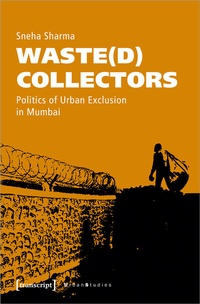
Waste(d) Collectors
Politics of Urban Exclusion in Mumbai
1st Edition
Published on 12. July 2022
Book
Paperback/Softback
248 pages
978-3-8376-5824-8 (ISBN)
Description
Modern waste disposal systems in mega-cities of the global South are embedded in socio-cultural belief systems, colonial histories and neoliberal logics which operate by reproducing existing social hierarchies. Sneha Sharma critically interrogates the politics around urban waste disposal in Mumbai, India, by undertaking an ethnographic journey to the city's most unwanted space, a dumping site. She challenges the dominant techno-managerial paradigm in waste management and reveals how spaces and people are made into waste through exclusionary social practices. Offering new insights on topics of urban marginality, informality, and urban planning, this book will attract scholars from sociology, urban studies, and human geography.
More details
Series
Language
English
Place of publication
Bielefeld
Germany
Target group
Professional and scholarly
Product notice
Klappenbroschur
Illustrations
11
11 s/w Abbildungen
Klebebindung, 20 SW-Abbildungen, 2 Farbabbildungen
Dimensions
Height: 22.5 cm
Width: 14.8 cm
Thickness: 15 mm
Weight
390 gr
ISBN-13
978-3-8376-5824-8 (9783837658248)
Schweitzer Classification
Other editions
Additional editions
E-Book
07/2022
1st Edition
transcript
€78.99
Available for download
Person
Sneha Sharma is a post-doctoral researcher at the department of geography, University of Bonn, Germany. After pursuing her bachelors and masters in sociology, she pursued an M.Phil in Planning and Development from Indian Institute of Technology, Bombay, India. She was awarded a DAAD scholarship for undertaking her PhD from Centre for Development Research (ZEF), Bonn. She is working on a project titled 'Urban Villages by the Airport', funded by the Fritz Thyssen Stiftung, which analyses intersections of urban renewal and affordable housing near international airports. With her keen interest in informality, discard studies and urban development, she continues to draw from critical perspectives in political ecology and urban sociology to shape her work.