

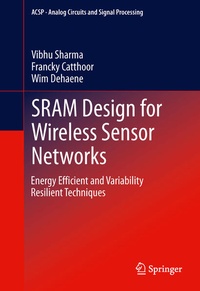
SRAM Design for Wireless Sensor Networks
Energy Efficient and Variability Resilient Techniques
Published on 8. August 2014
Book
Paperback/Softback
XII, 172 pages
978-1-4899-9215-4 (ISBN)
Description
This book features various, ultra low energy, variability resilient SRAM circuit design techniques for wireless sensor network applications. Conventional SRAM design targets area efficiency and high performance at the increased cost of energy consumption, making it unsuitable for computation-intensive sensor node applications. This book, therefore, guides the reader through different techniques at the circuit level for reducing energy consumption and increasing the variability resilience. It includes a detailed review of the most efficient circuit design techniques and trade-offs, introduces new memory architecture techniques, sense amplifier circuits and voltage optimization methods for reducing the impact of variability for the advanced technology nodes.
More details
Series
Edition
2013 ed.
Language
English
Place of publication
New York
United States
Target group
Professional and scholarly
Research
Illustrations
XII, 172 p.
Dimensions
Height: 235 mm
Width: 155 mm
Thickness: 11 mm
Weight
289 gr
ISBN-13
978-1-4899-9215-4 (9781489992154)
DOI
10.1007/978-1-4614-4039-0
Schweitzer Classification
Other editions
Additional editions

Vibhu Sharma | Francky Catthoor | Wim Dehaene
SRAM Design for Wireless Sensor Networks
Energy Efficient and Variability Resilient Techniques
Book
07/2012
Springer
€106.99
Shipment within 15-20 days

Vibhu Sharma | Francky Catthoor | Wim Dehaene
SRAM Design for Wireless Sensor Networks
Energy Efficient and Variability Resilient Techniques
E-Book
07/2012
1st Edition
Springer
€96.29
Available for download
Content
Introduction.- SRAM Bit Cell Optimization.- Adaptive Voltage Optimization Techniques: Low Voltage SRAM Operation.- Circuit Techniques to Assist SRAM Cell: Local Assist Circuitry.- SRAM Energy Reduction Techniques.- Variation Tolerant Low Power Sense Amplifiers.- Prototypes.- Conclusions.