

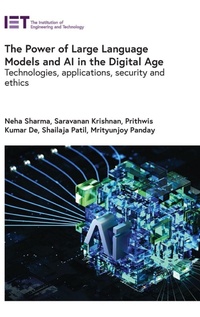
The Power of Large Language Models and AI in the Digital Age
Technologies, applications, security and ethics
Will be published approx. on 1. February 2026
Book
Hardback
440 pages
978-1-83724-101-9 (ISBN)
Description
Large language models (LLMs) represent a profound breakthrough in artificial intelligence. More than just statistical tools, these vast neural networks undergo an intensive training process that unlocks unexpected, emergent abilities. Models like ChatGPT are now demonstrating a surprising grasp of reasoning, semantics, and real-world concepts, leading many researchers to ask: are we witnessing the first sparks of Artificial General Intelligence (AGI)?
These models are doing more than just revolutionizing natural language processing; they are forcing us to reconsider the boundaries of machine intelligence. While their applications in chatbots, complex problem-solving, and content creation are already reshaping our digital world, their deeper implications point toward an entirely new era of AI.
To understand these emergent capabilities and confront the AGI question, a deep dive into the core technology is essential. This co-authored book provides that crucial foundation. The authors explore the significance and capabilities of LLMs, alongside the immense ethical, social, and security challenges that arise as these models grow more powerful.
For anyone seeking a comprehensive guide to navigate this new territory, The Power of Large Language Models and AI in the Digital Age: Technologies, applications, security and ethics is a valuable resource. It is essential reading for data scientists, researchers from academia and industry, lecturers, and advanced students in AI, computer science, and data science who will shape the future of intelligent systems.
These models are doing more than just revolutionizing natural language processing; they are forcing us to reconsider the boundaries of machine intelligence. While their applications in chatbots, complex problem-solving, and content creation are already reshaping our digital world, their deeper implications point toward an entirely new era of AI.
To understand these emergent capabilities and confront the AGI question, a deep dive into the core technology is essential. This co-authored book provides that crucial foundation. The authors explore the significance and capabilities of LLMs, alongside the immense ethical, social, and security challenges that arise as these models grow more powerful.
For anyone seeking a comprehensive guide to navigate this new territory, The Power of Large Language Models and AI in the Digital Age: Technologies, applications, security and ethics is a valuable resource. It is essential reading for data scientists, researchers from academia and industry, lecturers, and advanced students in AI, computer science, and data science who will shape the future of intelligent systems.
More details
Series
Language
English
Place of publication
Stevenage
United Kingdom
Target group
College/higher education
Professional and scholarly
Product notice
sewn/stitched
Cloth over boards
Dimensions
Height: 234 mm
Width: 156 mm
Thickness: 27 mm
Weight
857 gr
ISBN-13
978-1-83724-101-9 (9781837241019)
Copyright in bibliographic data and cover images is held by Nielsen Book Services Limited or by the publishers or by their respective licensors: all rights reserved.
Schweitzer Classification
Persons
Neha Sharma works with Tata Consultancy Services, India. She is the founder President of Bharat Research in AI and NextGen Foundation, India, and founder secretary of S4DS. A senior IEEE member and ACM distinguished speaker, she has 100+ publications, patents and awards, including the Golden Book Award 2023. With a PhD from IIT (ISM) Dhanbad, she champions AI for sustainability, societal transformation, and open data ecosystems, inspiring future innovators.
Saravanan Krishnan is an associate professor at College of Engineering, Guindy, Anna University, Chennai, India. He specializes in AI, ML, DL, NLP, cloud computing, software engineering, IoT and smart cities. He has published in reputed journals and at conferences, and has edited 15+ books and 20+ book chapters. He is also a consultant working on smart city initiatives. He is a fellow of IEI and a senior ACM member.
Prithwis Kumar De is affiliated with the Society for Data Science, Pune, India. He is an expert in data, analytics, and AI, having held leadership roles at Tata Consultancy Services, Accenture, CRISIL, Ernst & Young, and the Indian Institute of Foreign Trade. His expertise spans computing, data science, telecom, BFSI, retail, CPG, energy & utilities, life sciences, and healthcare sectors. He is an award-winning author, fellow of the Royal Statistical Society, and a chartered statistician.
Shailaja Patil is the dean of research and development at Rajarshi Shahu College of Engineering, Pune, India. With over 30 years of experience, she specializes in AI model development for IoT and excels in cutting-edge domains such as generative AI and foundational AI models. She has successfully secured research funding from DST, AICTE, and SPPU, has authored numerous research publications, and holds five patents.
Mrityunjoy Panday is currently serving as a principal architect in AI and ML and is the advanced AI competency lead at the Society for Data Science, Pune, India. His work encompasses a broad spectrum of applications, including natural language processing applications, time series analysis, reinforcement-based causality, and quantum hardware optimization. His expertise in GPT3, Codex, and automated scientific writing highlights his ability to merge cutting-edge AI technologies with practical applications.
Saravanan Krishnan is an associate professor at College of Engineering, Guindy, Anna University, Chennai, India. He specializes in AI, ML, DL, NLP, cloud computing, software engineering, IoT and smart cities. He has published in reputed journals and at conferences, and has edited 15+ books and 20+ book chapters. He is also a consultant working on smart city initiatives. He is a fellow of IEI and a senior ACM member.
Prithwis Kumar De is affiliated with the Society for Data Science, Pune, India. He is an expert in data, analytics, and AI, having held leadership roles at Tata Consultancy Services, Accenture, CRISIL, Ernst & Young, and the Indian Institute of Foreign Trade. His expertise spans computing, data science, telecom, BFSI, retail, CPG, energy & utilities, life sciences, and healthcare sectors. He is an award-winning author, fellow of the Royal Statistical Society, and a chartered statistician.
Shailaja Patil is the dean of research and development at Rajarshi Shahu College of Engineering, Pune, India. With over 30 years of experience, she specializes in AI model development for IoT and excels in cutting-edge domains such as generative AI and foundational AI models. She has successfully secured research funding from DST, AICTE, and SPPU, has authored numerous research publications, and holds five patents.
Mrityunjoy Panday is currently serving as a principal architect in AI and ML and is the advanced AI competency lead at the Society for Data Science, Pune, India. His work encompasses a broad spectrum of applications, including natural language processing applications, time series analysis, reinforcement-based causality, and quantum hardware optimization. His expertise in GPT3, Codex, and automated scientific writing highlights his ability to merge cutting-edge AI technologies with practical applications.
Author
Founder PresidentBharat Research in AI and NextGen Foundation, India
Associate ProfessorAnna University, College of Engineering, Guindy, Chennai, India
Society for Data Science, Pune, India
Dean of Research and DevelopmentRajarshi Shahu College of Engineering, Pune, India
Vice-President and Advanced AI Competency LeadBharat Research in AI and NextGen Foundation, India
Content
Part I: Understanding Large Language Models
Chapter 1: Introduction to deep learning and neural networks
Chapter 2: Foundation, Architecture, and Applications of Large Language Models
Chapter 3: Challenges and issues in implementing large language models
Part II: Practical Applications and Real-World Case Studies
Chapter 4: Practical applications of LLM Models
Chapter 5: Real-world case studies showcasing successful implementations
Part III: Technical Insights
Chapter 6: An In-depth Exploration of Large Language Model Architecture
Chapter 7: From Foundation to Specialization: A Comprehensive Analysis of Pre-training and Fine-Tuning in Large Language Models
Part IV: Ethical and Societal Implications
Chapter 8: Bias, fairness, and responsible AI in language models
Chapter 9: Consideration of privacy concerns and data security
Part V: Future Horizons
Chapter 10: The role of language models in the future of AI: future perspectives and research directions
Chapter 11: The Dawn of Agentic AI: AI Autonomous Systems and the future of intelligence
Chapter 1: Introduction to deep learning and neural networks
Chapter 2: Foundation, Architecture, and Applications of Large Language Models
Chapter 3: Challenges and issues in implementing large language models
Part II: Practical Applications and Real-World Case Studies
Chapter 4: Practical applications of LLM Models
Chapter 5: Real-world case studies showcasing successful implementations
Part III: Technical Insights
Chapter 6: An In-depth Exploration of Large Language Model Architecture
Chapter 7: From Foundation to Specialization: A Comprehensive Analysis of Pre-training and Fine-Tuning in Large Language Models
Part IV: Ethical and Societal Implications
Chapter 8: Bias, fairness, and responsible AI in language models
Chapter 9: Consideration of privacy concerns and data security
Part V: Future Horizons
Chapter 10: The role of language models in the future of AI: future perspectives and research directions
Chapter 11: The Dawn of Agentic AI: AI Autonomous Systems and the future of intelligence