

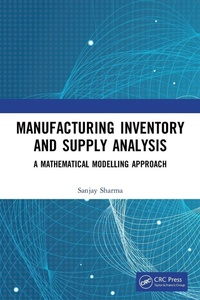
Manufacturing Inventory and Supply Analysis
A Mathematical Modelling Approach
1st Edition
Published on 8. October 2024
Book
Paperback/Softback
228 pages
978-1-032-10166-8 (ISBN)
Description
This reference text discusses models and analyzes cases that are useful for material requirements planning (MRP), just-in-time (JIT) environments and supply chain environments, as well as traditional production-inventory systems.
It covers important concepts, including production-inventory systems, optimal purchase quantity, optimal production quantity, instantaneous procurement, multiple input items, sensitivity analysis, multiproduct manufacturing, determination of optimum cycle time, fractional backlogging, and incorporating input item procurement and flexibility in the production rate.
Aimed at senior undergraduate and graduate students, and professionals in the field of industrial engineering, production engineering and manufacturing science, this text:
Provides detailed models/analysis pertaining to various cases which are useful for material requirements planning and supply chain environments
Elaborates manufacturing rate flexibility, demand variation and production rate variation
Discusses the multi-item manufacturing environment and presents models with backorders, as well as fractional backlogging
Analyzes flexible production rates, along with upward and downward variations
It covers important concepts, including production-inventory systems, optimal purchase quantity, optimal production quantity, instantaneous procurement, multiple input items, sensitivity analysis, multiproduct manufacturing, determination of optimum cycle time, fractional backlogging, and incorporating input item procurement and flexibility in the production rate.
Aimed at senior undergraduate and graduate students, and professionals in the field of industrial engineering, production engineering and manufacturing science, this text:
Provides detailed models/analysis pertaining to various cases which are useful for material requirements planning and supply chain environments
Elaborates manufacturing rate flexibility, demand variation and production rate variation
Discusses the multi-item manufacturing environment and presents models with backorders, as well as fractional backlogging
Analyzes flexible production rates, along with upward and downward variations
More details
Language
English
Place of publication
London
United Kingdom
Publishing group
Taylor & Francis Ltd
Target group
College/higher education
Academic, Postgraduate, Professional, and Undergraduate Advanced
Illustrations
53 s/w Abbildungen, 53 s/w Zeichnungen, 3 s/w Tabellen
3 Tables, black and white; 53 Line drawings, black and white; 53 Illustrations, black and white
Dimensions
Height: 234 mm
Width: 156 mm
Thickness: 13 mm
Weight
374 gr
ISBN-13
978-1-032-10166-8 (9781032101668)
Copyright in bibliographic data and cover images is held by Nielsen Book Services Limited or by the publishers or by their respective licensors: all rights reserved.
Schweitzer Classification
Other editions
Additional editions
Book
10/2021
1st Edition
CRC Press
€131.90
Shipment within 10-20 days
E-Book
10/2021
1st Edition
CRC Press
€63.49
Available for download
E-Book
10/2021
1st Edition
CRC Press
€63.49
Available for download
Person
Sanjay Sharma is Professor at National Institute of Industrial Engineering (NITIE), Mumbai, India. He is operations and supply chain management educator and researcher. He has more than the three decades experience including industrial, managerial, teaching/training, consultancy and research; also many awards/honours to his credit. He has published eight books and papers in various journals such as European Journal of Operational Research, International Journal of Production Economics, Computers & Operations Research, International Journal of Advanced Manufacturing Technology, Journal of the Operational Research Society, and Computers and Industrial Engineering. He is also on the editorial board of few journals including the International Journal of Logistics Management.
Content
1. Introduction. 2. Batch size. 3. Batch size relevance for just-in-time (JIT). 4. Price variation. 5. Batch size for material requirements planning. 6. Multiproduct manufacturing. 7. Manufacturing rate flexibility. 8. Additional Reading. 9. Bibliography.