

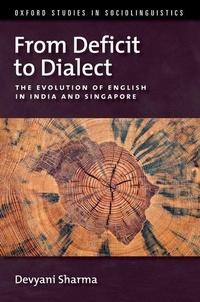
From Deficit to Dialect
The Evolution of English in India and Singapore
Published on 7. November 2023
Book
Hardback
320 pages
978-0-19-530750-4 (ISBN)
Description
The emergence of new English dialects in postcolonial regions has transformed the politics of English in the world and language ecologies in many regions. Why, how, and when did these dialects develop? Why do they have the accents and grammars that we hear? Are the grammars of these dialects completely different due to the influence of local languages, or similar due to natural tendencies in human cognition? In terms of social identity, do these new speakers behave like native speakers of British or American English, or like language learners?
Focusing on two prominent cases; English in India and in Singapore; this book examines the social, historical, and cognitive forces that together created and continue to shape these dialects. Differences in the linguistic ecology of the two regions help us to identify the strongest mechanisms of dialect formation under long-term cultural contact. The multi-scale analysis of a range of bilinguals moves beyond a simplistic divide between 'deficit' and 'dialect' views of these speech communities, showing that change proceeds unevenly across the language system and the social group, with feedback loops between social history, language learning, language structure, and identity.
Focusing on two prominent cases; English in India and in Singapore; this book examines the social, historical, and cognitive forces that together created and continue to shape these dialects. Differences in the linguistic ecology of the two regions help us to identify the strongest mechanisms of dialect formation under long-term cultural contact. The multi-scale analysis of a range of bilinguals moves beyond a simplistic divide between 'deficit' and 'dialect' views of these speech communities, showing that change proceeds unevenly across the language system and the social group, with feedback loops between social history, language learning, language structure, and identity.
Reviews / Votes
Sharma's book represents both an inspiration and a challenge for the scholarly community. * Claudia Lange, English Language and Linguistics *More details
Series
Language
English
Place of publication
New York
United States
Target group
College/higher education
Product notice
sewn/stitched
Cloth over boards
Dimensions
Height: 245 mm
Width: 165 mm
Thickness: 32 mm
Weight
588 gr
ISBN-13
978-0-19-530750-4 (9780195307504)
Copyright in bibliographic data and cover images is held by Nielsen Book Services Limited or by the publishers or by their respective licensors: all rights reserved.
Schweitzer Classification
Other editions
Additional editions
E-Book
09/2023
OUP eBook
€57.99
Available for download
E-Book
07/2023
OUP eBook
€57.99
Available for download
Person
Devyani Sharma is Professor of Sociolinguistics at Queen Mary University of London. Her research examines dialect variation and change in postcolonial and diaspora situations, style variation, dialect typology, language attitudes, and bilingualism. She has an interest in developing new methods for studying language variation in contact settings, and in outreach work with a range of sectors to promote understanding of English diversity and language-based discrimination. Her co-edited works include The Oxford Handbook of World Englishes, English in the Indian Diaspora, and Research Methods in Linguistics.
Content
Chapter 1. Introduction PART I. ENGLISH IN INDIA
Chapter 2. Histories of English in India
Chapter 3. Errors or innovations? Chapter 4. The article system Chapter 5. The verbal system
Chapter 6. Dialect identity PART II. COMPARING INDIA AND SINGAPORE
Chapter 7. Rates of change
Chapter 8. Grammatical universals? Chapter 9. The role of input
Chapter 10. Style range and attitudinal change Chapter 11. Summary and implications
Chapter 2. Histories of English in India
Chapter 3. Errors or innovations? Chapter 4. The article system Chapter 5. The verbal system
Chapter 6. Dialect identity PART II. COMPARING INDIA AND SINGAPORE
Chapter 7. Rates of change
Chapter 8. Grammatical universals? Chapter 9. The role of input
Chapter 10. Style range and attitudinal change Chapter 11. Summary and implications