

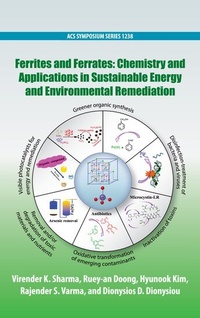
Ferrites and Ferrates
Chemistry and Applications in Sustainable Energy and Environmental Remediation
Published on 29. March 2018
Book
Hardback
516 pages
978-0-8412-3187-0 (ISBN)
Description
Earth-abundant iron and its oxides are not only "greener" than many of rare and precious metals, but can elegantly perform numerous catalytic reactions of industrial and environmental significance, often mimicking enzymes. Industrial applications include the use of iron and iron oxide-based compounds in pigments, magnetic recording media, catalysis, and magnetic fluids. Iron oxides have shown potential in manufacturing, water purification, and photocatalytic
transformation to generate solar fuel. This book presents synthesis and application of ferrites, including high energy density rechargeable batteries, in cleaner ("greener") technologies for organic syntheses, and in environmentally friendly water and wastewater treatment processes.
This book comprises 18 chapters with a focus on synthesis and environmental applications of ferrites and ferrates. Topics of the book encompass greener catalysis (nano-catalysis) emanating from ferrites and ferrates to achieve chemical energy transformation, organic syntheses and transformation, as well as eco-friendly water and wastewater treatment processes, namely removal of metals, oxidation of micropollutants, and inactivation of microorganisms and toxins.
transformation to generate solar fuel. This book presents synthesis and application of ferrites, including high energy density rechargeable batteries, in cleaner ("greener") technologies for organic syntheses, and in environmentally friendly water and wastewater treatment processes.
This book comprises 18 chapters with a focus on synthesis and environmental applications of ferrites and ferrates. Topics of the book encompass greener catalysis (nano-catalysis) emanating from ferrites and ferrates to achieve chemical energy transformation, organic syntheses and transformation, as well as eco-friendly water and wastewater treatment processes, namely removal of metals, oxidation of micropollutants, and inactivation of microorganisms and toxins.
More details
Series
Language
English
Place of publication
New York
United States
Target group
Professional and scholarly
Illustrations
133
Dimensions
Height: 234 mm
Width: 161 mm
Thickness: 37 mm
Weight
988 gr
ISBN-13
978-0-8412-3187-0 (9780841231870)
Copyright in bibliographic data and cover images is held by Nielsen Book Services Limited or by the publishers or by their respective licensors: all rights reserved.
Schweitzer Classification
Persons
Virender K. Sharma received his Ph.D. from Rosenstiel School of Marine and Atmospheric Science, University of Miami, Florida. He is currently a professor in the Department of Environmental and Occupational Health and the Director of the Program for Water Sustainability and Public Health Research, Texas A&M University, College Station, Texas. He has published more than 250 peer-reviewed journal publications, 36 proceedings, 50 book chapters, and authored and
edited seven books.
Ruey-an Doong received his Ph.D in Environmental Engineering at National Taiwan University, Taiwan in 1992. He is a full professor in the Department of Biomedical Engineering and Environmental Sciences, National Tsing Hua University, Taiwan. Currently, Prof. Doong is the Dean of the College of Nuclear Science, National Tsing Hua University.
Hyunook Kim is Professor at Environmental Engineering, University of Seoul, Korea, and Director of R&D Center of Core Technologies for Water Treatment. Professor Kim earned his B.S. degree in Environmental Science from Yonsei University, Korea in 1994, and an M.S. degree in Environmental Engineering from Johns Hopkins University in 1997, and a Ph.D. from University of Maryland at College Park in 2000. Before joining University of Seoul in 2002 as a faculty member, he worked as an
Environmental Engineer for the US Department of Agriculture.
Rajender S. Varma received his Ph.D in Chemistry from Delhi University in 1976. After postdoctoral research at Robert Robinson Laboratories, Liverpool, UK, he was a faculty member at Baylor College of Medicine and Sam Houston State University prior to joining the US Environmental Protection Agency (EPA) in 1999 with an affiliation at Palacky University, Olomouc, Czech Republic (2014).
Dionysios D. Dionysiou is currently a Professor of Environmental Engineering and Science Program at the University of Cincinnati. He teaches courses and performs research in the areas of drinking-water quality and treatment, advanced unit operations for water treatment, advanced oxidation technologies. Dr. Dionysiou is the author or co-author of over 290 refereed journal publications, over 90 conference proceedings, 20 book chapter publications, 20 editorials, and more than 550 presentations.
He has edited/co-edited 5 books on water quality, water reuse, and photocatalysis.
edited seven books.
Ruey-an Doong received his Ph.D in Environmental Engineering at National Taiwan University, Taiwan in 1992. He is a full professor in the Department of Biomedical Engineering and Environmental Sciences, National Tsing Hua University, Taiwan. Currently, Prof. Doong is the Dean of the College of Nuclear Science, National Tsing Hua University.
Hyunook Kim is Professor at Environmental Engineering, University of Seoul, Korea, and Director of R&D Center of Core Technologies for Water Treatment. Professor Kim earned his B.S. degree in Environmental Science from Yonsei University, Korea in 1994, and an M.S. degree in Environmental Engineering from Johns Hopkins University in 1997, and a Ph.D. from University of Maryland at College Park in 2000. Before joining University of Seoul in 2002 as a faculty member, he worked as an
Environmental Engineer for the US Department of Agriculture.
Rajender S. Varma received his Ph.D in Chemistry from Delhi University in 1976. After postdoctoral research at Robert Robinson Laboratories, Liverpool, UK, he was a faculty member at Baylor College of Medicine and Sam Houston State University prior to joining the US Environmental Protection Agency (EPA) in 1999 with an affiliation at Palacky University, Olomouc, Czech Republic (2014).
Dionysios D. Dionysiou is currently a Professor of Environmental Engineering and Science Program at the University of Cincinnati. He teaches courses and performs research in the areas of drinking-water quality and treatment, advanced unit operations for water treatment, advanced oxidation technologies. Dr. Dionysiou is the author or co-author of over 290 refereed journal publications, over 90 conference proceedings, 20 book chapter publications, 20 editorials, and more than 550 presentations.
He has edited/co-edited 5 books on water quality, water reuse, and photocatalysis.
Editor
Professor of Environmental and Occupational HealthProfessor of Environmental and Occupational Health, School of Rural Public Health, Texas A&M University
Distinguished Professor of Biomedical Engineering and Environmental SciencesDistinguished Professor of Biomedical Engineering and Environmental Sciences, National Chiao Tung University
Professor of Environmental EngineeringProfessor of Environmental Engineering, University of Seoul
Senior Scientist, Sustainable Technology Division, National Risk Management Research LaboratorySenior Scientist, Sustainable Technology Division, National Risk Management Research Laboratory, U.S. Environmental Protection Agency
UNESCO Co-Chair Professor of Water Access and Sustainability and Professor of Environmental EngineeringUNESCO Co-Chair Professor of Water Access and Sustainability and Professor of Environmental Engineering, University of Cincinnati
Content
Preface
1. Silica-Coated Magnetic Nano-Particles: Application in Catalysis
2. Magnetite (Ferrites)-Supported Nano-Catalysts: Sustainable Applications in Organic Transformations
3. Ferrites as Photocatalysts for Water Splitting and Degradation of Contaminants
4. Ferrites: Synthesis and Applications for Environmental Remediation
5. Purification of Water by Ferrites - Mini Review
6. Use of Ferrate and Ferrites for Water Disinfection
7. Ferrate(VI) a Greener Solution: Synthesis, Characterization, and Multifunctional Use in Treating Metal-Complexed Species in Aqueous Solution
8. Electrochemical Ferrates(VI) Preparation and Wastewater Treatment
9. Stability of Ferrate(VI) in 14 M NaOH-KOH Mixtures at Different Temperatures
10. Elimination of Organic Contaminants during Oxidative Water Treatment with Ferrate(VI): Reaction Kinetics and Transformation Products
11. Removal of Selected Pharmaceuticals Spiked in the Secondary Effluent of a Wastewater Treatment Plant (WWTP) by Potassium Ferrate(VI)
12. Review on the Stability of Ferrate (VI) Species in Aqueous Medium and Oxidation of Pharmaceuticals and Personal Care Products (PPCPs) by Ferrate (VI): Identification of Transformation By-Products
13. The Degradation Kinetics of Typical EDCs (Endocrine Disruption Chemicals) by Ferrate(VI)
14. Review on Greywater Treatment and Dye Removal from Aqueous Solution by Ferrate (VI)
15. Ferrate(VI) Reaction with Effluent Organic Matter (EfOM) in Secondary Effluent for Water Reuse
16. Comparison of the Effects of Ferrate, Ozone, and Permanganate Pre-Oxidation on Disinfection Byproduct Formation from Chlorination
17. A DFT Study on Oxygen Atom Transfer Reaction between Ferrate Ion and Arsenite Ion
18. DFT Study on the pH Dependence of the Reactivity of Ferrate(VI)
Editors' Biographies
Indexes
1. Silica-Coated Magnetic Nano-Particles: Application in Catalysis
2. Magnetite (Ferrites)-Supported Nano-Catalysts: Sustainable Applications in Organic Transformations
3. Ferrites as Photocatalysts for Water Splitting and Degradation of Contaminants
4. Ferrites: Synthesis and Applications for Environmental Remediation
5. Purification of Water by Ferrites - Mini Review
6. Use of Ferrate and Ferrites for Water Disinfection
7. Ferrate(VI) a Greener Solution: Synthesis, Characterization, and Multifunctional Use in Treating Metal-Complexed Species in Aqueous Solution
8. Electrochemical Ferrates(VI) Preparation and Wastewater Treatment
9. Stability of Ferrate(VI) in 14 M NaOH-KOH Mixtures at Different Temperatures
10. Elimination of Organic Contaminants during Oxidative Water Treatment with Ferrate(VI): Reaction Kinetics and Transformation Products
11. Removal of Selected Pharmaceuticals Spiked in the Secondary Effluent of a Wastewater Treatment Plant (WWTP) by Potassium Ferrate(VI)
12. Review on the Stability of Ferrate (VI) Species in Aqueous Medium and Oxidation of Pharmaceuticals and Personal Care Products (PPCPs) by Ferrate (VI): Identification of Transformation By-Products
13. The Degradation Kinetics of Typical EDCs (Endocrine Disruption Chemicals) by Ferrate(VI)
14. Review on Greywater Treatment and Dye Removal from Aqueous Solution by Ferrate (VI)
15. Ferrate(VI) Reaction with Effluent Organic Matter (EfOM) in Secondary Effluent for Water Reuse
16. Comparison of the Effects of Ferrate, Ozone, and Permanganate Pre-Oxidation on Disinfection Byproduct Formation from Chlorination
17. A DFT Study on Oxygen Atom Transfer Reaction between Ferrate Ion and Arsenite Ion
18. DFT Study on the pH Dependence of the Reactivity of Ferrate(VI)
Editors' Biographies
Indexes