

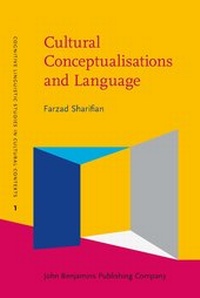
Cultural Conceptualisations and Language
Theoretical framework and applications
Published on 23. February 2011
Book
Hardback
238 pages
978-90-272-0404-2 (ISBN)
Description
This book presents a multidisciplinary theoretical model of cultural conceptualisations and language. Viewing language as firmly grounded in cultural cognition, the model draws on analytical tools and theoretical advancements in several disciplines, including cognitive linguistics, cognitive anthropology, anthropological linguistics, distributed cognition, complexity science, and cognitive psychology. The result is a framework that has significant implications for those disciplines as well as for applied linguistics. Applications of the model to intercultural communication, cross-cultural pragmatics, English as an International Language/World Englishes, and political discourse analysis are explored in detail.
For further research and theoretical advancements in this newly developed field see Cultural Linguistics. Cultural conceptualisations and language [CLSCC 8]
For further research and theoretical advancements in this newly developed field see Cultural Linguistics. Cultural conceptualisations and language [CLSCC 8]
More details
Series
Language
English
Place of publication
Amsterdam
Netherlands
Target group
Professional and scholarly
Illustrations
+ index
Dimensions
Height: 245 mm
Width: 164 mm
Weight
630 gr
ISBN-13
978-90-272-0404-2 (9789027204042)
Copyright in bibliographic data and cover images is held by Nielsen Book Services Limited or by the publishers or by their respective licensors: all rights reserved.
Schweitzer Classification
Other editions
Additional editions
E-Book
02/2011
1st Edition
John Benjamins Publishing Company
€113.99
Available for download
Person
Content
1. List of tables; 2. List of figures; 3. Acknowledgements; 4. Preface; 5. Part 1. Theoretical framework; 6. Chapter 1. On cultural conceptualisations; 7. Chapter 2. Distributed, emergent cultural cognition, conceptualisation and language; 8. Chapter 3. On collective cognition and language; 9. Part 2. Case studies - cultural conceptualisations in Aboriginal languages; 10. Chapter 4. Aboriginal language habitat and cultural continuity; 11. Chapter 5. Cultural conceptualisations in English words: A study of Aboriginal children in Perth; 12. Part 3. Intercultural communication; 13. Chapter 6. Cultural conceptualisations in intercultural communication: A study of Aboriginal and non-Aboriginal Australians; 14. Chapter 7. Cultural conceptualisations in English as an international language (EIL); 15. Chapter 8. Cultural schemas and intercultural communication: A study of Persian; 16. Part 4. Cross-cultural pragmatics; 17. Chapter 9. The Persian cultural schema of Shekasteh-Nafsi: Cultural schemas in compliment responses in Persian and Anglo-Australian speakers; 18. Chapter 10. Semantic and pragmatic conceptualisations within an emerging variety: Persian English; 19. Part 5. Culture, body, self, and language; 20. Chapter 11. Cultural conceptualisations of 'Self' and del 'heart/stomach' in Persian; 21. Chapter 12. Conceptualisations of Cheshm 'eye' and 'perception' in Persian; 22. Part 6. Political discourse; 23. Chapter 13. Figurative language in international political discourse: The case of Iran; 24. Chapter 14. Politics and/of translation: Case studies between Persian and English; 25. Final words; 26. References; 27. Index