

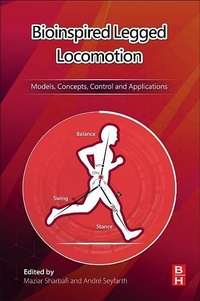
Bioinspired Legged Locomotion
Models, Concepts, Control and Applications
Published on 22. November 2017
Book
Paperback/Softback
698 pages
978-0-12-803766-9 (ISBN)
Description
Bioinspired Legged Locomotion: Models, Concepts, Control and Applications explores the universe of legged robots, bringing in perspectives from engineering, biology, motion science, and medicine to provide a comprehensive overview of the field. With comprehensive coverage, each chapter brings outlines, and an abstract, introduction, new developments, and a summary.
Beginning with bio-inspired locomotion concepts, the book's editors present a thorough review of current literature that is followed by a more detailed view of bouncing, swinging, and balancing, the three fundamental sub functions of locomotion. This part is closed with a presentation of conceptual models for locomotion.
Next, the book explores bio-inspired body design, discussing the concepts of motion control, stability, efficiency, and robustness. The morphology of legged robots follows this discussion, including biped and quadruped designs.
Finally, a section on high-level control and applications discusses neuromuscular models, closing the book with examples of applications and discussions of performance, efficiency, and robustness. At the end, the editors share their perspective on the future directions of each area, presenting state-of-the-art knowledge on the subject using a structured and consistent approach that will help researchers in both academia and industry formulate a better understanding of bioinspired legged robotic locomotion and quickly apply the concepts in research or products.
Beginning with bio-inspired locomotion concepts, the book's editors present a thorough review of current literature that is followed by a more detailed view of bouncing, swinging, and balancing, the three fundamental sub functions of locomotion. This part is closed with a presentation of conceptual models for locomotion.
Next, the book explores bio-inspired body design, discussing the concepts of motion control, stability, efficiency, and robustness. The morphology of legged robots follows this discussion, including biped and quadruped designs.
Finally, a section on high-level control and applications discusses neuromuscular models, closing the book with examples of applications and discussions of performance, efficiency, and robustness. At the end, the editors share their perspective on the future directions of each area, presenting state-of-the-art knowledge on the subject using a structured and consistent approach that will help researchers in both academia and industry formulate a better understanding of bioinspired legged robotic locomotion and quickly apply the concepts in research or products.
More details
Language
English
Place of publication
Woburn
United States
Publishing group
Elsevier - Health Sciences Division
Target group
Professional and scholarly
Scholars in motion science, (control/mechanical) engineering, robotics, medicine, biology, Companies in robotics and biorobotics, biomedical engineering
Product notice
Paperback (trade)
Unsewn / adhesive bound
Dimensions
Height: 226 mm
Width: 149 mm
Thickness: 38 mm
Weight
1081 gr
ISBN-13
978-0-12-803766-9 (9780128037669)
Copyright in bibliographic data and cover images is held by Nielsen Book Services Limited or by the publishers or by their respective licensors: all rights reserved.
Schweitzer Classification
Other editions
Additional editions
Maziar Ahmad Sharbafi | André Seyfarth
Bioinspired Legged Locomotion
Models, Concepts, Control and Applications
E-Book
11/2017
Butterworth-Heinemann
€119.00
Available for download
Persons
Maziar Sharbafi is an assistant professor in electrical and computer engineering department of University of Tehran. He is also a guest researcher at the Locomotion Laboratory, TU Darmstadt. He studied control engineering at Sharif University of Technology and University of Tehran (UT) for his bachelor and master, respectively. He started working on bipedal robot control in his PhD at University of Tehran, from 2007 and more on bio-inspired control approaches, since he entered lauflabor in 2011. His current research interests include bio-inspired locomotion control based on conceptual and analytic approaches, postural stability and the application of dynamical systems and nonlinear control in hybrid systems like locomotion Andre Seyfarth is full professor for Sports Biomechanics at the Department of Human Sciences of TU Darmstadt and head of the Lauflabor Locomotion Laboratory. After his studies in physics and his PhD in the field of biomechanics he went as a DFG "Emmy Noether? fellow to the MIT LegLab (Prof. Herr, USA) and the ParaLab at the university hospital Balgrist in Zurich (Prof. Dietz, Switzerland). His research topics include sport science, human and animal biomechanics and legged robots. Prof. Seyfarth was the organizer of the Dynamic Walking 2011 conference ("Principles and concepts of legged locomotion") and the AMAM 2013 conference ("Adaptive Motions in Animals and Machines?).
Content
1. Introduction
Part I : Concepts
2. Fundamental sub-functions of locomotion
3. Conceptual models for locomotion
Part II: Control
4. Control of motion and compliance
5. Torque control in legged locomotion
6. Neuromuscular control in locomotion
Part III: Implementation
7. Legged robots with bio-inspired morphology
8. Actuation in legged locomotion
9. Conclusions and outlook (How far are we from Nature?)
Part I : Concepts
2. Fundamental sub-functions of locomotion
3. Conceptual models for locomotion
Part II: Control
4. Control of motion and compliance
5. Torque control in legged locomotion
6. Neuromuscular control in locomotion
Part III: Implementation
7. Legged robots with bio-inspired morphology
8. Actuation in legged locomotion
9. Conclusions and outlook (How far are we from Nature?)