

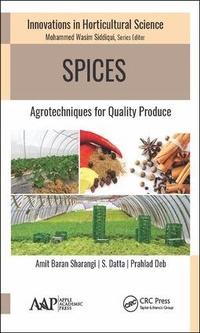
Spices
Agrotechniques for Quality Produce
1st Edition
Published on 7. March 2018
Book
Hardback
408 pages
978-1-77188-635-2 (ISBN)
Description
Indian spices are famous across the globe and have attracted food lovers for ages. With the increasing awareness of health through foods, people are now more conscious about the health and nutraceutical benefits of spices. The past few years have witnessed pioneering research work in this area with various spices. This volume is a comprehensive volume that collects and collates the wisdom of the past and blends it with the technological progress of today. The book offers comprehensive coverage on the subject of Indian spices and their agrotechniques. It is a rich compilation of agrotechniques coupled with background information, research work, and scientific discussion on the basic and applied aspects on the subject.
The first chapter in Spices: Agrotechniques for Quality Produce is introductory and provides an overview of spices that have important flavor compounds. It looks at the present status of world spice scenario on export and import, major markets, etc. The second chapter deals with classification of spices, condiments, and herbs. The third chapter is the major one that precisely describes agrotechniques and production technology of fifty individual spices comprised of the major spices. It covers three rhizomatous spices, six bulbous spices, eight tree spices (six aromatic and two acidulant), eleven seed spices, twelve leafy or herbal spices or aromatic herbs, four lesser-known spices, and three other spices with due consideration to quality and value-added benefits. This chapter also presents a general discussion of the systematic position, composition, uses, export-import scenario, medicinal values, etc., of these spices. The subsequent chapters deal with recent research approaches on spices around the world and explore the promises of organic spices and future research directions.
This volume will be useful to all those who are interested in spices, including students, teachers, researchers, amateur readers, policymakers, as well as farming communities.
The first chapter in Spices: Agrotechniques for Quality Produce is introductory and provides an overview of spices that have important flavor compounds. It looks at the present status of world spice scenario on export and import, major markets, etc. The second chapter deals with classification of spices, condiments, and herbs. The third chapter is the major one that precisely describes agrotechniques and production technology of fifty individual spices comprised of the major spices. It covers three rhizomatous spices, six bulbous spices, eight tree spices (six aromatic and two acidulant), eleven seed spices, twelve leafy or herbal spices or aromatic herbs, four lesser-known spices, and three other spices with due consideration to quality and value-added benefits. This chapter also presents a general discussion of the systematic position, composition, uses, export-import scenario, medicinal values, etc., of these spices. The subsequent chapters deal with recent research approaches on spices around the world and explore the promises of organic spices and future research directions.
This volume will be useful to all those who are interested in spices, including students, teachers, researchers, amateur readers, policymakers, as well as farming communities.
Reviews / Votes
"This book precisely highlights several important spices with their systematic position, national and international status, diverse uses, proximate composition, bioactive principles, agro-techniques for quality production, and value addition in a comprehensive and readable form. The efforts made by the authors are commendable and, I am sure, will be helpful for students, researchers, and industrialists to gain and improve their knowledge in this direction and ultimately provide a new treat for the livelihood of millions of farmers reeling under social and economic stresses. . . . A tremendous effort."-From the Foreword by C. Chattopadhyay, PhD, Vice Chancellor, Uttar Banga Krishi Viswavidyalya, India
"This book is very well thought through, well written, and easy to read. The book is comprehensive and packs a lot of information on production statistics, production techniques, uses, and value, adding of a wide range of spice crops in India in world context. The book reflects in-depth information based on published literature and personal research experience combined to provide the reader with profound knowledge of practical use. This book could be a good textbook at the undergraduate level. The authors have done painstaking research and provided scientific, factual information. The book will be useful to producers, connoisseurs of spices, students, and academic professionals."
-Dr. Srinivasa Rao Mentreddy, Professor, Crop Science, Department of Biological and Environmental Sciences, Alabama A&M University
More details
Series
Language
English
Place of publication
Oakville
Canada
Target group
College/higher education
Professional and scholarly
Academic and Postgraduate
Illustrations
11 s/w Abbildungen, 3 farbige Abbildungen, 11 s/w Photographien bzw. Rasterbilder, 3 Farbfotos bzw. farbige Rasterbilder, 29 s/w Tabellen
29 Tables, black and white; 3 Halftones, color; 11 Halftones, black and white; 3 Illustrations, color; 11 Illustrations, black and white
Dimensions
Height: 234 mm
Width: 156 mm
Weight
876 gr
ISBN-13
978-1-77188-635-2 (9781771886352)
Copyright in bibliographic data and cover images is held by Nielsen Book Services Limited or by the publishers or by their respective licensors: all rights reserved.
Schweitzer Classification
Other editions
Additional editions
Book
03/2021
1st Edition
Apple Academic Press Inc.
€123.49
Shipment within 3-4 weeks
E-Book
03/2018
1st Edition
Apple Academic Press Inc.
€172.99
Available for download
E-Book
03/2018
1st Edition
Apple Academic Press Inc.
€172.99
Available for download
Persons
Amit Baran Sharangi, PhD, is a Professor of Horticultural Science and is presently acting as the Head of the Department of Spices and Plantation Crops in the Faculty of Horticulture at Bidhan Chandra Krishi Viswavidyalaya (Agricultural University), India. He has published many research papers in peer-reviewed journals, as well as conference papers, book chapters, and popular scientific articles.
Suchand Datta, PhD, is currently an Associate Professor in vegetable and spice crops at Uttar Banga Krishi Viswavidyalaya, Pundibari, Cooch Behar, West Bengal, India. He has published many research papers in national and international journals, several popular articles, along with several books and book chapters. He has received several awards for his work.
Prahlad Deb, PhD, is currently Assistant Professor of Horticulture at the Institute of Agriculture (Palli Siksha Bhavana), Visva-Bharati, Sriniketan, West Bengal, India. Dr. Deb has been teaching courses related to horticulture for several years. His major thrust of research is in minor horticultural crops, postharvest technology, and value-addition of horticultural crops. He is working on two major research projects funded by the Department of Atomic Energy (BRNS-BARC) and National Horticulture Mission, India.
Suchand Datta, PhD, is currently an Associate Professor in vegetable and spice crops at Uttar Banga Krishi Viswavidyalaya, Pundibari, Cooch Behar, West Bengal, India. He has published many research papers in national and international journals, several popular articles, along with several books and book chapters. He has received several awards for his work.
Prahlad Deb, PhD, is currently Assistant Professor of Horticulture at the Institute of Agriculture (Palli Siksha Bhavana), Visva-Bharati, Sriniketan, West Bengal, India. Dr. Deb has been teaching courses related to horticulture for several years. His major thrust of research is in minor horticultural crops, postharvest technology, and value-addition of horticultural crops. He is working on two major research projects funded by the Department of Atomic Energy (BRNS-BARC) and National Horticulture Mission, India.
Content
Spice Crops: Scenario and Significance. Spice Crops: Classification. Agrotechniques of Different Spices. Recent Approaches on Improved Production Technology of Spices Around the World. Promises of Organic Spices. Future Thrust Areas.