

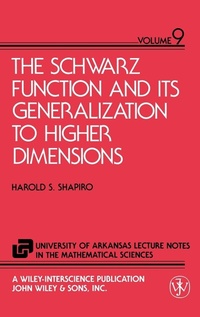
The Schwarz Function and Its Generalization to Higher Dimensions
1st Edition
Published on 14. April 1992
Book
Hardback
128 pages
978-0-471-57127-8 (ISBN)
Description
The Schwarz function originates in classical complex analysis and potential theory. Here the author presents the advantages favoring a mode of treatment which unites the subject with modern theory of distributions and partial differential equations thus bridging the gap between two-dimensional geometric and multi-dimensional analysts. Examines the Schwarz function and its relationship to recent investigations regarding inverse problems of Newtonian gravitation, free boundaries, Hele-Shaw flows and the propagation of singularities for holomorphic p.d.e.
More details
Series
Language
English
Place of publication
United States
Publishing group
John Wiley & Sons Inc
Target group
College/higher education
Professional and scholarly
Product notice
sewn/stitched
Cloth over boards
Dimensions
Height: 240 mm
Width: 161 mm
Thickness: 12 mm
Weight
360 gr
ISBN-13
978-0-471-57127-8 (9780471571278)
Copyright in bibliographic data and cover images is held by Nielsen Book Services Limited or by the publishers or by their respective licensors: all rights reserved.
Schweitzer Classification
Person
Harold Seymour Shapiro is a professor emeritus of mathematics at the Royal Institute of Technology in Stockholm, Sweden, best known for inventing the so-called Shapiro polynomials also known as Golay-Shapiro polynomials or Rudin-Shapiro polynomials and for pioneering work on quadrature domains.
Content
The Schwarz Principle of Reflection.
The Logarithmic Potential, Balayage, and Quadrature Domains.
Examples of ``Quadrature Identities''.
Quadrature Domains: Basic Properties, 1.
Quadrature Domains: Basic Properties, 2.
Schwarzian Reflection, Revisited.
Projectors from L? (dOmega) to H? (dOmega).
The Friedrichs Operator.
Concluding Remarks.
Bibliography.
Index.
The Logarithmic Potential, Balayage, and Quadrature Domains.
Examples of ``Quadrature Identities''.
Quadrature Domains: Basic Properties, 1.
Quadrature Domains: Basic Properties, 2.
Schwarzian Reflection, Revisited.
Projectors from L? (dOmega) to H? (dOmega).
The Friedrichs Operator.
Concluding Remarks.
Bibliography.
Index.