

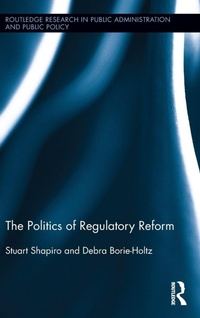
The Politics of Regulatory Reform
1st Edition
Published on 21. October 2013
Book
Hardback
168 pages
978-0-415-64246-0 (ISBN)
Description
Regulation has become a front-page topic recently, often referenced by politicians in conjunction with the current state of the U.S. economy. Yet despite regulation's increased presence in current politics and media, The Politics of Regulatory Reform argues that the regulatory process and its influence on the economy is misunderstood by the general public as well as by many politicians.
In this book, two experienced regulation scholars confront questions relevant to both academic scholars and those with a general interest in ascertaining the effects and importance of regulation. How does regulation impact the economy? What roles do politicians play in making regulatory decisions? Why do politicians enact laws that require regulations and then try to hamper agencies abilities to issue those same regulations? The authors answer these questions and untangle the misperceptions behind regulation by using an area of regulatory policy that has been underutilized until now. Rather than focusing on the federal government, Shapiro and Borie-Holtz have gathered a unique dataset on the regulatory process and output in the United States. They use state-specific data from twenty-eight states, as well as a series of case studies on regulatory reform, to question widespread impressions and ideas about the regulatory process.
The result is an incisive and comprehensive study of the relationship between politics and regulation that also encompasses the effects of regulation and the reasons why regulatory reforms are enacted.
In this book, two experienced regulation scholars confront questions relevant to both academic scholars and those with a general interest in ascertaining the effects and importance of regulation. How does regulation impact the economy? What roles do politicians play in making regulatory decisions? Why do politicians enact laws that require regulations and then try to hamper agencies abilities to issue those same regulations? The authors answer these questions and untangle the misperceptions behind regulation by using an area of regulatory policy that has been underutilized until now. Rather than focusing on the federal government, Shapiro and Borie-Holtz have gathered a unique dataset on the regulatory process and output in the United States. They use state-specific data from twenty-eight states, as well as a series of case studies on regulatory reform, to question widespread impressions and ideas about the regulatory process.
The result is an incisive and comprehensive study of the relationship between politics and regulation that also encompasses the effects of regulation and the reasons why regulatory reforms are enacted.
Reviews / Votes
"Shapiro and Borie-Holtz distinguish the reality from the rhetoric of regulatory reform by looking at past efforts through several different lenses. In clearly written prose, they review theories on what motivates regulation and initiatives for reform, present empirical analysis of reform efforts in the states, and supplement their findings with in-depth case studies and interviews. Anyone interested in understanding the motivations and effects of regulatory reform, regardless of their views on its merits, will benefit from reading this book."-Susan E. Dudley, Director, The George Washington University Regulatory Studies Center
"This important book provocatively challenges the conventional wisdom of regulatory reform, making the case that administrative procedures do little to affect the timing or outcomes of government rulemaking. Shapiro and Borie-Holtz convincingly explain why politicians nevertheless act as if procedure matters, revealing why regulatory reform remains a popular but controversial item on state and federal policy agendas."
-Cary Coglianese, Edward B. Shils Professor of Law and Professor of Political Science, University of Pennsylvania
"Not only would it serve as a valuable text for courses in political science and public administration, but it will benefit anyone interested in understanding regulatory reform."
- Susan E. Dudley, Risk Analysis
"The book provides some of the first empirical traction on the imposition and effects of regulatory reforms across the 50 American states-a topic that has long been recognized as important but has been infrequently investigated systematically."
-Susan Webb Yackee, University of Wisconsin-Madison
"Shapiro and Borie-Holtz (both, Rutgers Univ.) provide a convincing account of the allure of regulatory reform. Summing Up: Highly recommended. Upper-division undergraduates."
- M S. Rodriguez, Richard Stockton College of New Jersey "Shapiro and Borie-Holtz distinguish the reality from the rhetoric of regulatory reform by looking at past efforts through several different lenses. In clearly written prose, they review theories on what motivates regulation and initiatives for reform, present empirical analysis of reform efforts in the states, and supplement their findings with in-depth case studies and interviews. Anyone interested in understanding the motivations and effects of regulatory reform, regardless of their views on its merits, will benefit from reading this book."
-Susan E. Dudley, Director, The George Washington University Regulatory Studies Center
"This important book provocatively challenges the conventional wisdom of regulatory reform, making the case that administrative procedures do little to affect the timing or outcomes of government rulemaking. Shapiro and Borie-Holtz convincingly explain why politicians nevertheless act as if procedure matters, revealing why regulatory reform remains a popular but controversial item on state and federal policy agendas."
-Cary Coglianese, Edward B. Shils Professor of Law and Professor of Political Science, University of Pennsylvania
"Not only would it serve as a valuable text for courses in political science and public administration, but it will benefit anyone interested in understanding regulatory reform."
- Susan E. Dudley, Risk Analysis
"The book provides some of the first empirical traction on the imposition and effects of regulatory reforms across the 50 American states-a topic that has long been recognized as important but has been infrequently investigated systematically."
-Susan Webb Yackee, University of Wisconsin-Madison
"Shapiro and Borie-Holtz (both, Rutgers Univ.) provide a convincing account of the allure of regulatory reform. Summing Up: Highly recommended. Upper-division undergraduates."
- M S. Rodriguez, Richard Stockton College of New Jersey, in CHOICE
More details
Series
Language
English
Place of publication
London
United Kingdom
Publishing group
Taylor & Francis Ltd
Target group
College/higher education
Illustrations
10 s/w Zeichnungen, 29 s/w Tabellen
29 Tables, black and white; 10 Line drawings, black and white
Dimensions
Height: 235 mm
Width: 157 mm
Thickness: 15 mm
Weight
426 gr
ISBN-13
978-0-415-64246-0 (9780415642460)
Copyright in bibliographic data and cover images is held by Nielsen Book Services Limited or by the publishers or by their respective licensors: all rights reserved.
Schweitzer Classification
Other editions
Additional editions
Stuart Shapiro | Debra Borie-Holtz
The Politics of Regulatory Reform
Book
07/2015
1st Edition
Routledge
€43.60
Shipment within 10-20 days

Stuart Shapiro | Debra Borie-Holtz
The Politics of Regulatory Reform
E-Book
01/2014
1st Edition
Routledge
€37.99
Available for download

Stuart Shapiro | Debra Borie-Holtz
The Politics of Regulatory Reform
E-Book
01/2014
1st Edition
Routledge
€37.99
Available for download
Persons
Stuart Shapiro is Associate Professor and Director of the Public Policy Program at the Bloustein School of Planning and Public Policy, Rutgers University. Professor Shapiro's research focuses on the regulatory process and regulatory reform, including the role of cost-benefit analysis, public participation, and e-rulemaking. He has also done research on the regulatory process in the states. Prior to becoming a professor, he was a desk officer and manager in the Office of Information and Regulatory Affairs at the Office of Management and Budget.
Debra Borie-Holtz is an instructor at the Bloustein School and a senior research analyst at the Center for Women and Work. Debra's research interests include state legislative leadership and policy formation, regulations, women in government and survey methodology. Prior to receiving her doctorate, Debra held a Presidential appointment as an agency director during the Clinton Administration and served as New Jersey Assistant Secretary of State during the Florio Administration.
Debra Borie-Holtz is an instructor at the Bloustein School and a senior research analyst at the Center for Women and Work. Debra's research interests include state legislative leadership and policy formation, regulations, women in government and survey methodology. Prior to receiving her doctorate, Debra held a Presidential appointment as an agency director during the Clinton Administration and served as New Jersey Assistant Secretary of State during the Florio Administration.
Content
Chapter 1. The Mystery of Regulatory Reform. Chapter 2. Do Regulatory Reforms Influence Regulations? Chapter 3. In the Regulatory Weeds of the Garden State: A Case Study. Chapter 4. Regulations and the Economy Chapter 5. Seeing Red: Are Regulations a Perceived of Actual Threat? Chapter 6. Alternative Explanations for Regulatory Reform Chapter 7. Regulatory Reform: Rhetoric and Reality in Pennsylvania and North Carolina. Chapter 8. The Politics of Regulatory Reform.