

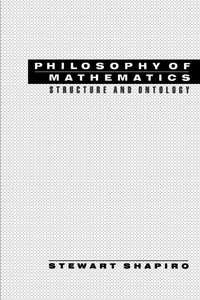
Philosophy of Mathematics
Structure and Ontology
Published on 12. October 2000
Book
Paperback/Softback
296 pages
978-0-19-513930-3 (ISBN)
Description
Do numbers, sets, and so forth, exist? What do mathematical statements mean? Are they literally true or false, or do they lack truth values altogether? Addressing questions that have attracted lively debate in recent years, Stewart Shapiro contends that standard realist and antirealist accounts of mathematics are both problematic.
As Benacerraf first noted, we are confronted with the following powerful dilemma. The desired continuity between mathematical and, say, scientific language suggests realism, but realism in this context suggests seemingly intractable epistemic problems. As a way out of this dilemma, Shapiro articulates a structuralist approach. On this view, the subject matter of arithmetic, for example, is not a fixed domain of numbers independent of each other, but rather is the natural number structure, the pattern common to any system of objects that has an initial object and successor relation satisfying the induction principle. Using this framework, realism in mathematics can be preserved without troublesome epistemic consequences.
Shapiro concludes by showing how a structuralist approach can be applied to wider philosophical questions such as the nature of an "object" and the Quinean nature of ontological commitment. Clear, compelling, and tautly argued, Shapiro's work, noteworthy both in its attempt to develop a full-length structuralist approach to mathematics and to trace its emergence in the history of mathematics, will be of deep interest to both philosophers and mathematicians.
As Benacerraf first noted, we are confronted with the following powerful dilemma. The desired continuity between mathematical and, say, scientific language suggests realism, but realism in this context suggests seemingly intractable epistemic problems. As a way out of this dilemma, Shapiro articulates a structuralist approach. On this view, the subject matter of arithmetic, for example, is not a fixed domain of numbers independent of each other, but rather is the natural number structure, the pattern common to any system of objects that has an initial object and successor relation satisfying the induction principle. Using this framework, realism in mathematics can be preserved without troublesome epistemic consequences.
Shapiro concludes by showing how a structuralist approach can be applied to wider philosophical questions such as the nature of an "object" and the Quinean nature of ontological commitment. Clear, compelling, and tautly argued, Shapiro's work, noteworthy both in its attempt to develop a full-length structuralist approach to mathematics and to trace its emergence in the history of mathematics, will be of deep interest to both philosophers and mathematicians.
Reviews / Votes
Extremely interesting and deserves the attention of anyone with a serious interest in the field ... a careful study of the book will be enormously rewarding to anyone with some prior exposure to the field. * Philosophia Mathematica *More details
Language
English
Place of publication
New York
United States
Target group
Professional and scholarly
Dimensions
Height: 229 mm
Width: 152 mm
Thickness: 17 mm
Weight
478 gr
ISBN-13
978-0-19-513930-3 (9780195139303)
Copyright in bibliographic data and cover images is held by Nielsen Book Services Limited or by the publishers or by their respective licensors: all rights reserved.
Schweitzer Classification
Other editions
Additional editions
E-Book
08/1997
1st Edition
OUP USA
€23.99
Available for download