

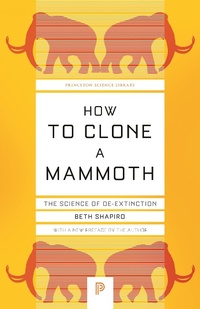
How to Clone a Mammoth
The Science of De-Extinction
Published on 8. September 2020
Book
Paperback/Softback
256 pages
978-0-691-20900-5 (ISBN)
Description
An insider's view on bringing extinct species back to life
Could extinct species, like mammoths and passenger pigeons, be brought back to life? In How to Clone a Mammoth, Beth Shapiro, an evolutionary biologist and pioneer in ancient DNA research, addresses this intriguing question by walking readers through the astonishing and controversial process of de-extinction. From deciding which species should be restored to anticipating how revived populations might be overseen in the wild, Shapiro vividly explores the extraordinary cutting-edge science that is being used to resurrect the past. Considering de-extinction's practical benefits and ethical challenges, Shapiro argues that the overarching goal should be the revitalization and stabilization of contemporary ecosystems. Looking at the very real and compelling science behind an idea once seen as science fiction, How to Clone a Mammoth demonstrates how de-extinction will redefine conservation's future.
Could extinct species, like mammoths and passenger pigeons, be brought back to life? In How to Clone a Mammoth, Beth Shapiro, an evolutionary biologist and pioneer in ancient DNA research, addresses this intriguing question by walking readers through the astonishing and controversial process of de-extinction. From deciding which species should be restored to anticipating how revived populations might be overseen in the wild, Shapiro vividly explores the extraordinary cutting-edge science that is being used to resurrect the past. Considering de-extinction's practical benefits and ethical challenges, Shapiro argues that the overarching goal should be the revitalization and stabilization of contemporary ecosystems. Looking at the very real and compelling science behind an idea once seen as science fiction, How to Clone a Mammoth demonstrates how de-extinction will redefine conservation's future.
More details
Series
Language
English
Place of publication
New Jersey
United States
Product notice
Paperback (trade)
Illustrations
16 color illus. 2 halftones. 9 line illus.
Dimensions
Height: 216 mm
Width: 141 mm
Thickness: 20 mm
Weight
286 gr
ISBN-13
978-0-691-20900-5 (9780691209005)
Copyright in bibliographic data and cover images is held by Nielsen Book Services Limited or by the publishers or by their respective licensors: all rights reserved.
Schweitzer Classification
Other editions
Additional editions
E-Book
09/2020
1st Edition
Princeton University Press
€14.49
Available for download
Previous edition
Book
09/2016
Princeton University Press
€16.08
Article exhausted; check for reprint
Person
Beth Shapiro is professor of ecology and evolutionary biology at the University of California, Santa Cruz. She received a MacArthur Award in 2009. Twitter @bonesandbugs.