

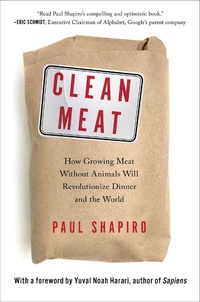
Clean Meat
How Growing Meat Without Animals Will Revolutionize Dinner and the World
Published on 2. January 2018
Book
Hardback
256 pages
978-1-5011-8908-1 (ISBN)
Description
Paul Shapiro gives you a front-row seat for the wild story of the race to create and commercialize cleaner, safer, sustainable meat—real meat—without the animals. From the entrepreneurial visionaries to the scientists’ workshops to the big business boardrooms—Shapiro details that quest for clean meat and other animal products and examines the debate raging around it.
Since the dawn of Homo sapiens some quarter million years ago, animals have satiated our species’ desire for meat. But with a growing global population and demand for meat, eggs, dairy, leather, and more, raising such massive numbers of farm animals is woefully inefficient and takes an enormous toll on the planet, public health, and certainly the animals themselves.
But what if we could have our meat and eat it, too? The next great scientific revolution is underway—discovering new ways to create enough food for the world’s ever-growing, ever-hungry population.
Enter clean meat—real, actual meat grown (or brewed!) from animal cells—as well as other clean foods that ditch animal cells altogether and are simply built from the molecule up. Also called lab-grown meat, cultured meat, or cell-based meat, this race promises promise to bring about another domestication. Whereas our ancestors domesticated wild animals into livestock, today we’re beginning to domesticate their cells, leaving the animals out of the equation. From one single cell of a cow, you could feed an entire village. And the story of this coming “second domestication” is anything but tame.
Since the dawn of Homo sapiens some quarter million years ago, animals have satiated our species’ desire for meat. But with a growing global population and demand for meat, eggs, dairy, leather, and more, raising such massive numbers of farm animals is woefully inefficient and takes an enormous toll on the planet, public health, and certainly the animals themselves.
But what if we could have our meat and eat it, too? The next great scientific revolution is underway—discovering new ways to create enough food for the world’s ever-growing, ever-hungry population.
Enter clean meat—real, actual meat grown (or brewed!) from animal cells—as well as other clean foods that ditch animal cells altogether and are simply built from the molecule up. Also called lab-grown meat, cultured meat, or cell-based meat, this race promises promise to bring about another domestication. Whereas our ancestors domesticated wild animals into livestock, today we’re beginning to domesticate their cells, leaving the animals out of the equation. From one single cell of a cow, you could feed an entire village. And the story of this coming “second domestication” is anything but tame.
More details
Language
English
Product notice
sewn/stitched
Cloth over boards
Dimensions
Height: 236 mm
Width: 158 mm
Thickness: 30 mm
Weight
415 gr
ISBN-13
978-1-5011-8908-1 (9781501189081)
Copyright in bibliographic data and cover images is held by Nielsen Book Services Limited or by the publishers or by their respective licensors: all rights reserved.
Schweitzer Classification
Other editions
Additional editions
E-Book
01/2018
1st Edition
Gallery Books
€13.84
Available for download
Persons
When Paul Shapiro took his first bite of clean meat in 2014, more humans had gone into space than had eaten real meat grown outside an animal. In addition to being among the world’s first clean meat consumers, Paul is a four-time TEDx speaker, the co-host of the Business for Good Podcast, the CEO of The Better Meat Co., and longtime leader in food sustainability. He’s published hundreds of articles in publications ranging from daily newspapers to academic journals. Paul lives in Sacramento, California with his wife Toni Okamoto, author and founder of Plant-Based on a Budget. His first book, Clean Meat, is a Washington Post bestseller, and has been translated into numerous other languages. You can read more about Paul’s work and contact him at Paul-Shapiro.com.