

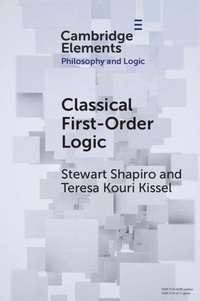
Classical First-Order Logic
Published on 19. May 2022
Book
Paperback/Softback
80 pages
978-1-108-98700-4 (ISBN)
Description
One is often said to be reasoning well when they are reasoning logically. Many attempts to say what logical reasoning is have been proposed, but one commonly proposed system is first-order classical logic. This Element will examine the basics of first-order classical logic and discuss some surrounding philosophical issues. The first half of the Element develops a language for the system, as well as a proof theory and model theory. The authors provide theorems about the system they developed, such as unique readability and the Lindenbaum lemma. They also discuss the meta-theory for the system, and provide several results there, including proving soundness and completeness theorems. The second half of the Element compares first-order classical logic to other systems: classical higher order logic, intuitionistic logic, and several paraconsistent logics which reject the law of ex falso quodlibet.
More details
Series
Language
English
Place of publication
Cambridge
United Kingdom
Product notice
Paperback (trade)
Illustrations
Worked examples or Exercises
Dimensions
Height: 229 mm
Width: 152 mm
Thickness: 5 mm
Weight
131 gr
ISBN-13
978-1-108-98700-4 (9781108987004)
Copyright in bibliographic data and cover images is held by Nielsen Book Services Limited or by the publishers or by their respective licensors: all rights reserved.
Schweitzer Classification
Other editions
Additional editions
Stewart Shapiro
Classical First-Order Logic
E-Book
05/2022
Cambridge University Press
€15.49
Available for download
Stewart Shapiro | Teresa Kouri Kissel
Classical First-Order Logic
E-Book
05/2022
Cambridge University Press
€15.49
Available for download
Persons
Content
1. Introduction; 2. Formal System; 3. Language; 4. Deduction; 5. Model-Theoretic Semantics; 6. Meta-theory; 7. Classical Higher-Order Logic; 8. Intuitionism; 9. Paraconsistency: demurring from ex falso quodlibet; 10. Conclusion.