

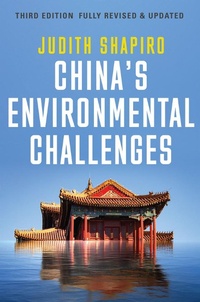
China's Environmental Challenges
3rd Edition
Published on 26. January 2024
Book
Paperback/Softback
288 pages
978-1-5095-5968-8 (ISBN)
Description
China's huge environmental challenges affect not only the health and well-being of China but the very future of the planet. In this fully revised and updated third edition of her acclaimed book, noted scholar of Chinese environmentalism Judith Shapiro explores China's struggle to achieve the 'ecological civilization' championed by Xi Jinping since 2017.
Drawing on six core analytical concepts - globalization, governance, national identity, civil society, environmental justice, and extractivism - Shapiro ably demonstrates the multifaceted and complex nature of this struggle. China's precipitous economic growth has carried a heavy cost in air and water pollution, soil contamination, and loss of habitat for the biodiversity upon which human life depends. But its quest for sustainability has been further hampered by authoritarian governance patterns, soaring middle class consumption, the need to provide employment and safety nets for a population of more than one billion, and a manufacturing sector thirsty to secure global resources and sell to new markets.
Transformation to a more sustainable development model is still possible. But, as Shapiro persuasively argues, this will require humility, creativity, and a rejection of business as usual. China - and the planet - are at a pivotal moment.
China's huge environmental challenges affect not only the health and well-being of China but the very future of the planet. In this fully revised and updated third edition of her acclaimed book, noted scholar of Chinese environmentalism Judith Shapiro explores China's struggle to achieve the 'ecological civilization' championed by Xi Jinping since 2017.
Drawing on six core analytical concepts - globalization, governance, national identity, civil society, environmental justice, and extractivism - Shapiro ably demonstrates the multifaceted and complex nature of this struggle. China's precipitous economic growth has carried a heavy cost in air and water pollution, soil contamination, and loss of habitat for the biodiversity upon which human life depends. But its quest for sustainability has been further hampered by authoritarian governance patterns, soaring middle class consumption, the need to provide employment and safety nets for a population of more than one billion, and a manufacturing sector thirsty to secure global resources and sell to new markets.
Transformation to a more sustainable development model is still possible. But, as Shapiro persuasively argues, this will require humility, creativity, and a rejection of business as usual. China - and the planet - are at a pivotal moment.
Drawing on six core analytical concepts - globalization, governance, national identity, civil society, environmental justice, and extractivism - Shapiro ably demonstrates the multifaceted and complex nature of this struggle. China's precipitous economic growth has carried a heavy cost in air and water pollution, soil contamination, and loss of habitat for the biodiversity upon which human life depends. But its quest for sustainability has been further hampered by authoritarian governance patterns, soaring middle class consumption, the need to provide employment and safety nets for a population of more than one billion, and a manufacturing sector thirsty to secure global resources and sell to new markets.
Transformation to a more sustainable development model is still possible. But, as Shapiro persuasively argues, this will require humility, creativity, and a rejection of business as usual. China - and the planet - are at a pivotal moment.
China's huge environmental challenges affect not only the health and well-being of China but the very future of the planet. In this fully revised and updated third edition of her acclaimed book, noted scholar of Chinese environmentalism Judith Shapiro explores China's struggle to achieve the 'ecological civilization' championed by Xi Jinping since 2017.
Drawing on six core analytical concepts - globalization, governance, national identity, civil society, environmental justice, and extractivism - Shapiro ably demonstrates the multifaceted and complex nature of this struggle. China's precipitous economic growth has carried a heavy cost in air and water pollution, soil contamination, and loss of habitat for the biodiversity upon which human life depends. But its quest for sustainability has been further hampered by authoritarian governance patterns, soaring middle class consumption, the need to provide employment and safety nets for a population of more than one billion, and a manufacturing sector thirsty to secure global resources and sell to new markets.
Transformation to a more sustainable development model is still possible. But, as Shapiro persuasively argues, this will require humility, creativity, and a rejection of business as usual. China - and the planet - are at a pivotal moment.
Reviews / Votes
"The third edition of China's Environmental Challenges remains the go-to text for Chinese environmental studies. An excellent guide, the reader will find historical depth, cultural nuance, humanistic sensitivity, global relevance, critical timeliness, and conceptual clarity all in one place."Yifei Li, NYU Shanghai
"The third edition of <i>China's Environmental Challenges</i> remains the go-to text for Chinese environmental studies. An excellent guide, the reader will find historical depth, cultural nuance, humanistic sensitivity, global relevance, critical timeliness, and conceptual clarity all in one place."
<b>Yifei Li, NYU Shanghai</b>
More details
Edition
Third Edition
Language
English
Place of publication
Oxford
United Kingdom
Publishing group
John Wiley and Sons Ltd
Target group
Professional and scholarly
Dimensions
Height: 225 mm
Width: 151 mm
Thickness: 20 mm
Weight
360 gr
ISBN-13
978-1-5095-5968-8 (9781509559688)
Copyright in bibliographic data and cover images is held by Nielsen Book Services Limited or by the publishers or by their respective licensors: all rights reserved.
Schweitzer Classification
Other editions
Additional editions
Judith Shapiro
China's Environmental Challenges
Book
01/2024
3rd Edition
Polity Press
€65.00
Shipment within 15-20 days
Judith Shapiro
China's Environmental Challenges
E-Book
01/2024
3rd Edition
Wiley
€19.99
Available for download
Previous edition

Judith Shapiro
China's Environmental Challenges
Book
12/2015
2nd Edition
Polity Press
Unfortunately, price unknown
Article exhausted; check for reprint
Person
Judith Shapiro is one of the world's leading authorities on Chinese environmentalism. Currently professor in the School of International Service at American University, Washington DC, she is the author of the international classic Mao's War against Nature , co-author (with Yifei Li) of China Goes Green and author of the popular student text China's Environmental Challenges, now in its third edition.
<b>Judith Shapiro</b> is one of the world's leading authorities on Chinese environmentalism. Currently professor in the School of International Service at American University, Washington DC, she is the author of the international classic <i>Mao's War against Nature</i> , co-author (with Yifei Li) of <i>China Goes Green</i> and author of the popular student text <i>China's Environmental Challenges</i>, now in its third edition.
<b>Judith Shapiro</b> is one of the world's leading authorities on Chinese environmentalism. Currently professor in the School of International Service at American University, Washington DC, she is the author of the international classic <i>Mao's War against Nature</i> , co-author (with Yifei Li) of <i>China Goes Green</i> and author of the popular student text <i>China's Environmental Challenges</i>, now in its third edition.
Content
<i>Map</i>
<i>Chronology</i>
<i>Preface</i>
<i>Acknowledgments and Note to the Third Edition</i>
1. The Big Picture
2. Globalization and Other Drivers and Trends
3. State-led Environmentalism
4. Sustainable Development and National Identity
5. Public Participation and Civil Society
6. Environmental Justice and the Displacement of Environmental Harm
7. Extractivism and the Climate Crisis
8. Prospects for the Future
<i>References</i>
<i>Index</i>
<i>Chronology</i>
<i>Preface</i>
<i>Acknowledgments and Note to the Third Edition</i>
1. The Big Picture
2. Globalization and Other Drivers and Trends
3. State-led Environmentalism
4. Sustainable Development and National Identity
5. Public Participation and Civil Society
6. Environmental Justice and the Displacement of Environmental Harm
7. Extractivism and the Climate Crisis
8. Prospects for the Future
<i>References</i>
<i>Index</i>