

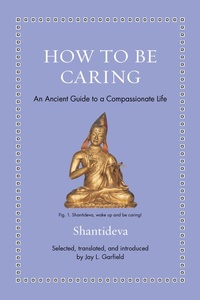
How to Be Caring
An Ancient Guide to a Compassionate Life
Published on 30. September 2025
Book
Hardback
176 pages
978-0-691-27407-2 (ISBN)
Description
A vivid new translation of selections from an inspiring guide to self-transformation through kindness by an eighth-century Buddhist monk
Written by the medieval Indian Buddhist monk Shantideva, The Bodhicaryavatara is one of the most beloved and frequently taught works in Buddhism and a favorite of the Dalai Lama. An inspiring and powerful poem that uses a gripping, first-person, confessional voice, it is the most systematic work of ethical thought in the Indo-Tibetan Buddhist tradition. And its invaluable insights, exhortations, and encouragements about how we can relieve suffering by becoming more caring and compassionate are universal. In How to Be Caring, philosopher and Buddhist scholar Jay Garfield presents a lively new translation of selected verses from Shantideva's text that capture its powerful lessons for all of us. The result is the clearest, most concise, and most accessible introduction to this masterful Buddhist guidebook about how we can change the world by changing ourselves.
Focusing on the life of a bodhisattva, a person committed to attaining awakening for the benefit of all beings, Shantideva argues that the first step to reducing suffering and making the world better is to conquer our own psychopathologies. Urging us to remember that we won't live forever and therefore need to think about what is most important, the work seeks to inspire us and teach us how to be more generous, thoughtful, polite, patient, committed, and self-aware. Featuring an introduction and the original Tibetan text on facing pages, this dazzling volume is filled with wisdom that still speaks directly to readers today.
Written by the medieval Indian Buddhist monk Shantideva, The Bodhicaryavatara is one of the most beloved and frequently taught works in Buddhism and a favorite of the Dalai Lama. An inspiring and powerful poem that uses a gripping, first-person, confessional voice, it is the most systematic work of ethical thought in the Indo-Tibetan Buddhist tradition. And its invaluable insights, exhortations, and encouragements about how we can relieve suffering by becoming more caring and compassionate are universal. In How to Be Caring, philosopher and Buddhist scholar Jay Garfield presents a lively new translation of selected verses from Shantideva's text that capture its powerful lessons for all of us. The result is the clearest, most concise, and most accessible introduction to this masterful Buddhist guidebook about how we can change the world by changing ourselves.
Focusing on the life of a bodhisattva, a person committed to attaining awakening for the benefit of all beings, Shantideva argues that the first step to reducing suffering and making the world better is to conquer our own psychopathologies. Urging us to remember that we won't live forever and therefore need to think about what is most important, the work seeks to inspire us and teach us how to be more generous, thoughtful, polite, patient, committed, and self-aware. Featuring an introduction and the original Tibetan text on facing pages, this dazzling volume is filled with wisdom that still speaks directly to readers today.
More details
Series
Language
English
Place of publication
New Jersey
United States
Product notice
Trade binding
Dimensions
Height: 175 mm
Width: 115 mm
Thickness: 17 mm
Weight
234 gr
ISBN-13
978-0-691-27407-2 (9780691274072)
Copyright in bibliographic data and cover images is held by Nielsen Book Services Limited or by the publishers or by their respective licensors: all rights reserved.
Schweitzer Classification
Other editions
Additional editions
E-Book
09/2025
1st Edition
University of Pittsburgh Press
€17.49
Available for download
Persons
Shantideva was an eighth-century Buddhist monk who taught at Nalanda University, which was in the present-day state of Bihar in Eastern India. According to legend, he recited How to Lead an Awakened Life to a huge assembly of students and scholars at the school, then rose into the air, flew from the lecture hall, and vanished into space, never to be seen again but leaving behind in his room a copy of the text. Jay L. Garfield is the Doris Silbert Professor in the Humanities and professor of philosophy and Buddhist studies at Smith College and a visiting professor of Buddhist philosophy at Harvard Divinity School. His books include How to Lose Yourself: An Ancient Guide to Letting Go (Princeton), Losing Ourselves: Learning to Live without a Self (Princeton), and Buddhist Ethics: A Philosophical Exploration.