

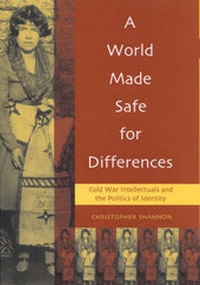
A World Made Safe for Differences
Cold War Intellectuals and the Politics of Identity
Published on 20. December 2000
Book
Hardback
184 pages
978-0-8476-9057-2 (ISBN)
Description
In A World Made Safe for Differences, Christopher Shannon examines how an anthropological definition of culture shaped the central political and social narratives of the Cold War era. In the middle decades of the twentieth century, American intellectuals understood culture as a "whole way of life" and a "pattern of values" in order to account for and accommodate differences between America and other countries, and within America itself. Shannon locates the ideological origins of current debates about multiculturalism in the pluralist thought of "consensus" liberalism. The emphasis on individualism in contemporary identity politics, Shannon suggests, must be understood as a legacy of the Cold War liberalism of the 1950s rather than the counter-culture radicalism of the 1960s. A World Made Safe for Differences is a highly original and controversial book that will be of great interest to students and scholars of twentieth century American history.
Reviews / Votes
A World Made Safe for Differences will make a significant contribution to the field of American cultural and intellectual history. Shannon is becoming a leading voice in a radical reconsideration of modern American intellectual life. -- James T. Fisher, University of St. Louis Christopher Shannon is a highly original and provocative critic. Whether or not one agrees with the Catholic tradition out of which he writes, it cannot be denied that his perspective in A World Made Safe for Differences is challenging and illuminating in important ways, revealing heretofore unseen connections between modernity, secularism, culture, and identity in the work of leading postwar intellectuals. With this book he opens up new space for thinking freshly about the intellectual culture of the mid-twentieth century. -- Thomas Bender, New York University A very thought-provoking book for anyone interested in modern religious life, American secular society, and the complex and challenging relations between the two. Particularly intriguing is the book's study of the relationship between autonomy (and the self) and community (and culture). -- Amitai Etzioni, professor, George Washington University; founder of the Society for the Advancement of Socio-Economics A brilliant young historian and social critic traces the ramifications of the postwar ideology of tolerance. * Christianity Today * Provides a valuable critical lens for thinking about contemporary multiculturalism and its prevailing discourse of tolerance. * Insight * The main argument-that Western intellectuals during the Cold War sought to respect other cultures or non-mainstream movements even as they practiced subtle imperialism-is beautifully and forcefully demonstrated. -- Robert Royal, Ethics and Public Policy CenterMore details
Series
Language
English
Place of publication
United States
Publishing group
Bloomsbury Publishing Plc
Target group
College/higher education
Dimensions
Height: 237 mm
Width: 156 mm
Thickness: 19 mm
Weight
399 gr
ISBN-13
978-0-8476-9057-2 (9780847690572)
Copyright in bibliographic data and cover images is held by Nielsen Book Services Limited or by the publishers or by their respective licensors: all rights reserved.
Schweitzer Classification
Person
Christopher Shannon is assistant professor of history at Christendom College in Front Royal, Virginia. He is the author of Conspicuous Criticism: Tradition, the Individual, and Culture in American Social Thought, from Veblen to Mills.
Content
Introduction
Chapter 1: Integrating the World
Chapter 2: Culture and Counterculture
Chapter 3: The Negro Dilemma
Chapter 4: Beyond the Unmeltable Ethics
Chapter 5: The Feminist Mystique
Chapter 6: Compulsory Sexuality
Conclusion
Chapter 1: Integrating the World
Chapter 2: Culture and Counterculture
Chapter 3: The Negro Dilemma
Chapter 4: Beyond the Unmeltable Ethics
Chapter 5: The Feminist Mystique
Chapter 6: Compulsory Sexuality
Conclusion