

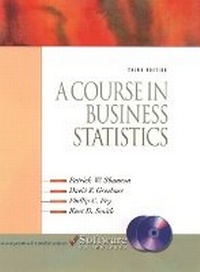
A Course in Business Statistics
3rd Edition
Published on 23. August 2001
Book
Mixed media product
688 pages
978-0-13-093657-8 (ISBN)
Description
For the one semester course in Business Statistics.
This text presents core topics in descriptive and inferential statistics with a rich assortment of business examples and real data and an emphasis on decision-making. There is significant emphasis on using statistical software as a tool, with most examples presented in a spreadsheet environment using Excel and Minitab.
This text presents core topics in descriptive and inferential statistics with a rich assortment of business examples and real data and an emphasis on decision-making. There is significant emphasis on using statistical software as a tool, with most examples presented in a spreadsheet environment using Excel and Minitab.
More details
Edition
3rd edition
Language
English
Place of publication
United States
Publishing group
Pearson Education (US)
Target group
Professional and scholarly
Dimensions
Height: 261 mm
Width: 210 mm
Thickness: 30 mm
Weight
1426 gr
ISBN-13
978-0-13-093657-8 (9780130936578)
Copyright in bibliographic data and cover images is held by Nielsen Book Services Limited or by the publishers or by their respective licensors: all rights reserved.
Schweitzer Classification
Other editions
New editions
David F. Groebner | Patrick W. Shannon | Phillip C. Fry
Course in Business Statistics with CD-ROM
Book
04/2005
4th Edition
Pearson
€129.85
Article is exhausted; no reprint
Persons
PATRICK W. SHANNON, PH.D. is Professor of Production and Operations Management in the College of Business and Economics at Boise State University. He teaches graduate and undergraduate courses in business statistics, quality management, and production and operations management. In addition, Dr. Shannon has lectured and consulted in the statistical analysis and quality management areas for over 20 years. Listed among his consulting clients are Boise Cascade Corporation, Hewlett-Packard; PowerBar, Inc.; Potlatch Corporation; Woodgrain Millwork, Inc.; J.R. Simplot Company; Zilog Corporation; and numerous other public- and private-sector organizations. Professor Shannon has co-authored several university-level textbooks and has published numerous articles in such journals as Business Horizons, Interfaces, Journal of Simulation, Journal of Production and Inventory Control, Quality Progress, and Journal of Marketing Research. He obtained B.S. and M.S. degrees from the University of Montana and a Ph.D. in Statistics and Quantitative Methods from the University of Oregon.
DAVID F. GROEBNER is a Professor of Production Management and Chairman of the Department of Computer Information Systems and Production Management at Boise State University. He has bachelor's and master's degrees in Engineering and a Ph.D. in Business Administration. After working as an engineer, he has taught statistics and related subjects for 27 years. In addition to writing textbooks and academic papers, he has worked extensively with both small and large organizations, including Hewlett-Packard, Boise Cascade, Albertson's, and Ore-Ida. He has worked with numerous government agencies, including Boise City and the U.S. Air Force.
PHILLIP C. FRY is an Associate Professor in the Department of Computer Information Systems and Production Management in the College of Business and Economics at Boise State University, where he has taught since 1988. Phil received his B.A. and M.B.A degrees from the University of Arkansas, and his M.S. and Ph.D. degrees from Louisiana State University. His teaching and research interests are in the areas of business statistics, production management, and quantitative business modeling. In addition to his academic responsibilities, Phil has consulted with and provided training to small and large organizations, including Boise Cascade Corporation; Hewlett-Packard Corporation; The J.R. Simplot Company; United Water of Idaho; Woodgrain Millwork, Inc.; Boise City; and Micron Electronics.
Phil spends most of his free time with his wife Susan, to whom he has been married for 18 years, and his four children, Phillip Alexander, age 8, Alejandra Johanna, age 7, and twins, Courtney Rene and Candace Marie, age 1.
KENT D. SMITH received a Ph.D. in Applied Statistics from the University of California, Riverside in 1981. He holds a Master of Science degree in Statistics from the University of California, Riverside and a Master of Science degree in Systems Analysis from the Air Force Institute of Technology. His Bachelor of Arts degree in Mathematics was obtained from the University of Utah. Dr. Smith has served as a University Statistical Consultant at the University of California, Riverside and at California Polytechnic State University, San Luis Obispo. While at the University of California, he served as a consultant for the Biometrical Services Unit of the Biometrical Project at the University of California, Riverside. His private consulting has ranged from serving as an expert witness in legal cases, survey sampling for corporations and private researchers, medical and orthodontic research, and assisting graduate students with analysis required for master and doctoral degrees in various disciplines.
Dr. Smith began teaching as a part-time lecturer at the California State University, San Bernardino. While completing his doctoral dissertation, he served as a lecturer at the University of California, Riverside. Currently, he is a Professor of Statistics at the California Polytechnic State University, San Luis Obispo, one of the minority of universities that offer an undergraduate degree in statistics. The subjects he teaches include upper-division courses in regression, analysis of variance, nonparametrics, linear models, and probability and mathematical statistics, as well as a full array of service courses.
DAVID F. GROEBNER is a Professor of Production Management and Chairman of the Department of Computer Information Systems and Production Management at Boise State University. He has bachelor's and master's degrees in Engineering and a Ph.D. in Business Administration. After working as an engineer, he has taught statistics and related subjects for 27 years. In addition to writing textbooks and academic papers, he has worked extensively with both small and large organizations, including Hewlett-Packard, Boise Cascade, Albertson's, and Ore-Ida. He has worked with numerous government agencies, including Boise City and the U.S. Air Force.
PHILLIP C. FRY is an Associate Professor in the Department of Computer Information Systems and Production Management in the College of Business and Economics at Boise State University, where he has taught since 1988. Phil received his B.A. and M.B.A degrees from the University of Arkansas, and his M.S. and Ph.D. degrees from Louisiana State University. His teaching and research interests are in the areas of business statistics, production management, and quantitative business modeling. In addition to his academic responsibilities, Phil has consulted with and provided training to small and large organizations, including Boise Cascade Corporation; Hewlett-Packard Corporation; The J.R. Simplot Company; United Water of Idaho; Woodgrain Millwork, Inc.; Boise City; and Micron Electronics.
Phil spends most of his free time with his wife Susan, to whom he has been married for 18 years, and his four children, Phillip Alexander, age 8, Alejandra Johanna, age 7, and twins, Courtney Rene and Candace Marie, age 1.
KENT D. SMITH received a Ph.D. in Applied Statistics from the University of California, Riverside in 1981. He holds a Master of Science degree in Statistics from the University of California, Riverside and a Master of Science degree in Systems Analysis from the Air Force Institute of Technology. His Bachelor of Arts degree in Mathematics was obtained from the University of Utah. Dr. Smith has served as a University Statistical Consultant at the University of California, Riverside and at California Polytechnic State University, San Luis Obispo. While at the University of California, he served as a consultant for the Biometrical Services Unit of the Biometrical Project at the University of California, Riverside. His private consulting has ranged from serving as an expert witness in legal cases, survey sampling for corporations and private researchers, medical and orthodontic research, and assisting graduate students with analysis required for master and doctoral degrees in various disciplines.
Dr. Smith began teaching as a part-time lecturer at the California State University, San Bernardino. While completing his doctoral dissertation, he served as a lecturer at the University of California, Riverside. Currently, he is a Professor of Statistics at the California Polytechnic State University, San Luis Obispo, one of the minority of universities that offer an undergraduate degree in statistics. The subjects he teaches include upper-division courses in regression, analysis of variance, nonparametrics, linear models, and probability and mathematical statistics, as well as a full array of service courses.
Content
(NOTE: Each chapter contains Summary and Conclusions).
1. The Where, Why, and How of Data Collection.
What Is Business Statistics? Tools and Techniques for Collecting Data. Populations, Samples and Sampling Techniques. Data Types and Data Measurement Levels. Using Your Computer.
2. Graphs, Charts, and Tables-Describing Your Data.
Frequency Distributions and Histograms. Joint Frequency Distributions. Bar Charts and Pie Charts. Line Charts and Scatter Diagrams.
3. Describing Data Using Numerical Measures.
Measures of Central Tendency. Measures of Variation. Using the Mean and Standard Deviation Together.
4. Using Probability and Discrete Probability Distributions.
The Basics of Probability. The Rules of Probability. Discrete Probability Distributions. The Binomial Probability Distribution. The Poisson Probability Distribution.
5. Continuous Probability Distributions.
The Normal Probability Distribution. Other Continuous Probability Distributions.
6. Introduction to Sampling Distributions.
Sampling Error-What It Is and Why It Happens. The Basics of Sampling Distributions. Sampling Distribution of a Proportion.
7. Estimating Population Values.
Point and Confidence Interval Estimates. Determining the Appropriate Sample Size. Estimating a Population Proportion.
8. Introduction to Hypothesis Testing.
Hypotheses Tests for Means. Type II Errors. Hypotheses Tests for Proportions. Hypotheses Tests for Variance.
9. Hypothesis Testing and Estimation for Two Population Parameters.
Hypothesis Tests for Two Population Variances. Hypothesis Tests and Estimation for Two Population Means. Estimation and Hypothesis Tests for Two Population Proportions.
10. Analysis of Variance.
One-Way Analysis of Variance. Randomized Complete Block Analysis of Variance.
11. Introduction to Linear Regression and Correlation Analysis.
Correlation. Simple Linear Regression Analysis. Uses for Regression Analysis.
12. Multiple Regression Analysis and Model Building.
Introduction to Multiple Regression Analysis. Using Qualitative Independent Variables. Stepwise Regression.
13. Analyzing and Forecasting Time-Series Data.
Introduction to Forecasting and Time-Series Data. Trend-Based Forecasting Techniques. Forecasting Using Smoothing Methods.
CD-ROM Chapters:
14. Goodness-of-Fit Tests and Contingency Analysis.
Introduction to Goodness-of-Fit Tests. Introduction to Contingency Analysis.
15. Introduction to Nonparametric Statistics.
Testing for Randomness Using the Runs Test. Nonparametric Tests for Two Population Centers. Kruskal-Wallis One-Way Analysis of Variance.
16. Introduction to Quality and Statistical Process Control.
Quality Management and Tools for Process Improvement. Introduction to Statistical Process Control Charts.
17. Introduction to Decision Analysis.
Decision-Making Environments. Decision Criteria. Cost of Uncertainty. Decision-Tree Analysis. Risk-Preference Attitudes and Functions.
Answer Section.
List of Tables.
Appendix A: Random Numbers Table.
Appendix B: Binomial Distribution Table-Individual Probabilities and Cumulative Probabilities.
Appendix C: Poisson Probability Distribution Table.
Appendix D: Standard Normal Distribution Table.
Appendix E: Exponential Distribution Table.
Appendix F: Values of t for Selected Probabilities.
Appendix G: Values of ...2 for Selected Probabilities.
Appendix H: F-Distribution Table Table.
Appendix I: Critical Values of Hartley's Fmax Test.
Appendix J: Distribution of the Studentized Range.
Appendix K: Critical Values for r in the Runs Test.
Appendix L: Mann-Whitey U Test Probabilities (n<9)
Appendix M: Mann-Whitey U Test Critical Values (9...an...a20)
Appendix N: Critical Values of T in the Wilcoxon Match-Pairs Signed-Ranks Tests (n...a25).
Glossary.
Index.
1. The Where, Why, and How of Data Collection.
What Is Business Statistics? Tools and Techniques for Collecting Data. Populations, Samples and Sampling Techniques. Data Types and Data Measurement Levels. Using Your Computer.
2. Graphs, Charts, and Tables-Describing Your Data.
Frequency Distributions and Histograms. Joint Frequency Distributions. Bar Charts and Pie Charts. Line Charts and Scatter Diagrams.
3. Describing Data Using Numerical Measures.
Measures of Central Tendency. Measures of Variation. Using the Mean and Standard Deviation Together.
4. Using Probability and Discrete Probability Distributions.
The Basics of Probability. The Rules of Probability. Discrete Probability Distributions. The Binomial Probability Distribution. The Poisson Probability Distribution.
5. Continuous Probability Distributions.
The Normal Probability Distribution. Other Continuous Probability Distributions.
6. Introduction to Sampling Distributions.
Sampling Error-What It Is and Why It Happens. The Basics of Sampling Distributions. Sampling Distribution of a Proportion.
7. Estimating Population Values.
Point and Confidence Interval Estimates. Determining the Appropriate Sample Size. Estimating a Population Proportion.
8. Introduction to Hypothesis Testing.
Hypotheses Tests for Means. Type II Errors. Hypotheses Tests for Proportions. Hypotheses Tests for Variance.
9. Hypothesis Testing and Estimation for Two Population Parameters.
Hypothesis Tests for Two Population Variances. Hypothesis Tests and Estimation for Two Population Means. Estimation and Hypothesis Tests for Two Population Proportions.
10. Analysis of Variance.
One-Way Analysis of Variance. Randomized Complete Block Analysis of Variance.
11. Introduction to Linear Regression and Correlation Analysis.
Correlation. Simple Linear Regression Analysis. Uses for Regression Analysis.
12. Multiple Regression Analysis and Model Building.
Introduction to Multiple Regression Analysis. Using Qualitative Independent Variables. Stepwise Regression.
13. Analyzing and Forecasting Time-Series Data.
Introduction to Forecasting and Time-Series Data. Trend-Based Forecasting Techniques. Forecasting Using Smoothing Methods.
CD-ROM Chapters:
14. Goodness-of-Fit Tests and Contingency Analysis.
Introduction to Goodness-of-Fit Tests. Introduction to Contingency Analysis.
15. Introduction to Nonparametric Statistics.
Testing for Randomness Using the Runs Test. Nonparametric Tests for Two Population Centers. Kruskal-Wallis One-Way Analysis of Variance.
16. Introduction to Quality and Statistical Process Control.
Quality Management and Tools for Process Improvement. Introduction to Statistical Process Control Charts.
17. Introduction to Decision Analysis.
Decision-Making Environments. Decision Criteria. Cost of Uncertainty. Decision-Tree Analysis. Risk-Preference Attitudes and Functions.
Answer Section.
List of Tables.
Appendix A: Random Numbers Table.
Appendix B: Binomial Distribution Table-Individual Probabilities and Cumulative Probabilities.
Appendix C: Poisson Probability Distribution Table.
Appendix D: Standard Normal Distribution Table.
Appendix E: Exponential Distribution Table.
Appendix F: Values of t for Selected Probabilities.
Appendix G: Values of ...2 for Selected Probabilities.
Appendix H: F-Distribution Table Table.
Appendix I: Critical Values of Hartley's Fmax Test.
Appendix J: Distribution of the Studentized Range.
Appendix K: Critical Values for r in the Runs Test.
Appendix L: Mann-Whitey U Test Probabilities (n<9)
Appendix M: Mann-Whitey U Test Critical Values (9...an...a20)
Appendix N: Critical Values of T in the Wilcoxon Match-Pairs Signed-Ranks Tests (n...a25).
Glossary.
Index.