

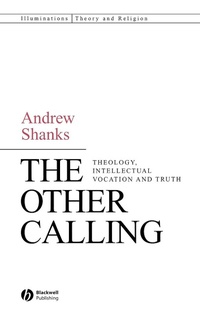
The Other Calling
Theology, Intellectual Vocation and Truth
1st Edition
Will be published approx. on 18. December 2006
Book
Hardback
248 pages
978-1-4051-5766-7 (ISBN)
Description
What is the true calling of the intellectual? In this provocative new book, Andrew Shanks presents a distinctive fresh answer. The Other Calling is a systematic riposte both to the elitism of philosophy in the heritage of Plato, and to the typical individualism of Plato's philosophic opponents. Here, instead, intellectual integrity is identified with a form of priesthood.
Asserts that intellectuals are critical to bringing together the common aspirations of a community
Offers a strikingly original approach to the moral and political aspects of theology's relationship with philosophy, exploring the perspectives of both disciplines
Draws on the work and thought of Christians, Muslims, Hindus, Buddhists, Agnostics, and Atheists
Argues for a new, religiously multicultural "priesthood of all thinkers", considering how once, all intellectuals were as a matter of course also priests
Published in the new and prestigious Illuminations series
Asserts that intellectuals are critical to bringing together the common aspirations of a community
Offers a strikingly original approach to the moral and political aspects of theology's relationship with philosophy, exploring the perspectives of both disciplines
Draws on the work and thought of Christians, Muslims, Hindus, Buddhists, Agnostics, and Atheists
Argues for a new, religiously multicultural "priesthood of all thinkers", considering how once, all intellectuals were as a matter of course also priests
Published in the new and prestigious Illuminations series
Reviews / Votes
"This book is a brave counter to both anti-intellectualism and intellectual elitism, and would be worth buying simply for the opening and closing chapters, where the essentials of the argument are clearly articulated. Nevertheless, those who wish to overhear the author coming to his conclusions in conversation with the likes of Plato, Hegel, Leo Strauss, Alexandre Kojeve, Coleridge, and Girard will find the intervening chapters intellectually demanding, but also consistently enlightening." Church TimesMore details
Series
Language
English
Place of publication
Hoboken
United Kingdom
Publishing group
John Wiley and Sons Ltd
Target group
Professional and scholarly
Product notice
sewn/stitched
Paper over boards
Dimensions
Height: 240 mm
Width: 161 mm
Thickness: 17 mm
Weight
507 gr
ISBN-13
978-1-4051-5766-7 (9781405157667)
Copyright in bibliographic data and cover images is held by Nielsen Book Services Limited or by the publishers or by their respective licensors: all rights reserved.
Schweitzer Classification
Other editions
Additional editions
E-Book
05/2008
Wiley-Blackwell
€40.99
Available for download

Book
12/2006
Wiley
€49.52
Article exhausted; check different version
Person
Andrew Shanks is the Canon Theologian for Manchester Cathedral. He is also the author of the following books: Hegel's Political Theology (1991), Civil Society, Civil Religion (Blackwell, 1995), God and Modernity (2000), What is Truth? (2001), and Faith in Honesty (2006).
Content
Introduction: Why Theology? / What is an Intellectual?. PART I: PHILOSOPHY.
1. The Incompleteness of Philosophy Alone.
2. Philosophy and Folk Religion: Two 'Forms' for a Single 'Content'.
3. 'Philosophic Politics' (i): Strauss amongst 'the Moderns' and 'the Postmoderns'.
4. 'Philosophic Politics' (ii): Strauss and 'the Ancients'.
5. Anti-Philosophical Philosophy (i): Kojeve's Critique of the 'Cloistered Mind'.
6. Anti-Philosophical Philosophy (ii): Epicurus, Rousseau.
PART II: THEOLOGY.
7. Beyond Metaphysics: 'the Science of the Sacralisation of Honesty, in Theist, Catholic form'.
8. Coleridge's Notion of the 'Clerisy'.
9. Sacramentally Framed Thought.
10. 'The Conflict': From Amos to Hegel, and Girard.
11. What is an Intellectual? / Why Theology?.
Notes.
Index
1. The Incompleteness of Philosophy Alone.
2. Philosophy and Folk Religion: Two 'Forms' for a Single 'Content'.
3. 'Philosophic Politics' (i): Strauss amongst 'the Moderns' and 'the Postmoderns'.
4. 'Philosophic Politics' (ii): Strauss and 'the Ancients'.
5. Anti-Philosophical Philosophy (i): Kojeve's Critique of the 'Cloistered Mind'.
6. Anti-Philosophical Philosophy (ii): Epicurus, Rousseau.
PART II: THEOLOGY.
7. Beyond Metaphysics: 'the Science of the Sacralisation of Honesty, in Theist, Catholic form'.
8. Coleridge's Notion of the 'Clerisy'.
9. Sacramentally Framed Thought.
10. 'The Conflict': From Amos to Hegel, and Girard.
11. What is an Intellectual? / Why Theology?.
Notes.
Index