

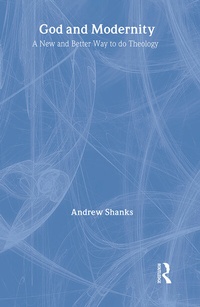
God and Modernity
A New and Better Way To Do Theology
1st Edition
Will be published approx. on 18. November 1999
Book
Hardback
200 pages
978-0-415-22188-7 (ISBN)
Description
For the past four hundred years, theological debate has been dominated by a fundamental divide: between the liberals, with strong loyalties to the secularity of the secular state and university on the one hand, and the neo-orthodox, insisting on the absolute priority of a proper loyalty to the church community itself, on the other. God and Modernity strikes off in a fundamentally new directionAndrew Shanks boldly calls for a new and better way to do theology.
Shanks argues that God is most present in a culture where public debate over ethical issues flourishes best. Social movements such as feminist movements, peace movements, and green movements have emerged to challenge both Church and State. These new movements are no longer confined to a particular confessional religious identity and are independent of state sponsorship. These social movements already made an individual impact on theology. What would a theology look like, systematically trying to reconcile older divisions in the theological debate with a new loyalty to such movements common ethos?
Anyone wishing to gain a refreshing insight into a new way of understanding theology and politics will welcome this ground-breaking book.
Shanks argues that God is most present in a culture where public debate over ethical issues flourishes best. Social movements such as feminist movements, peace movements, and green movements have emerged to challenge both Church and State. These new movements are no longer confined to a particular confessional religious identity and are independent of state sponsorship. These social movements already made an individual impact on theology. What would a theology look like, systematically trying to reconcile older divisions in the theological debate with a new loyalty to such movements common ethos?
Anyone wishing to gain a refreshing insight into a new way of understanding theology and politics will welcome this ground-breaking book.
Reviews / Votes
'This is one of the most interesting and challenging books I have read recently ... This book challenged my own theological prejudices and commitments and Shanks is full of imaginative and intelligent insights.' - Gavin D'Costa, Univeristy of Britsol, Theology'Lucidly written, and easy to read ... God and Modernity is an original and provocative contribution to theology.' - Times Literary Supplement
'Andrew Shanks has given us an elegant monography deidcated to the finding of a theology which breaks out from the confinement within the university (liberal) or the church (neo-orthodox)' - Andy Draycott, Themelios
'... in this original and important book, Andrew SHanks engages with one interesting feature of current society: the emergence in our 'post-political' times of 'new social movements' ... That [he] can relate a theological reading of solidarity to social movements highlights the importance and provocation of God and Modernity - Peter Scott, Reviews in Religion and Theology
More details
Language
English
Place of publication
London
United Kingdom
Publishing group
Taylor & Francis Ltd
Target group
College/higher education
Postgraduate
Dimensions
Height: 234 mm
Width: 156 mm
Weight
453 gr
ISBN-13
978-0-415-22188-7 (9780415221887)
Copyright in bibliographic data and cover images is held by Nielsen Book Services Limited or by the publishers or by their respective licensors: all rights reserved.
Schweitzer Classification
Other editions
Additional editions
E-Book
10/2012
1st Edition
Routledge
€55.49
Available for download
E-Book
10/2012
1st Edition
Routledge
€55.49
Available for download
Book
11/1999
1st Edition
Routledge
€63.00
Shipment within 15-20 days
Person
Andrew Shanks is a priest in the Church of England, currently working for the diocese of York. He is also the author of Hegel's Political Theology and Civil Society, Civil Religion.
Content
Chapter 1 The promise of new social movements; Chapter 2 ?EUR?Theology?EUR?; Chapter 3 Three stages of modernity?; Chapter 4 A second Axial Period?; Chapter 5 Arguments for calendar-reform; Chapter 6 Beyond ?EUR?metaphysics?EUR?; Chapter 7 Post-metaphysical faith; Chapter 8 Expressivism and individuality in new social movements; Chapter 9 Against ?EUR?recoil-theology?EUR?; Chapter 10 The healing of Christendom?EUR?s original trauma; Chapter 11 A new covenant?; Chapter 12 The other matrix; Chapter 13 ?EUR?Holy, Catholic and Apostolic?EUR?; Chapter 14 Discourse ethics and religion; Chapter 15 ?EUR?Wo aber Gefahr ist?EUR??EUR?;