

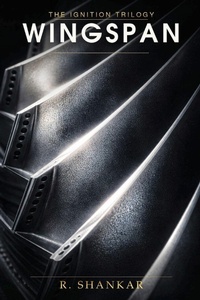
WINGSPAN
Description
Harish Raghav Rao is twenty-two years old, suspended from college, and entirely his father's son - which is the problem.
Raghav Rao built Raghav Defence Industries from nothing: forty-seven acres of precision manufacturing in Pune, ammunition contracts with the Ministry of Defence, a Rolex his late wife gave him that he has not removed in seven years. He is one of the most respected industrialists in Maharashtra. He is also a man whose silences his son has been reading since he was twelve.
On a balcony in Coorg, with a glass of wine and the dark coming down, Harish is told by a woman he is half in love with that he is Raghav Rao's shadow. That he has never once stood in his own light long enough to know what shape it makes.
He goes home and decides to build a jet engine company.
Wingspan, the first novel of The Ignition Trilogy, follows what comes next - a fifty-lakh cheque, a Bhosari machine shop, a retired DERA engineer who reserves judgment, a celebrity investor whose warmth is a strategy, and an engineering idea that emerges quietly from the friction of unlikely people working at the edge of what India's private sector has ever attempted: that stability does not always come from one force overcoming another. Sometimes it comes from the competition itself.
A novel of ambition, betrayal, and the shape a young man's light makes when he finally steps out of his father's - in the tradition of Richard Powers, Philip Roth, and Aravind Adiga.
A note on what's inside: Wingspan does not flinch from the engineering. Turbine metallurgy, manufacturing tolerances, the institutional argument that has kept India out of commercial aviation for forty years - the technical material is rigorously researched and integral to the story, not decoration. Readers who want pure narrative may find the precision demanding; readers who want a novel that takes its industry as seriously as its people will find a book that respects them. An appendix at the back of the novel develops the science further.
The Ignition Trilogy, taken as a whole, reaches further: toward the place where physics, neuroscience, and metaphysics converge - and what that convergence has to say about the nature of consciousness. The trilogy makes its arguments scientifically, not spiritually. Readers of Ted Chiang, Greg Egan, and Dan Simmons will find the inquiry developing across the three books. Wingspan is where it begins.