

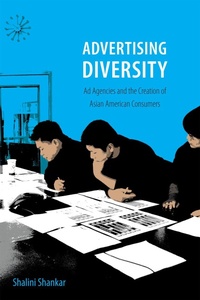
Advertising Diversity
Ad Agencies and the Creation of Asian American Consumers
Published on 27. April 2015
Book
Hardback
328 pages
978-0-8223-5864-0 (ISBN)
Description
In Advertising Diversity Shalini Shankar explores how racial and ethnic differences are created and commodified through advertisements, marketing, and public relations. Drawing from periods of fieldwork she conducted over four years at Asian American ad agencies in New York, San Francisco, and Los Angeles, Shankar illustrates the day-to-day process of creating and producing broadcast and internet advertisements. She examines the adaptation of general market brand identities for Asian American audiences, the ways ad executives make Asian cultural and linguistic concepts accessible to their clients, and the differences between casting Asian Americans in ads for general and multicultural markets. Shankar argues that as a form of racialized communication, advertising shapes the political and social status of Asian Americans, transforming them from "model minorities" to "model consumers." Asian Americans became visible in the twenty-first century United States through a process Shankar calls "racial naturalization." Once seen as foreign, their framing as model consumers has legitimized their presence in the American popular culture landscape. By making the category of Asian American suitable for consumption, ad agencies shape and refine the population they aim to represent.
Reviews / Votes
"The combination of Shankar's critical lens and outsider perspective commingle to produce an originative piece of work. Advertising Diversity offers even the most seasoned consumption and marketing scholars a compelling (but all too rare) look inside the world of Asian-American advertising, where culture and consumption converge to create 'model consumers.'" - Kevin D. Thomas (Consumption Markets & Culture) "In the cultural hermeneutic tradition of great storytelling, Shalini Shankar has produced an empirically rich and theoretically sound ethnography. In it she tells a brilliant analytic story about race, Asian America, and the assumed 'post-racial' world of advertising.... Advertising Diversity is an ideal book for upper-level undergraduate and graduate classes in anthropology, Asian American studies, ethnic studies, and business." - Stanley Thangaraj (Journal of Anthropological Research) "Shankar has accomplished plenty with this work and can be justly applauded for bringing to bear the detailed processes by which Asian American-images, sounds, languages, bodies, and lives-inhabit our mediascape. Advertising Diversity vividly demonstrates the role of ad agencies in constructing a place for Asian Americans to take at the colorful table of multicultural consumerism." - Christine R. Yano (Business History Review) "This book will be of great interest to anthropologists as well as scholars and students from a wide variety of fields that engage with popular culture as well as the study of ethnicity and race, and it could be successfully used in a number of advanced undergraduate courses on related topics. Overall, Shankar does a masterful job at demonstrating the nuances of media production in a multicultural society and her latest contribution to the field should be widely read." - Susan Dewey (Journal of Linguistic Anthropology) "Advertising Diversity is a valuable addition to this area of study.... [T]he book makes a powerful case for the way in which corporate uses of apparently progressive ideas like 'diversity' and 'multiculturalism' are in fact deeply retrogressive, normalizing various types and groups of people into a convenient, colourblind and postracial monoculture." - Nicky Falkof (Ethnic and Racial Studies) "[T]his book is a valuable and innovative contribution to the burgeoning field of media ethnography and particularly useful to those interested in conducting fieldwork in media industries. It is here, in the backrooms and boardrooms of corporate America, where Shankar's work shines as she illuminates the internal dynamics of racial naturalization and its circulation.... This is an important and innovative book for scholars interested in Asian American studies, communication, media studies, media industries, cultural studies, and visual culture." - Vincent N. Pham (Anthropological Quarterly) "Shalini Shankar's new book Advertising Diversity ... makes an ... important contribution by improving our understanding of the subtle techniques through which difference is depoliticized and reproduced through racial and ethnic representation." - Cindy Isenhour (American Anthropologist) "Offers some fascinating insights into advertising industry practices and relationships." - Stephanie O'Donohoe (Journal of the Royal Anthropological Institute)More details
Language
English
Place of publication
North Carolina
United States
Target group
Professional and scholarly
Product notice
Cloth over boards
Illustrations
42 illustrations
Dimensions
Height: 234 mm
Width: 155 mm
Thickness: 23 mm
Weight
567 gr
ISBN-13
978-0-8223-5864-0 (9780822358640)
Copyright in bibliographic data and cover images is held by Nielsen Book Services Limited or by the publishers or by their respective licensors: all rights reserved.
Schweitzer Classification
Other editions
Additional editions
E-Book
01/2015
1st Edition
Duke University Press
€208.99
Available for download
Person
Shalini Shankar is Associate Professor of Anthropology and Asian American Studies at Northwestern University. She is the author of Desi Land: Teen Culture, Class, and Success in Silicon Valley, also published by Duke University Press.
Content
Preface ix
Introduction. The Pitch 1
1. Account Planning 37
2. Creative 89
3. Account Services 147
4. Production and Media 191
Conclusion. Audience Testing 250
Acknowledgments 269
Appendix 1. Transcription Key 271
Appendix 2. Asian American Populations in the United States 272
Notes 275
Glossary 287
References 289
Index 307
Introduction. The Pitch 1
1. Account Planning 37
2. Creative 89
3. Account Services 147
4. Production and Media 191
Conclusion. Audience Testing 250
Acknowledgments 269
Appendix 1. Transcription Key 271
Appendix 2. Asian American Populations in the United States 272
Notes 275
Glossary 287
References 289
Index 307