

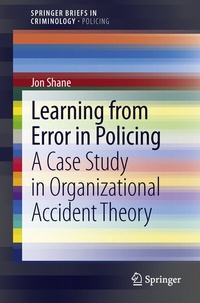
Learning from Error in Policing
A Case Study in Organizational Accident Theory
Published on 29. May 2013
Book
Paperback/Softback
XI, 91 pages
978-3-319-00040-4 (ISBN)
Description
While the proximate cause of any accident is usually someone's immediate action- or omission (failure to act)-there is often a trail of underlying latent conditions that facilitated their error: the person has, in effect, been unwittingly "set up" for failure by the organization. This Brief explores an accident in policing, as a framework for examining existing police practices.
Learning from Error in Policing describes a case of wrongful arrest from the perspective of organizational accident theory, which suggests a single unsafe act-in this case a wrongful arrest-is facilitated by several underlying latent conditions that triggered the event and failed to stop the harm once in motion. The analysis demonstrates that the risk of
errors committed by omission (failing to act) were significantly more likely to occur than errors committed by acts of commission. By examining this case, policy implications and directions for future research are discussed.
The analysis of this case, and the underlying lessons learned from it will have important implications for researchers and practitioners in the policing field.
More details
Series
Edition
2013 ed.
Language
English
Place of publication
Cham
Switzerland
Publishing group
Springer International Publishing
Target group
Professional and scholarly
Research
Illustrations
1 s/w Abbildung
XI, 91 p. 1 illus.
Dimensions
Height: 235 mm
Width: 155 mm
Thickness: 7 mm
Weight
172 gr
ISBN-13
978-3-319-00040-4 (9783319000404)
DOI
10.1007/978-3-319-00041-1
Schweitzer Classification
Other editions
Additional editions
E-Book
04/2013
1st Edition
Springer
€53.49
Available for download
Person
Jon M. Shane is an Associate Professor in the Department of Law, Police Science, and Criminal Justice Administration. He retired from the Newark Police Department after 20 years at the rank of captain. Dr. Shane has published in leading criminal justice and policing, including Crime Science, Journal of Criminal Justice,Justice Quarterly, Policing: An International Journal of Strategies and Management,and Police Practice and Research. He is the author of What Every Chief Executive Should Know: Using Data to Measure Police Performance (2007, Looseleaf Law Publications) and Learning From Error: A Case Study in Organizational Accident Theory. Dr. Shane is a graduate of the 193rd session of the FBI National Academy and a graduate of the 25th session of the Senior Management Institute for Police (SMIP) held by the Police Executive Research Forum at Harvard's John F.Kennedy School of Government. He also holds a certification in non-profit management from Rutgers Graduate School of Public Administration. Prior to coming to John Jay College, he was a lecturer at Rutgers University --Newark campus and at Fairleigh Dickinson University --Teaneck (NJ) campus, where he taught courses in policing and criminal justice. He is currently a senior research associate for the Police Foundation, Washington, D.C. and a subject matter expert for the Center for Problem Oriented Policing. Some of his most recent work (2013-2015) includes providing technical assistance to the Uruguay National Police on criminal investigations and solvability factors as they transition from an inquisitorial model of criminal justice to an adversarial model. His current research focus is police policy and practice issues and crime control through problem-oriented policing, situational crime prevention and environmental criminology. Professor Shane can be reached at jshane@jjay.cuny.edu or jmsnpd@gmail.com.
Content
Introduction.-Theoretical Framwork, Data, and Methodology.-Details of the Incident.- Show-up Procedures, Relevant Policy Standards, and Training Standards.