

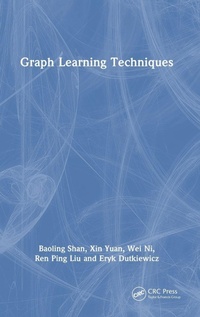
Graph Learning Techniques
1st Edition
Published on 26. February 2025
Book
Hardback
162 pages
978-1-032-85113-6 (ISBN)
Description
This comprehensive guide addresses key challenges at the intersection of data science, graph learning, and privacy preservation.
It begins with foundational graph theory, covering essential definitions, concepts, and various types of graphs. The book bridges the gap between theory and application, equipping readers with the skills to translate theoretical knowledge into actionable solutions for complex problems. It includes practical insights into brain network analysis and the dynamics of COVID-19 spread. The guide provides a solid understanding of graphs by exploring different graph representations and the latest advancements in graph learning techniques. It focuses on diverse graph signals and offers a detailed review of state-of-the-art methodologies for analyzing these signals. A major emphasis is placed on privacy preservation, with comprehensive discussions on safeguarding sensitive information within graph structures. The book also looks forward, offering insights into emerging trends, potential challenges, and the evolving landscape of privacy-preserving graph learning.
This resource is a valuable reference for advance undergraduate and postgraduate students in courses related to Network Analysis, Privacy and Security in Data Analytics, and Graph Theory and Applications in Healthcare.
It begins with foundational graph theory, covering essential definitions, concepts, and various types of graphs. The book bridges the gap between theory and application, equipping readers with the skills to translate theoretical knowledge into actionable solutions for complex problems. It includes practical insights into brain network analysis and the dynamics of COVID-19 spread. The guide provides a solid understanding of graphs by exploring different graph representations and the latest advancements in graph learning techniques. It focuses on diverse graph signals and offers a detailed review of state-of-the-art methodologies for analyzing these signals. A major emphasis is placed on privacy preservation, with comprehensive discussions on safeguarding sensitive information within graph structures. The book also looks forward, offering insights into emerging trends, potential challenges, and the evolving landscape of privacy-preserving graph learning.
This resource is a valuable reference for advance undergraduate and postgraduate students in courses related to Network Analysis, Privacy and Security in Data Analytics, and Graph Theory and Applications in Healthcare.
More details
Language
English
Place of publication
London
United Kingdom
Publishing group
Taylor & Francis Ltd
Target group
College/higher education
Professional Practice & Development, Professional Training, and Undergraduate Advanced
Illustrations
49 s/w Photographien bzw. Rasterbilder, 122 s/w Abbildungen, 73 s/w Zeichnungen, 11 s/w Tabellen
11 Tables, black and white; 73 Line drawings, black and white; 49 Halftones, black and white; 122 Illustrations, black and white
Dimensions
Height: 240 mm
Width: 161 mm
Thickness: 15 mm
Weight
449 gr
ISBN-13
978-1-032-85113-6 (9781032851136)
Copyright in bibliographic data and cover images is held by Nielsen Book Services Limited or by the publishers or by their respective licensors: all rights reserved.
Schweitzer Classification
Other editions
Additional editions

Baoling Shan | Xin Yuan | Wei Ni
Graph Learning Techniques
Book
02/2025
1st Edition
CRC Press
€74.50
Shipment within 10-20 days

Baoling Shan | Xin Yuan | Wei Ni
Graph Learning Techniques
E-Book
02/2025
1st Edition
CRC Press
€68.49
Available for download

Baoling Shan | Xin Yuan | Wei Ni
Graph Learning Techniques
E-Book
02/2025
1st Edition
CRC Press
€68.49
Available for download
Persons
Baoling Shan is currently a Lecturer at University of Science and Technology Beijing, Beijing, China.
Xin Yuan is currently a Senior Research Scientist at CSIRO, Sydney, NSW, Australia, and an Adjunct Senior Lecturer at the University of New South Wales.
Wei Ni is a Principal Research Scientist at CSIRO, Sydney, Australia, a Fellow of IEEE, a Conjoint Professor at the University of New South Wales, an Adjunct Professor at the University of Technology Sydney, and an Honorary Professor at Macquarie University.
Ren Ping Liu is a Professor and the Head of the Discipline of Network and Cybersecurity, University of Technology Sydney (UTS), Ultimo, NSW, Australia.
Eryk Dutkiewicz is currently the Head of School of Electrical and Data Engineering at the University of Technology Sydney, Australia. He is a Senior Member of IEEE and his research interests cover 5G/6G and IoT networks.
Xin Yuan is currently a Senior Research Scientist at CSIRO, Sydney, NSW, Australia, and an Adjunct Senior Lecturer at the University of New South Wales.
Wei Ni is a Principal Research Scientist at CSIRO, Sydney, Australia, a Fellow of IEEE, a Conjoint Professor at the University of New South Wales, an Adjunct Professor at the University of Technology Sydney, and an Honorary Professor at Macquarie University.
Ren Ping Liu is a Professor and the Head of the Discipline of Network and Cybersecurity, University of Technology Sydney (UTS), Ultimo, NSW, Australia.
Eryk Dutkiewicz is currently the Head of School of Electrical and Data Engineering at the University of Technology Sydney, Australia. He is a Senior Member of IEEE and his research interests cover 5G/6G and IoT networks.
Content
Table of Contents
Abstract
List of Figures
List of Tables
Contributors
1. Introduction
2. Privacy Considerations in Graph and Graph Learning
3. Existing Technologies of Graph Learning
4. Graph Extraction and Topology Learning of Band-limited Signals
5. Graph Learning from Band-Limited Data by Graph Fourier Transform Analysis
6. Graph Topology Learning of Brain Signals
7. Graph Topology Learning of COVID-19
8. Preserving the Privacy of Latent Information for Graph-Structured Data
9. Future Directions and Challenges
10. Appendix
Bibliography
Index
Abstract
List of Figures
List of Tables
Contributors
1. Introduction
2. Privacy Considerations in Graph and Graph Learning
3. Existing Technologies of Graph Learning
4. Graph Extraction and Topology Learning of Band-limited Signals
5. Graph Learning from Band-Limited Data by Graph Fourier Transform Analysis
6. Graph Topology Learning of Brain Signals
7. Graph Topology Learning of COVID-19
8. Preserving the Privacy of Latent Information for Graph-Structured Data
9. Future Directions and Challenges
10. Appendix
Bibliography
Index