

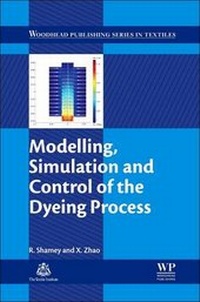
Modelling, Simulation and Control of the Dyeing Process
Published on 30. October 2018
Book
Paperback/Softback
260 pages
978-0-08-101556-8 (ISBN)
Description
With increased environmental awareness and rising costs, manufacturers are investing in real time monitoring and control of dyeing to increase its efficiency and quality. This book reviews ways of automating the dyeing process as well as ways of understanding key processes in dyeing, including dye transport in fluid systems. This understanding is then used to create models to simulate the dyeing process which can then be used to develop appropriate measurement and control systems. Control of variables such as temperature, pH, conductivity and dye concentration can then be used to ensure a more consistent and cost-effective dyeing process.
More details
Series
Language
English
Place of publication
Cambridge
United Kingdom
Publishing group
Elsevier Science & Technology
Target group
Professional and scholarly
This book will be of interest to textiles researchers, and will provide the industrial sector with examples which demonstrate the environmental and cost benefits of recent advances.
Dimensions
Height: 234 mm
Width: 156 mm
ISBN-13
978-0-08-101556-8 (9780081015568)
Copyright in bibliographic data and cover images is held by Nielsen Book Services Limited or by the publishers or by their respective licensors: all rights reserved.
Schweitzer Classification
Other editions
Additional editions
R. Shamey | X. Zhao
Modelling, Simulation and Control of the Dyeing Process
Book
08/2014
Woodhead Publishing Ltd
€205.01
Article exhausted; check different version
Persons
Professor Xiaobin Zhao is Director of the UK-China Research Academy of Bioactive Molecules and Materials (RABMM).
Content
Dedication I
Dedication II
Woodhead Publishing Series in Textiles
Preface
Definition of terms
Nomenclature
1. Introduction to dyeing and dyehouse automation
Abstract:
1.1 Introduction
1.2 Factors affecting dyeing quality
1.3 Practical difficulties involved in dyeing process control
1.4 Package dyeing machinery
1.5 Difficulties in package dyeing
1.6 Automation in the dyehouse
1.7 References
2. Principles underlying the dyeing process
Abstract:
2.1 Introduction
2.2 Dye transport from the bulk solution to the fibre surface
2.3 Adsorption of dyes by textile fibres
2.4 Diffusion of the dye into the interior of the fibre
2.5 Rate of dyeing
2.6 References
3. Dye transport in fluid systems
Abstract:
3.1 Introduction
3.2 Fluid properties in perspective
3.3 Flows in porous media
3.4 Convective mass transfer in fluid system
3.5 Dye transfer in dyeing
3.6 References
4. Developing theoretical models of dyeing
Abstract:
4.1 Introduction
4.2 System description and basic assumptions
4.3 Development of mathematical model
4.4 References
5. Solving dynamic equations in dye transport
Abstract:
5.1 Introduction
5.2 Numerical methods
5.3 Summary of the model equations
5.4 Numerical solutions of equations
5.5 References
6. Simulation of the dyeing process
Abstract:
6.1 Introduction
6.2 Fluid flow behaviour in dyeing
6.3 Dynamic behaviour of mass transfer in package dyeing
6.4 Conclusions from simulation results
6.5 References
7. Principles of control in dyeing processes
Abstract:
7.1 Introduction
7.2 Introduction to process control
7.3 Control algorithms
7.4 Analog and digital processing
7.5 Practical application in a pilot-scale operation
7.6 pH measurement and control in a dyeing system
7.7 The feed-forward control strategy
7.8 Acknowledgement
7.9 References
8. Measurement and control of dyeing
Abstract:
8.1 Introduction
8.2 Real-time measurement of dye concentration
8.3 Data processing and tools to analyse and interpret real-time dye monitoring data
8.4 Conclusion
8.5 References
Index
Dedication II
Woodhead Publishing Series in Textiles
Preface
Definition of terms
Nomenclature
1. Introduction to dyeing and dyehouse automation
Abstract:
1.1 Introduction
1.2 Factors affecting dyeing quality
1.3 Practical difficulties involved in dyeing process control
1.4 Package dyeing machinery
1.5 Difficulties in package dyeing
1.6 Automation in the dyehouse
1.7 References
2. Principles underlying the dyeing process
Abstract:
2.1 Introduction
2.2 Dye transport from the bulk solution to the fibre surface
2.3 Adsorption of dyes by textile fibres
2.4 Diffusion of the dye into the interior of the fibre
2.5 Rate of dyeing
2.6 References
3. Dye transport in fluid systems
Abstract:
3.1 Introduction
3.2 Fluid properties in perspective
3.3 Flows in porous media
3.4 Convective mass transfer in fluid system
3.5 Dye transfer in dyeing
3.6 References
4. Developing theoretical models of dyeing
Abstract:
4.1 Introduction
4.2 System description and basic assumptions
4.3 Development of mathematical model
4.4 References
5. Solving dynamic equations in dye transport
Abstract:
5.1 Introduction
5.2 Numerical methods
5.3 Summary of the model equations
5.4 Numerical solutions of equations
5.5 References
6. Simulation of the dyeing process
Abstract:
6.1 Introduction
6.2 Fluid flow behaviour in dyeing
6.3 Dynamic behaviour of mass transfer in package dyeing
6.4 Conclusions from simulation results
6.5 References
7. Principles of control in dyeing processes
Abstract:
7.1 Introduction
7.2 Introduction to process control
7.3 Control algorithms
7.4 Analog and digital processing
7.5 Practical application in a pilot-scale operation
7.6 pH measurement and control in a dyeing system
7.7 The feed-forward control strategy
7.8 Acknowledgement
7.9 References
8. Measurement and control of dyeing
Abstract:
8.1 Introduction
8.2 Real-time measurement of dye concentration
8.3 Data processing and tools to analyse and interpret real-time dye monitoring data
8.4 Conclusion
8.5 References
Index