

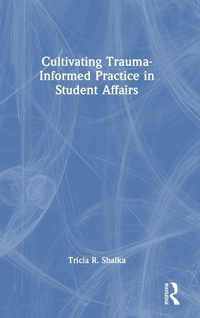
Cultivating Trauma-Informed Practice in Student Affairs
1st Edition
Published on 23. October 2023
Book
Hardback
160 pages
978-1-64267-460-6 (ISBN)
Description
Winner of the NASPA 2025 Faculty Council Outstanding Publication Award
Offering a multi-tiered approach to supporting college students who have experienced trauma, this book considers how trauma manifests for post-secondary college students and how colleges and universities can implement trauma-informed practice in student affairs.
Author Tricia R. Shalka offers knowledge about trauma and its trajectories to help ground trauma-informed practice, before translating this knowledge into specific strategies that span a spectrum of individual and systems-level efforts in colleges and universities. The story of college student trauma is presented through several different lenses, including discussions around the research literature, what the author's research participants offer, and the author's own personal experience with trauma. Drawing on these diverse perspectives, Shalka initiates a journey of reflection and (re)connection that will ultimately inform an understanding of the challenges college student trauma survivors encounter and what it means to embrace trauma-informed approaches in student affairs supportive of student success and well-being-centric organizations.
Written in an approachable and conversational style, this book introduces new concepts to consider when working toward building a trauma-informed practice in student affairs and as such will assist student affairs practitioners, university administrators, and college-level educators in supporting students.
Offering a multi-tiered approach to supporting college students who have experienced trauma, this book considers how trauma manifests for post-secondary college students and how colleges and universities can implement trauma-informed practice in student affairs.
Author Tricia R. Shalka offers knowledge about trauma and its trajectories to help ground trauma-informed practice, before translating this knowledge into specific strategies that span a spectrum of individual and systems-level efforts in colleges and universities. The story of college student trauma is presented through several different lenses, including discussions around the research literature, what the author's research participants offer, and the author's own personal experience with trauma. Drawing on these diverse perspectives, Shalka initiates a journey of reflection and (re)connection that will ultimately inform an understanding of the challenges college student trauma survivors encounter and what it means to embrace trauma-informed approaches in student affairs supportive of student success and well-being-centric organizations.
Written in an approachable and conversational style, this book introduces new concepts to consider when working toward building a trauma-informed practice in student affairs and as such will assist student affairs practitioners, university administrators, and college-level educators in supporting students.
Reviews / Votes
The text is a preparation ground for coming to terms with the intensities of trauma and responding to the urgent imperative for trauma-informed practice. Consistent with Dr. Shalka's commitments to generating language, skills, and dispositions for practitioners, educators, and students, the text is a forum on care as she lovingly, which is to say, deliberately and compassionately, calls forth humanizing ways of being.Wilson Okello, Assistant Professor of Higher Education, The Pennsylvania State University, USA
Given the ongoing presence of trauma for college students, the importance of Shalka's book cannot be overstated. Cultivating Trauma-Informed Practice in Student Affairs speaks to a necessary shift in educational praxis and serves as a timeless reminder for educators to embody a person-centered ethic of care in an educational landscape increasingly animated through the dehumanizing logic of racialized capitalism.
Z Nicolazzo, Associate Professor, Trans* Studies in Education
I have been changed by Dr. Tricia Shalka's writing and will be a better student affairs educator because of the gift of her work. She has written a must-read for all educators committed to creating cultures of care. She calls us to act by helping us understand that there is an imperative for trauma-informed student affairs practice. Given that the majority of college students have already been exposed to trauma, and more will be impacted while in college, the need to act is now. Read this book for it is a masterful and compassionate blueprint on the principles, practice, skills, knowledge and ways of being that foster environments that create the conditions for students to thrive. Become a trauma-informed practitioner --- our students are depending on us.
Patty Perillo, Vice President for Student Affairs and Affiliate Faculty, Higher Education, Student Affairs and International Education Policy, University of Maryland, USA
More details
Language
English
Place of publication
New York
United States
Publishing group
Taylor & Francis Inc
Target group
College/higher education
Professional and scholarly
Postgraduate and Professional Practice & Development
Dimensions
Height: 235 mm
Width: 157 mm
Thickness: 14 mm
Weight
406 gr
ISBN-13
978-1-64267-460-6 (9781642674606)
Copyright in bibliographic data and cover images is held by Nielsen Book Services Limited or by the publishers or by their respective licensors: all rights reserved.
Schweitzer Classification
Other editions
Additional editions
Tricia R. Shalka
Cultivating Trauma-Informed Practice in Student Affairs
E-Book
10/2023
1st Edition
Routledge
€31.49
Available for download
Tricia R. Shalka
Cultivating Trauma-Informed Practice in Student Affairs
Book
10/2023
1st Edition
Routledge
€44.50
Shipment within 3-4 weeks
Tricia R. Shalka
Cultivating Trauma-Informed Practice in Student Affairs
E-Book
10/2023
1st Edition
Routledge
€31.49
Available for download
Person
Tricia R. Shalka is an associate professor of higher education at the University of Rochester's Warner School of Education & Human Development, USA.
Content
Introduction 1. What Is Trauma? 2. What Might It Be Like for a College Student to Experience Trauma? 3. What Does It Mean to be Trauma-Informed? 4. Personal Practices for Trauma-Informed Student Affairs Work 5. Supporting Students Who Have Experienced Trauma 6. Supporting Student Leaders Who Care for Others 7. Organizational End Goal: Equity-Focused Systems of Wellness and Care 8. Toward a Trauma-Informed Student Affairs Practice