

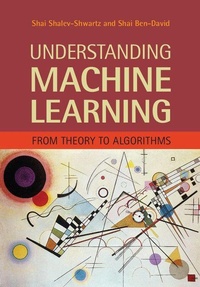
Understanding Machine Learning
From Theory to Algorithms
Published on 19. May 2014
Book
Hardback
410 pages
978-1-107-05713-5 (ISBN)
Description
Machine learning is one of the fastest growing areas of computer science, with far-reaching applications. The aim of this textbook is to introduce machine learning, and the algorithmic paradigms it offers, in a principled way. The book provides a theoretical account of the fundamentals underlying machine learning and the mathematical derivations that transform these principles into practical algorithms. Following a presentation of the basics, the book covers a wide array of central topics unaddressed by previous textbooks. These include a discussion of the computational complexity of learning and the concepts of convexity and stability; important algorithmic paradigms including stochastic gradient descent, neural networks, and structured output learning; and emerging theoretical concepts such as the PAC-Bayes approach and compression-based bounds. Designed for advanced undergraduates or beginning graduates, the text makes the fundamentals and algorithms of machine learning accessible to students and non-expert readers in statistics, computer science, mathematics and engineering.
Reviews / Votes
'This elegant book covers both rigorous theory and practical methods of machine learning. This makes it a rather unique resource, ideal for all those who want to understand how to find structure in data.' Bernhard Schoelkopf, Max Planck Institute for Intelligent Systems, Germany 'This is a timely text on the mathematical foundations of machine learning, providing a treatment that is both deep and broad, not only rigorous but also with intuition and insight. It presents a wide range of classic, fundamental algorithmic and analysis techniques as well as cutting-edge research directions. This is a great book for anyone interested in the mathematical and computational underpinnings of this important and fascinating field.' Avrim Blum, Carnegie Mellon University 'This text gives a clear and broadly accessible view of the most important ideas in the area of full information decision problems. Written by two key contributors to the theoretical foundations in this area, it covers the range from theoretical foundations to algorithms, at a level appropriate for an advanced undergraduate course.' Peter L. Bartlett, University of California, BerkeleyMore details
Language
English
Place of publication
Cambridge
United Kingdom
Target group
College/higher education
Illustrations
Worked examples or Exercises; 1 Halftones, unspecified; 46 Line drawings, unspecified
Dimensions
Height: 260 mm
Width: 183 mm
Thickness: 27 mm
Weight
970 gr
ISBN-13
978-1-107-05713-5 (9781107057135)
Copyright in bibliographic data and cover images is held by Nielsen Book Services Limited or by the publishers or by their respective licensors: all rights reserved.
Schweitzer Classification
Other editions
Additional editions
E-Book
05/2014
Cambridge University Press
€45.49
Available for download
E-Book
05/2014
1st Edition
Cambridge University Press
€52.99
Available for download
Persons
Shai Shalev-Shwartz is an Associate Professor at the School of Computer Science and Engineering at the Hebrew University of Jerusalem, Israel. Shai Ben-David is a Professor in the School of Computer Science at the University of Waterloo, Canada.
Content
1. Introduction; Part I. Foundations: 2. A gentle start; 3. A formal learning model; 4. Learning via uniform convergence; 5. The bias-complexity trade-off; 6. The VC-dimension; 7. Non-uniform learnability; 8. The runtime of learning; Part II. From Theory to Algorithms: 9. Linear predictors; 10. Boosting; 11. Model selection and validation; 12. Convex learning problems; 13. Regularization and stability; 14. Stochastic gradient descent; 15. Support vector machines; 16. Kernel methods; 17. Multiclass, ranking, and complex prediction problems; 18. Decision trees; 19. Nearest neighbor; 20. Neural networks; Part III. Additional Learning Models: 21. Online learning; 22. Clustering; 23. Dimensionality reduction; 24. Generative models; 25. Feature selection and generation; Part IV. Advanced Theory: 26. Rademacher complexities; 27. Covering numbers; 28. Proof of the fundamental theorem of learning theory; 29. Multiclass learnability; 30. Compression bounds; 31. PAC-Bayes; Appendix A. Technical lemmas; Appendix B. Measure concentration; Appendix C. Linear algebra.