

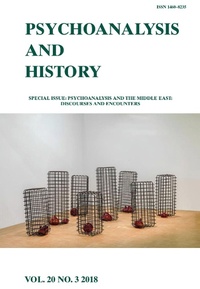
Psychoanalysis and the Middle East: Discourses and Encounters: Volume 20
Psychoanalysis and History
Will be published approx. on 30. December 2018
Book
Paperback/Softback
272 pages
978-1-4744-3970-1 (ISBN)
Description
This special issue stages an encounter between psychoanalysis and the Middle East by reopening the psychoanalytic canon to consider key concepts through unexpected interlocutors, religious traditions, and intellectual formations. This includes bringing Islamic philosophical concepts of the Cloud to bear on conceptions of causality and apres coup; and thinking from the point of view of the Last Judgment in dialogue with the therapeutic work of a Moroccan imam and the Lacanian analyst Fouad Benchekroun. Authors also recover lesser known histories of psychoanalytic theory: in the work of Egyptian psychoanalyst Sami-Ali, who developed a distinctly expansive theory of the imaginary influenced by Islamic apophatic theology and his own clinical work; and in Iraqi sociologist ?Ali al-Wardi's critical reevaluation of the unconscious, via the Islamic revolutionary tradition, as a source of the miraculous. Moving to the contemporary era, chapters tackle the various uses of psychoanalysis in `dialogue initiatives' that delegitimize Palestinians' use of violence in Palestine/Israel; and in efforts to `lay on the couch' the figure of the jihadi in contemporary France in the service of a secular modernizing project. Engaging critical theory, history, anthropology, and Islamic studies, this special issue will be of interest to all those concerned with psychoanalysis in relation to a geopolitical elsewhere.
The special issue joins a growing literature on psychoanalysis and the Middle East. It stands out insofar as it brings together ethnographic, historical, literary, and theological perspectives in a single volume. Prominent scholars of psychoanalysis and Islam, including Joan Copjec and Stefania Pandolfo, provide a contextually-informed, theoretically rich account of psychoanalysis in the Middle East and in Islam. This body of work demonstrates the extent to which the relationship between Europe and the Middle East has been a site of productive engagement for psychoanalysis. Challenging assumptions of Europe as the metropolitan source of psychoanalytic concepts and thought, chapters contribute to a move away from Eurocentric histories and theoretical perspectives towards a global and transnational account of psychoanalysis. This interdisciplinary special issue will be of interest to scholars of psychology, psychoanalysis, Middle Eastern studies, Islamic studies, religious studies, history, anthropology, sociology, and postcolonial studies.
The special issue joins a growing literature on psychoanalysis and the Middle East. It stands out insofar as it brings together ethnographic, historical, literary, and theological perspectives in a single volume. Prominent scholars of psychoanalysis and Islam, including Joan Copjec and Stefania Pandolfo, provide a contextually-informed, theoretically rich account of psychoanalysis in the Middle East and in Islam. This body of work demonstrates the extent to which the relationship between Europe and the Middle East has been a site of productive engagement for psychoanalysis. Challenging assumptions of Europe as the metropolitan source of psychoanalytic concepts and thought, chapters contribute to a move away from Eurocentric histories and theoretical perspectives towards a global and transnational account of psychoanalysis. This interdisciplinary special issue will be of interest to scholars of psychology, psychoanalysis, Middle Eastern studies, Islamic studies, religious studies, history, anthropology, sociology, and postcolonial studies.
More details
Series
Language
English
Place of publication
Edinburgh
United Kingdom
Target group
Professional and scholarly
College/higher education
Product notice
Paperback (trade)
Unsewn / adhesive bound
Illustrations
11 B/W illustrations
Dimensions
Height: 216 mm
Width: 149 mm
Thickness: 8 mm
Weight
180 gr
ISBN-13
978-1-4744-3970-1 (9781474439701)
Copyright in bibliographic data and cover images is held by Nielsen Book Services Limited or by the publishers or by their respective licensors: all rights reserved.
Schweitzer Classification
Persons
Omnia El Shakry is Professor at the Department of History, University of California, Davis Sara D Pursley is Assistant Professor at the Department of Middle Eastern and Islamic Studies, New York University
Caroline Beatrice McKusick is a PhD doctoral candidate at the Department of Anthropology, University of California Davis
Caroline Beatrice McKusick is a PhD doctoral candidate at the Department of Anthropology, University of California Davis
Content
"Introduction," Omnia El Shakry, Sara Pursley, and Caroline McKusick
"Cloud, Precinct of the Theological-Historical," Joan Copjec
"Divine Trial and Experimentum Mentis: The Psychoanalyst, the Imam, and the Ordeal of Madness" Stefania Pandolfo
"Psychoanalysis and the Imaginary: Translating Freud in Postcolonial Egypt," Omnia El Shakry
"?Ali al-Wardi and the Miracles of the Unconscious," Sara Pursley
"Psychoanalysis Under Occupation: Non-Violence and Dialogue Initiatives as a Psychic Extension of the Closure System," Stephen Sheehi
"Jihad on the Couch," Nouri Gana
"Cloud, Precinct of the Theological-Historical," Joan Copjec
"Divine Trial and Experimentum Mentis: The Psychoanalyst, the Imam, and the Ordeal of Madness" Stefania Pandolfo
"Psychoanalysis and the Imaginary: Translating Freud in Postcolonial Egypt," Omnia El Shakry
"?Ali al-Wardi and the Miracles of the Unconscious," Sara Pursley
"Psychoanalysis Under Occupation: Non-Violence and Dialogue Initiatives as a Psychic Extension of the Closure System," Stephen Sheehi
"Jihad on the Couch," Nouri Gana