

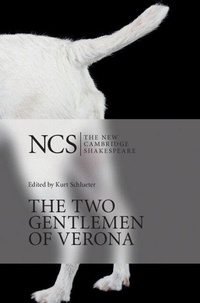
The Two Gentlemen of Verona
2nd Edition
Published on 5. April 2012
Book
Hardback
180 pages
978-1-107-00489-4 (ISBN)
Description
The New Cambridge Shakespeare appeals to students worldwide for its up-to-date scholarship and emphasis on performance. The series features line-by-line commentaries and textual notes on the plays and poems. Introductions are regularly refreshed with accounts of new critical, stage and screen interpretations. In this second edition of The Two Gentlemen of Verona, Kurt Schlueter approaches Shakespeare's early comedy as a parody of two types of Renaissance educational fiction: the love-quest story and the test-of-friendship story, which in combination show high-flown human ideals as incompatible with each other and with human nature. Since the first known production at David Garrick's Drury Lane Theatre, the play has tempted major directors and actors, though changing conceptions of the play often fail to recognise its subversive impetus. This updated edition includes a new introductory section by Lucy Munro on recent stage and critical interpretations, bringing the thoroughly researched, illustrated performance history up to date.
More details
Series
Edition
2nd Revised edition
Language
English
Place of publication
Cambridge
United Kingdom
Target group
College/higher education
Professional and scholarly
Edition type
Revised edition
Illustrations
16 Halftones, unspecified
Dimensions
Height: 235 mm
Width: 157 mm
Thickness: 14 mm
Weight
420 gr
ISBN-13
978-1-107-00489-4 (9781107004894)
Copyright in bibliographic data and cover images is held by Nielsen Book Services Limited or by the publishers or by their respective licensors: all rights reserved.
Schweitzer Classification
Other editions
Additional editions
William Shakespeare | Kurt Schlueter
The Two Gentlemen of Verona
E-Book
07/2013
2nd Edition
Cambridge University Press
€9.99
Available for download
William Shakespeare
Two Gentlemen of Verona
E-Book
04/2012
Cambridge University Press
€8.49
Available for download
Previous edition

Book
09/1990
Cambridge University Press
€49.60
Article exhausted; check for reprint
Persons
Lucy Munro is a lecturer in Shakespeare and Early Modern Drama Studies at King's College London. Her research focuses on the performance and reception of Elizabethan, Jacobean and Caroline drama, on editing, book history and textual scholarship, on literary style and genre, and on dramatic representations of childhood and ageing. Her books include Children of the Queen's Revels: A Jacobean Theatre Repertory (Cambridge University Press, 2005) and Archaic Style in English Literature, 1590-1674 (Cambridge University Press, 2013). She is editor of Edward Sharpham's The Fleer (2006), Shakespeare and George Wilkins' Pericles, in William Shakespeare: Complete Works (ed. Jonathan Bate and Eric Rasmussen, 2007), Richard Brome's The Queen and Concubine and The Demoiselle, in Richard Brome Online (gen. ed. Richard Allen Cave, 2009), and John Fletcher's The Tamer Tamed (2010). Her essays have appeared or are forthcoming in Huntington Library Quarterly, Modern Philology, Shakespeare Bulletin, Shakespeare and Ageing and Society, and in collections such as The Oxford Handbook of Early Modern Theatre (ed. Richard Dutton, 2009), Performing Early Modern Drama Today (ed. Kathryn Prince and Pascale Aebischer, Cambridge University Press, 2012) and The Elizabethan Top Ten: Defining Print Popularity in Early Modern England (ed. Andy Kesson and Emma Smith, 2013). Her stage history of The Alchemist appears in The Cambridge Edition of the Works of Ben Jonson, electronic edition (gen. ed. David Bevington, Martin Butler and Ian Donaldson, Cambridge University Press, 2014).
Content
Introduction: date; Themes and criticism; Structure and sources; Speed and Lance; The outlaws; Stage history; Recent stage and critical interpretations by Lucy Munro; List of characters; The play; Textual analysis; Appendix: a further note on stage directions; Reading list.