

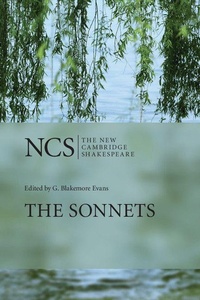
The Sonnets
Introducion by Anthony Hecht. Edited by Gwynne Blakemore Evans
2nd Edition
Published on 22. June 2006
Book
Hardback
292 pages
978-0-521-86118-2 (ISBN)
Description
The New Cambridge Shakespeare appeals to students worldwide for its up-to-date scholarship and emphasis on performance. The series features line-by-line commentaries and textual notes on the plays and poems. Introductions are regularly refreshed with accounts of new critical, stage and screen interpretations. For this second edition of The Sonnets, Stephen Orgel has written a new introduction to Shakespeare's best-loved and most widely read poems. In a series of focused readings he probes the sonnets' sexual and temperamental ambiguity as well as their complex textual history, and explores the difficulties editors face when modernising the spelling, punctuation and layout of the 1609 quarto. Orgel reminds us that the order in which the sonnets were composed bears no relation to the order in which they appear in the quarto and he warns against reading them biographically. This edition retains the text prepared by G. Blakemore Evans, together with his notes and commentary.
More details
Series
Edition
2nd Revised edition
Language
English
Place of publication
Cambridge
United Kingdom
Target group
College/higher education
Professional and scholarly
US School Grade: Second Grade and over, Interest Age: From 12 years
Edition type
Revised edition
Illustrations
3 Halftones, unspecified
Dimensions
Height: 240 mm
Width: 161 mm
Thickness: 20 mm
Weight
605 gr
ISBN-13
978-0-521-86118-2 (9780521861182)
Copyright in bibliographic data and cover images is held by Nielsen Book Services Limited or by the publishers or by their respective licensors: all rights reserved.
Schweitzer Classification
Other editions
Additional editions
William Shakespeare | G. Blakemore Evans
The Sonnets
E-Book
07/2013
2nd Edition
Cambridge University Press
€9.99
Available for download
Previous edition

William Shakespeare | Gwynne Blakemore Evans
The Sonnets
Book
04/1996
Cambridge University Press
€49.52
Article exhausted; check for reprint
Persons
William Shakespeare (bapt. 26 April 1564 - 23 April 1616)[a] was an English poet, playwright, and actor, widely regarded as the greatest writer in the English language and the world's greatest dramatist. He is often called England's national poet and the "Bard of Avon" (or simply "the Bard"). His extant works, including collaborations, consist of some 39 plays,[c] 154 sonnets, two long narrative poems, and a few other verses, some of uncertain authorship. His plays have been translated into every major living language and are performed more often than those of any other playwright.[7]
Shakespeare was born and raised in Stratford-upon-Avon, Warwickshire. At the age of 18, he married Anne Hathaway, with whom he had three children: Susanna and twins Hamnet and Judith. Sometime between 1585 and 1592, he began a successful career in London as an actor, writer, and part-owner of a playing company called the Lord Chamberlain's Men, later known as the King's Men. At age 49 (around 1613), he appears to have retired to Stratford, where he died three years later. Few records of Shakespeare's private life survive; this has stimulated considerable speculation about such matters as his physical appearance, his sexuality, his religious beliefs, and whether the works attributed to him were written by others.
Shakespeare produced most of his known works between 1589 and 1613.[11][12][d] His early plays were primarily comedies and histories and are regarded as some of the best work produced in these genres. Until about 1608, he wrote mainly tragedies, among them Hamlet, Othello, King Lear, and Macbeth, all considered to be among the finest works in the English language. In the last phase of his life, he wrote tragicomedies (also known as romances) and collaborated with other playwrights. Many of Shakespeare's plays were published in editions of varying quality and accuracy in his lifetime. However, in 1623, two fellow actors and friends of Shakespeare's, John Heminges and Henry Condell, published a more definitive text known as the First Folio, a posthumous collected edition of Shakespeare's dramatic works that included all but two of his plays.[13] The volume was prefaced with a poem by Ben Jonson, in which Jonson presciently hails Shakespeare in a now-famous quote as "not of an age, but for all time".[13]
Throughout the 20th and 21st centuries, Shakespeare's works have been continually adapted and rediscovered by new movements in scholarship and performance. His plays remain popular and are studied, performed, and reinterpreted through various cultural and political contexts around the world.
Shakespeare was born and raised in Stratford-upon-Avon, Warwickshire. At the age of 18, he married Anne Hathaway, with whom he had three children: Susanna and twins Hamnet and Judith. Sometime between 1585 and 1592, he began a successful career in London as an actor, writer, and part-owner of a playing company called the Lord Chamberlain's Men, later known as the King's Men. At age 49 (around 1613), he appears to have retired to Stratford, where he died three years later. Few records of Shakespeare's private life survive; this has stimulated considerable speculation about such matters as his physical appearance, his sexuality, his religious beliefs, and whether the works attributed to him were written by others.
Shakespeare produced most of his known works between 1589 and 1613.[11][12][d] His early plays were primarily comedies and histories and are regarded as some of the best work produced in these genres. Until about 1608, he wrote mainly tragedies, among them Hamlet, Othello, King Lear, and Macbeth, all considered to be among the finest works in the English language. In the last phase of his life, he wrote tragicomedies (also known as romances) and collaborated with other playwrights. Many of Shakespeare's plays were published in editions of varying quality and accuracy in his lifetime. However, in 1623, two fellow actors and friends of Shakespeare's, John Heminges and Henry Condell, published a more definitive text known as the First Folio, a posthumous collected edition of Shakespeare's dramatic works that included all but two of his plays.[13] The volume was prefaced with a poem by Ben Jonson, in which Jonson presciently hails Shakespeare in a now-famous quote as "not of an age, but for all time".[13]
Throughout the 20th and 21st centuries, Shakespeare's works have been continually adapted and rediscovered by new movements in scholarship and performance. His plays remain popular and are studied, performed, and reinterpreted through various cultural and political contexts around the world.
Content
List of illustrations; Preface; List of abbreviations and conventions; Introduction Stephen Orgel; Note on the text; The Sonnets; The commentary; Textual analysis; Appendix: manuscript copies of the Sonnets; Reading list; Index of first lines.