

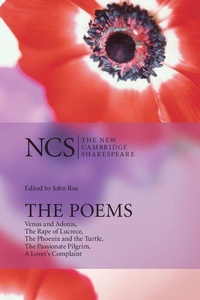
The Poems
Venus and Adonis, The Rape of Lucrece, The Phoenix and the Turtle, The Passionate Pilgrim, A Lover's Complaint
2nd Edition
Published on 1. June 2006
Book
Paperback/Softback
326 pages
978-0-521-67162-0 (ISBN)
Description
This second edition of Shakespeare's narrative poems contains an introductory section on recent critical interpretations. Fully annotated and introduced, it includes all the poems which can be confidently assigned to Shakespeare, excluding the Sonnets: Venus and Adonis, The Rape of Lucrece, The Phoenix and the Turtle, The Passionate Pilgrim and A Lover's Complaint. An updated reading list completes the edition.
Reviews / Votes
'John Roe offers without doubt the best treatment of the poems for many years ...' The Year's Work in Modern LanguagesMore details
Series
Edition
2nd Revised edition
Language
English
Place of publication
Cambridge
United Kingdom
Target group
College/higher education
Professional and scholarly
Edition type
Revised edition
Product notice
Paperback (trade)
Illustrations
5 Halftones, unspecified
Dimensions
Height: 229 mm
Width: 152 mm
Thickness: 18 mm
Weight
474 gr
ISBN-13
978-0-521-67162-0 (9780521671620)
Copyright in bibliographic data and cover images is held by Nielsen Book Services Limited or by the publishers or by their respective licensors: all rights reserved.
Schweitzer Classification
Other editions
Additional editions
William Shakespeare | John Roe
The Poems
Venus and Adonis, The Rape of Lucrece, The Phoenix and the Turtle, The Passionate Pilgrim, A Lover's Complaint
E-Book
08/2013
2nd Edition
Cambridge University Press
€9.99
Available for download
Previous edition
William Shakespeare | John Roe
The Poems
Venus and Adonis, The Rape of Lucrece, The Phoenix and the Turtle, The Passionate Pilgrim
Book
01/1992
Cambridge University Press
€9.89
Article exhausted; check for reprint
Persons
A Midsummer Night's Dream is a comedy written by William Shakespeare in 1595/96. It portrays the events surrounding the marriage of Theseus, the Duke of Athens, to Hippolyta, the former queen of the Amazons. These include the adventures of four young Athenian lovers and a group of six amateur actors (the mechanicals) who are controlled and manipulated by the fairies who inhabit the forest in which most of the play is set.The play is one of Shakespeare's most popular works for the stage and is widely performed across the world. It is unknown exactly when A Midsummer Night's Dream was written or first performed, but on the basis of topical references and an allusion to Edmund Spenser's Epithalamion, it is usually dated 1595 or early 1596. Some have theorised that the play might have been written for an aristocratic wedding (for example that of Elizabeth Carey, Lady Berkeley), while others suggest that it was written for the Queen to celebrate the feast day of St. John, but no evidence exists to support this theory. In any case, it would have been performed at The Theatre and, later, The Globe. Though it is not a translation or adaptation of an earlier work, various sources such as Ovid's Metamorphoses and Chaucer's "The Knight's Tale" served as inspiration. According to John Twyning, the play's plot of four lovers undergoing a trial in the woods was intended as a "riff" on Der Busant, a Middle High German poem. According to Dorothea Kehler, the writing period can be placed between 1594 and 1596, which means that Shakespeare had probably already completed Romeo and Juliet and had yet to start working on The Merchant of Venice. The play belongs to the early-middle period of the author, when Shakespeare devoted his attention to the lyricism of his works.
Content
List of illustrations; Preface; List of abbreviations and conventions; Introduction: Venus and Adonis, The Rape of Lucrece, The Phoenix and the Turtle, The Passionate Pilgrim, A Lover's Complaint; Note on the text; Recent critical interpretations; Principles of collation; Venus and Adonis; The Rape of Lucrece; The Phoenix and the Turtle; The Passionate Pilgrim; A Lover's Complaint; Supplementary notes; Textual analysis; Reading list.