

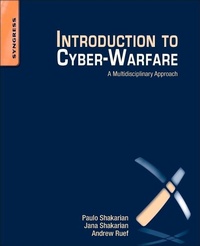
Introduction to Cyber-Warfare
A Multidisciplinary Approach
Published on 1. August 2013
Book
Paperback/Softback
336 pages
978-0-12-407814-7 (ISBN)
Description
Introduction to Cyber-Warfare: A Multidisciplinary Approach, written by experts on the front lines, gives you an insider's look into the world of cyber-warfare through the use of recent case studies. The book examines the issues related to cyber warfare not only from a computer science perspective but from military, sociological, and scientific perspectives as well. You'll learn how cyber-warfare has been performed in the past as well as why various actors rely on this new means of warfare and what steps can be taken to prevent it.
Reviews / Votes
"...an excellent overview of the topic...It looks at the information security aspect of cyberwarfare, as well the military, sociological and other aspects...this book should indeed be read by everyone in Washington, as they are making decisions on the topic, without truly understanding it." --Slashdot.org, RSAConference.com, August 4 2014More details
Language
English
Place of publication
Rockland, MA
United States
Target group
Professional and scholarly
Information security professionals, system administrators. Security managers, security analysts. defense analysts, defense personnel, U.S Cybercom staff
Product notice
Paperback (trade)
Unsewn / adhesive bound
Dimensions
Height: 233 mm
Width: 187 mm
Thickness: 17 mm
Weight
687 gr
ISBN-13
978-0-12-407814-7 (9780124078147)
Copyright in bibliographic data and cover images is held by Nielsen Book Services Limited or by the publishers or by their respective licensors: all rights reserved.
Schweitzer Classification
Other editions
Additional editions
Paulo Shakarian | Jana Shakarian | Andrew Ruef
Introduction to Cyber-Warfare
A Multidisciplinary Approach
E-Book
05/2013
Syngress
€38.95
Available for download
Persons
Paulo Shakarian, Ph.D. is a Major in the U.S. Army and an Assistant Professor of Computer Science at the U.S. Military Academy (West Point) teaching classes on computer science and information technology as wells as conducting research on cyber-security, social networks, and artificial intelligence. He has written over twenty papers published in scientific and military journals. Relating to cyber-warfare, he has written the paper "Stuxnet: Cyberwar Revolution in Military Affairs? published in Small Wars Journal and "The 2008 Russian Cyber-Campaign Against Georgia? published in Military Review. His scientific research has also been well received, featured in major news media such including The Economist and Nature. Previously, he has authored Geospatial Abduction: Principles and Practice published by Springer. Paulo holds a Ph.D. and M.S. in computer science from the University of Maryland, College Park, a B.S. in computer science from West Point, and a Depth of Study in Information Assurance also from West Point. Paulo has served two combat tours in Operation Iraqi Freedom. His military awards include the Bronze Star, Meritorious Service Medal, Army Commendation Medal with Valor Device, and Combat Action Badge. Paulo's website is: http://shakarian.net/paulo. Jana Shakarian is a Research Fellow at the West Point Network Science Center conducting sociological research in support of various DoD-sponsored projects. Previously, Jana has worked as a research assistant at Laboratory for Computational Cultural Dynamics at the University of Maryland where she extensively studied terrorist groups in south-east Asia in addition to other research initiatives at the intersection of social and computational science applied to military and security problems. She has written numerous papers in addition to co-authoring the book Computational Analysis of Terrorist Groups: Lashkar-e-Tabia, to be published by Springer in the near future. Jana holds an M.A. in cultural and social anthropology and sociology from the Johannes Gutenberg University, Mainz where her thesis was on "new war? theory. Jana's website is: http://shakarian.net/jana. Andrew Ruef is a Senior Systems Engineer at the firm Trail of Bits (New York, NY) where he conducts information security analysis. Andrew has nearly a decade of industry experience in computer network security and software engineering, working on various projects including reverse-engineering of malware, analysis of computer network traffic for security purposes, system administration, and development of secure software products. Andrew has also written numerous white papers on information security and has spoken at various conferences such including a recent conference talk at the Dagstuhl computer research center in Germany. Currently, Andrew is working toward his B.S. in Computer Science at the University of Maryland, College Park. A sampling of some of Andrew's technical work can be found here: http://www.kyrus-tech.com/tag/andrew-ruef/.
Content
Chapter 1 Introduction
Part I: Cyber Attack
Chapter 2 - Cyber Attack in an Inter-State Conflict
Chapter 3 - Cyber Attack in Conjunction with Conventional Military Operations :
Chapter 4 - Cyber Attack in Support of Information Operations:
Chapter 5 - Cyber Attack Against Internal Dissidents
Chapter 6 - Cyber Attacks by Non-State Hacking Groups
Part II Cyber Espionage and Exploitation
Chapter 7 - Chinese Attributed Cyber Espionage
Chapter 8 - Hacking Unmanned Aerial Vehicles Chapter 9 - Social Network Exploitation: Theory and Practice
Chapter 10 The Next Generation of Cyber Exploitation
Chapter 11 -Chapter 12 - Case Study
Part III
Chapter 11 - Industrial Control Systems
Chapter 12 - Cyber Attacks on the Power Grid
Chapter 13 - Stuxnet
Chapter 14- Conclusion and the Future of Cyber War
Part I: Cyber Attack
Chapter 2 - Cyber Attack in an Inter-State Conflict
Chapter 3 - Cyber Attack in Conjunction with Conventional Military Operations :
Chapter 4 - Cyber Attack in Support of Information Operations:
Chapter 5 - Cyber Attack Against Internal Dissidents
Chapter 6 - Cyber Attacks by Non-State Hacking Groups
Part II Cyber Espionage and Exploitation
Chapter 7 - Chinese Attributed Cyber Espionage
Chapter 8 - Hacking Unmanned Aerial Vehicles Chapter 9 - Social Network Exploitation: Theory and Practice
Chapter 10 The Next Generation of Cyber Exploitation
Chapter 11 -Chapter 12 - Case Study
Part III
Chapter 11 - Industrial Control Systems
Chapter 12 - Cyber Attacks on the Power Grid
Chapter 13 - Stuxnet
Chapter 14- Conclusion and the Future of Cyber War