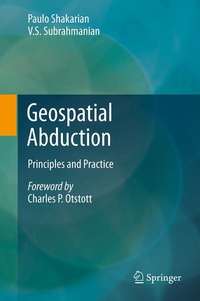
Imagine yourself as a military officer in a conflict zone trying to identify locations of weapons caches supporting road-side bomb attacks on your country's troops. Or imagine yourself as a public health expert trying to identify the location of contaminated water that is causing diarrheal diseases in a local population. Geospatial abduction is a new technique introduced by the authors that allows such problems to be solved.
Geospatial Abduction provides the mathematics underlying geospatial abduction and the algorithms to solve them in practice; it has wide applicability and can be used by practitioners and researchers in many different fields. Real-world applications of geospatial abduction to military problems are included. Compelling examples drawn from other domains as diverse as criminology, epidemiology and archaeology are covered as well. This book also includes access to a dedicated website on geospatial abduction hosted by University of Maryland.
Geospatial Abduction targets practitioners working in general AI, game theory, linear programming, data mining, machine learning, and more. Those working in the fields of computer science, mathematics, geoinformation, geological and biological science will also find this book valuable.
Reviews / Votes
From the reviews:
"This monograph is an attempt to formalize abductive reasoning based on geospatial information. It includes conceptual definitions, algorithms for exact and approximate solutions, descriptions of heuristics, and examples of applying geospatial abduction to real-world problems. . The exposition is comparable to senior undergraduate or graduate-level texts in algorithms and computability theory. . This monograph will be a useful addition to the shelves of academics, students, and developers working with geospatial knowledge in a variety of domains." (R. M. Malyankar, ACM Computing Reviews, June, 2012)
Edition
Language
Place of publication
Target group
Professional and scholarly
Professional/practitioner
Illustrations
Dimensions
Height: 241 mm
Width: 160 mm
Thickness: 15 mm
Weight
ISBN-13
978-1-4614-1793-4 (9781461417934)
DOI
10.1007/978-1-4614-1794-1
Schweitzer Classification
Paulo Shakarian is an associate professor at Arizona State University. His research focuses on symbolic AI and hybrid symbolic-ML systems. He received his Ph.D. from the University of Maryland, College Park. He is a past DARPA Military Fellow, AFOSR Young Investigator recipient, and his work earned multiple "best paper" awards.
Gerardo I. Simari is a professor at UNS, and a researcher at CONICET. His research focuses on AI and Databases, and reasoning under uncertainty. He received a PhD in computer science from University of Maryland College Park and later joined the Department of Computer Science, University of Oxford, where he was also a Fulford Junior Research Fellow of Somerville College.
Chitta Baral is a Professor at the Arizona State University, and a past President of KR Inc. His research interests include Knowledge Representation and Reasoning, NLP and Image Understanding and often involves combining logical reasoning with explicit knowledge and neural learning and reasoning with textual and perceptual inputs.
Bowen Xi is a Ph.D. student at Arizona State University, specializing in the field of Neural Symbolic AI. She is passionate about combining the strengths of neural networks and symbolic reasoning to advance the field of artificial intelligence. Bowen's research interests include developing novel algorithms and techniques that enable machines to learn and reason like humans.
Lahari Pokala is a student pursuing her Master's degree at Arizona State University, where she is majoring in Computer Science. Her interests lie in artificial intelligence and data engineering.