

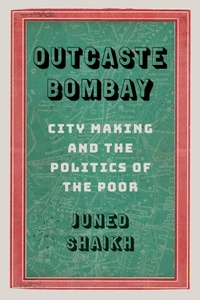
Outcaste Bombay
City Making and the Politics of the Poor
Published on 25. April 2021
Book
Paperback/Softback
242 pages
978-0-295-74850-4 (ISBN)
Description
Caste, class, and development converge in a booming metropolis
Over the course of the twentieth century, Bombay's population grew twentyfold as the city became increasingly industrialized and cosmopolitan. Yet beneath a veneer of modernity, old prejudices endured, including the treatment of the Dalits. Even as Indians engaged with aspects of modern life, including the Marxist discourse of class, caste distinctions played a pivotal role in determining who was excluded from the city's economic transformations. Labor historian Juned Shaikh documents the symbiosis between industrial capitalism and the caste system, mapping the transformation of the city as urban planners marked Dalit neighborhoods as slums that needed to be demolished in order to build a modern Bombay.
Drawing from rare sources written by the urban poor and Dalits in the Marathi language-including novels, poems, and manifestos-Outcaste Bombay examines how language and literature became a battleground for cultural politics. Through careful scrutiny of one city's complex social fabric, this study illuminates issues that remain vital for labor activists and urban planners around the world.
Over the course of the twentieth century, Bombay's population grew twentyfold as the city became increasingly industrialized and cosmopolitan. Yet beneath a veneer of modernity, old prejudices endured, including the treatment of the Dalits. Even as Indians engaged with aspects of modern life, including the Marxist discourse of class, caste distinctions played a pivotal role in determining who was excluded from the city's economic transformations. Labor historian Juned Shaikh documents the symbiosis between industrial capitalism and the caste system, mapping the transformation of the city as urban planners marked Dalit neighborhoods as slums that needed to be demolished in order to build a modern Bombay.
Drawing from rare sources written by the urban poor and Dalits in the Marathi language-including novels, poems, and manifestos-Outcaste Bombay examines how language and literature became a battleground for cultural politics. Through careful scrutiny of one city's complex social fabric, this study illuminates issues that remain vital for labor activists and urban planners around the world.
Reviews / Votes
"This inter-disciplinary book draws on rare English and Marathi language sources - including novels, poems, and manifestoes - and contributes to debates in the fields of South Asian history, global Marxism, social anthropology, urban studies, labor studies, Dalit studies, and literature."(New Books in South Asia (NBN)) "Highlighting the nexus among caste, class, language, urban space, and the tensions within these categories, as well as how caste and class shaped the urban environment, this remarkable book contributes significantly to social/labor history and urban studies."
(Choice) "A fascinating study of the politics of urban poor in the rapidly shifting landscape of twentieth-century Bombay city...it offers a glimpse of [the city] as it is lived, reshaped, and appropriated by its Dalit inhabitants, and makes a great contribution to the bourgeoning scholarship on Dalit labor and Bombay city."
(The Middle Ground Journal) "A moving account of the symbiosis of caste and capitalism in the city."
(Pacific Affairs) "richly researched and perceptively argued"
(American Historical Review)
More details
Series
Language
English
Place of publication
Seattle
United States
Target group
Professional and scholarly
Product notice
Paperback (trade)
Illustrations
0 illustrations
Dimensions
Height: 231 mm
Width: 154 mm
Thickness: 17 mm
Weight
352 gr
ISBN-13
978-0-295-74850-4 (9780295748504)
Copyright in bibliographic data and cover images is held by Nielsen Book Services Limited or by the publishers or by their respective licensors: all rights reserved.
Schweitzer Classification