

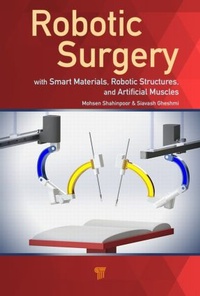
Robotic Surgery
Smart Materials, Robotic Structures, and Artificial Muscles
1st Edition
Published on 18. November 2014
Book
Hardback
210 pages
978-981-4316-23-1 (ISBN)
Description
Robotic surgery has already created a paradigm shift in medical surgical procedures and will continue to expand to all surgical and microsurgical interventions. There is no doubt that in doing so robotic surgical systems, such as the da Vinci surgical system, will become smarter and more sophisticated with the integration, implementation, and synergy of new smart multifunctional material systems that will make surgical tools and equipment more functional in biomimetic sensing and actuation incorporating haptic/tactile feedback to surgeons in connection with kinesthetic interaction with organs during robotic surgery.
This book is the first textbook in robotic surgery to discuss the integration of smart multifunctional soft and biomimetic materials with robotic end effectors to provide haptic and tactile feedback to surgeons during robotic surgery. It is also the first textbook in robotic surgery that comes with a solutions manual, which makes it useful as a supplement to faculty members teaching many different programs and courses such as robotics, medical devices, surgical interventions, and many more.
This book can be adapted by professors to teach graduate students and researchers, to enable them to further employ their creativity and knowledge, and to undergraduates to enable them to get an excellent grasp of this exciting field. It is also useful for individuals interested in the field for self-study. The background required for this book is college-level mathematics, matrix analysis, geometry, and medical/surgical terminologies.
This book is the first textbook in robotic surgery to discuss the integration of smart multifunctional soft and biomimetic materials with robotic end effectors to provide haptic and tactile feedback to surgeons during robotic surgery. It is also the first textbook in robotic surgery that comes with a solutions manual, which makes it useful as a supplement to faculty members teaching many different programs and courses such as robotics, medical devices, surgical interventions, and many more.
This book can be adapted by professors to teach graduate students and researchers, to enable them to further employ their creativity and knowledge, and to undergraduates to enable them to get an excellent grasp of this exciting field. It is also useful for individuals interested in the field for self-study. The background required for this book is college-level mathematics, matrix analysis, geometry, and medical/surgical terminologies.
More details
Language
English
Place of publication
Singapore
Singapore
Target group
College/higher education
Professional and scholarly
Academic and Postgraduate
Illustrations
133 s/w Abbildungen, 22 farbige Abbildungen
22 Illustrations, color; 133 Illustrations, black and white
Dimensions
Height: 229 mm
Width: 152 mm
Weight
446 gr
ISBN-13
978-981-4316-23-1 (9789814316231)
Copyright in bibliographic data and cover images is held by Nielsen Book Services Limited or by the publishers or by their respective licensors: all rights reserved.
Schweitzer Classification
Other editions
Additional editions
Mohsen Shahinpoor | Siavash Gheshmi
Robotic Surgery
Smart Materials, Robotic Structures, and Artificial Muscles
E-Book
11/2014
1st Edition
Pan Stanford Publishing Pte Ltd
€172.99
Available for download
Persons
Mohsen Shahinpoor is the Richard C. Hill Professor and Chair at the University of Maine, Department of Mechanical Engineering, where he also serves as the director of Biomedical Engineering and Advanced Robotic Surgery laboratories. He is also a professor of biomedical science and engineering at the Graduate School of Biomedical Science and Engineering at the University of Maine. Prof. Shahinpoor is internationally known for his work on smart materials and artificial muscles as well as smart medical devices, implants, and non-invasive surgery. He is the first author to introduce smart materials and artificial muscles for haptic feedback in robotic surgery in a first textbook on robotic surgery. His research has been featured in numerous reports in the popular media. He has served on the editorial board of over 18 research journals and has authored over 670 research publications. He is a Fellow of the American Society of Mechanical Engineers, Fellow of the Institute of Physics, and a member of the New York Academy of Sciences.
Siavash Gheshmi is a biomedical engineer, inventor, and engineering consultant who has been serving the robotics, medical devices, life sciences, and biotechnology industries for years. He earned his M.Sc. in mechanical engineering from the University of Maine in 2012. His efforts in different engineering capacities have resulted in publications, intellectual properties, and more. Gheshmi's desire to simultaneously work in the fields of both medical devices and robotics was his incentive to enter the field of robotic surgery. As a research assistant at the University of Maine, he has developed and fabricated robotic surgical systems.
Siavash Gheshmi is a biomedical engineer, inventor, and engineering consultant who has been serving the robotics, medical devices, life sciences, and biotechnology industries for years. He earned his M.Sc. in mechanical engineering from the University of Maine in 2012. His efforts in different engineering capacities have resulted in publications, intellectual properties, and more. Gheshmi's desire to simultaneously work in the fields of both medical devices and robotics was his incentive to enter the field of robotic surgery. As a research assistant at the University of Maine, he has developed and fabricated robotic surgical systems.
Content
Introduction to Surgical Robots General Configurations. Surgical Robots Kinematics and Workspace. Intraocular Robotic Surgical Systems. Deployable Laparoscopic Robotic Surgical Systems. Applications of Intelligent Materials and Artificial Muscles to Robotic Surgery. Summary and Conclusions. References. Appendix. Index.