

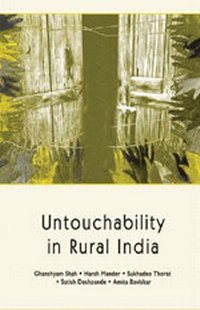
Untouchability in Rural India
1st Edition
Published on 7. August 2006
Book
Paperback/Softback
216 pages
978-0-7619-3507-0 (ISBN)
Description
This book is focused and systematic documentation of the incidence and extent of the practice of untouchability in contemporary India. Based on the results of a large survey covering 565 villages in 11 states, it reveals that untouchability continues to be widely prevalent and is practiced in one form or another in almost 80 per cent of the villages. Field data is supplemented by information about the forms of discrimination which Dalits face in everyday life, such as:
- The 'unclean' occupations open to them
- The double burden of Dalit women, who suffer both gender and caste discrimination
- The upper-caste violence with which any Dalit self-assertion is met
The authors also describe Dalit efforts to overcome deeply entrenched caste hierarchies and assert their right to live with dignity. While the evidence presented here suggests that the more blatant and extreme forms of untouchability appear to have declined, discrimination continues and is most prevalent in the religious and personal spheres. The authors show that the notion of untouchability continues to pervade the public sphere, including a host of state institutions and the interactions that occur within them.
- The 'unclean' occupations open to them
- The double burden of Dalit women, who suffer both gender and caste discrimination
- The upper-caste violence with which any Dalit self-assertion is met
The authors also describe Dalit efforts to overcome deeply entrenched caste hierarchies and assert their right to live with dignity. While the evidence presented here suggests that the more blatant and extreme forms of untouchability appear to have declined, discrimination continues and is most prevalent in the religious and personal spheres. The authors show that the notion of untouchability continues to pervade the public sphere, including a host of state institutions and the interactions that occur within them.
Reviews / Votes
Untouchability in Rural India is a fascinating, lively and well-written book, which I would recommend those interested in class and cast to consult. It is a pleasure to read, the style is clear and concise without losing complex details, and the study is relevant for experienced researchers in this area as well as new students. -- Journal of South Asian Development Practices of discrimination against people born into particular castes and legitimizes practices that are humiliating, exclusionary and exploitative.... "unclean occupations open to them; the double burden of Dalit women, who face both gender and caste discrimination; the upper caste violence with which any Dalit self-assertation is met.".... forms of discriminations faced by women with several real life incidences.... The emerging emancipation of these women and how, many of them, despite all odds, have managed to achieve greater control over their lives. -- Development Alternatives The volume proves beyond doubt that the dalits have learnt the use of radical language in order to establish their right to dignity and equal concern. -- Economic & Political WeeklyMore details
Edition
First Edition
Language
English
Place of publication
Thousand Oaks
United States
Target group
College/higher education
Professional and scholarly
Dimensions
Height: 216 mm
Width: 140 mm
Weight
254 gr
ISBN-13
978-0-7619-3507-0 (9780761935070)
Copyright in bibliographic data and cover images is held by Nielsen Book Services Limited or by the publishers or by their respective licensors: all rights reserved.
Schweitzer Classification
Persons
Ghanshyam Shah is currently Fellow, Netherlands Institute for Advanced Study in the Humanities and Social Sciences, Wassenaar, The Netherlands. During a rich and distinguished career, he has been Director of the Centre for Social Studies, Surat (1976-85 and again from 1991 to 1996); Dr Ambedkar Chair Professor at the National Academy of Administration, Mussoorie (1996-97); and Professor in Social Sciences at the Centre of Social Medicine and Community Health, Jawaharlal Nehru University, New Delhi, (1997-2003).
Professor Shah has taught in the Department of Public Administration at South Gujarat University; and has been a Visiting Professor at the Department of Political Science at Banaras Hindu University and at the Department of Political Science, University of Chicago, among others. He was awarded the V.K.R.V. Rao prize in Political Science Research in 1979 and 1980, and the University Grants Commission National Award in Political Science in 1998. Ghanshyam Shah has authored, co-authored or edited more than 15 books, including Social Movements and the State (2002), Dalit Identity and Politics (2001) and Public Health and Urban Development: The Study of the Surat Plague (1997). Sukhadeo Thorat is Chairman, Indian Council of Social Science Research (ICSSR); former Chairman of University Grants Commission (UGC); and Professor of Economics, Jawaharlal Nehru University, New Delhi. He has a BA (Milind College of Arts, Aurangabad, Maharashtra), MA in Economics (Dr Babasaheb Ambedkar Marathwada University, Aurangabad), MPhil/PhD in Economics (Jawaharlal Nehru University) and Diploma in Economic Planning (Main School of Planning, Warsaw, Poland). His research areas include agricultural development, rural poverty, institution and economic growth, problems of marginalised groups, economics of caste system, caste discrimination and poverty. He was the Director of the Indian Institute of Dalit Studies, New Delhi from 2003 to 2006 and the Research Associate of International Food Policy Research Institute, Washington DC, USA, since 1992. In 2008 he was awarded the Padmashree in the field of literature and education.
After studying Economics and Sociology at the University of Delhi, Amita Baviskar received her PhD in Development Sociology from Cornell University. She is currently Professor of Sociology, Institute of Economic Growth, Delhi. Her research focuses on the cultural politics of environment and development in rural and urban India. She has taught at the University of Delhi and has been a visiting scholar at several universities including Stanford, Cornell, Yale, SciencesPo, University of California at Berkeley and the University of Cape Town. A recipient of the 2010 Infosys Prize for Social Sciences, she was also awarded the 2005 Malcolm Adiseshiah Award for Distinguished Contributions to Development Studies, and the 2008 VKRV Rao Prize for Social Science Research. Her writings explore the themes of resource rights, popular resistance and discourses of environmentalism.
Professor Shah has taught in the Department of Public Administration at South Gujarat University; and has been a Visiting Professor at the Department of Political Science at Banaras Hindu University and at the Department of Political Science, University of Chicago, among others. He was awarded the V.K.R.V. Rao prize in Political Science Research in 1979 and 1980, and the University Grants Commission National Award in Political Science in 1998. Ghanshyam Shah has authored, co-authored or edited more than 15 books, including Social Movements and the State (2002), Dalit Identity and Politics (2001) and Public Health and Urban Development: The Study of the Surat Plague (1997). Sukhadeo Thorat is Chairman, Indian Council of Social Science Research (ICSSR); former Chairman of University Grants Commission (UGC); and Professor of Economics, Jawaharlal Nehru University, New Delhi. He has a BA (Milind College of Arts, Aurangabad, Maharashtra), MA in Economics (Dr Babasaheb Ambedkar Marathwada University, Aurangabad), MPhil/PhD in Economics (Jawaharlal Nehru University) and Diploma in Economic Planning (Main School of Planning, Warsaw, Poland). His research areas include agricultural development, rural poverty, institution and economic growth, problems of marginalised groups, economics of caste system, caste discrimination and poverty. He was the Director of the Indian Institute of Dalit Studies, New Delhi from 2003 to 2006 and the Research Associate of International Food Policy Research Institute, Washington DC, USA, since 1992. In 2008 he was awarded the Padmashree in the field of literature and education.
After studying Economics and Sociology at the University of Delhi, Amita Baviskar received her PhD in Development Sociology from Cornell University. She is currently Professor of Sociology, Institute of Economic Growth, Delhi. Her research focuses on the cultural politics of environment and development in rural and urban India. She has taught at the University of Delhi and has been a visiting scholar at several universities including Stanford, Cornell, Yale, SciencesPo, University of California at Berkeley and the University of Cape Town. A recipient of the 2010 Infosys Prize for Social Sciences, she was also awarded the 2005 Malcolm Adiseshiah Award for Distinguished Contributions to Development Studies, and the 2008 VKRV Rao Prize for Social Science Research. Her writings explore the themes of resource rights, popular resistance and discourses of environmentalism.
Content
Foreword Babu Mathew
Preface Harsh Mander
Introduction: Caste, Untouchability and Dalits in Rural India
'Unclean Occupations': Savaged by Tradition
Dalit Women and the Practice of Untouchability
Violence against Dalits
Demanding Rights, Equality and Dignity
Conclusion
Appendices
Glossary
References
Index
Preface Harsh Mander
Introduction: Caste, Untouchability and Dalits in Rural India
'Unclean Occupations': Savaged by Tradition
Dalit Women and the Practice of Untouchability
Violence against Dalits
Demanding Rights, Equality and Dignity
Conclusion
Appendices
Glossary
References
Index