

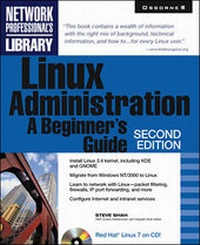
Linux Administration: A Beginner's Guide
2nd Edition
Published on 16. February 2001
Book
Paperback/Softback
608 pages
978-0-07-213136-9 (ISBN)
Description
"A delight to read. I think this book is well-written enough in explaining what is behind much of Linux." --Harvey Friedman, Linux Journal
Reviews / Votes
"In the past two years, Linux has infiltrated mainstram computing with a vengence. From Red Hat's IPO to adoption by IBM Corp., Linux is making serious waves in the enterprise space." Network Computing, July 26, 2000"More details
Edition
2nd edition
Language
English
Place of publication
United States
Publishing group
McGraw-Hill Education - Europe
Target group
College/higher education
Professional and scholarly
Illustrations
150 illustrations
Dimensions
Height: 231 mm
Width: 188 mm
Thickness: 41 mm
Weight
1361 gr
ISBN-13
978-0-07-213136-9 (9780072131369)
Copyright in bibliographic data and cover images is held by Nielsen Book Services Limited or by the publishers or by their respective licensors: all rights reserved.
Schweitzer Classification
Person
Steve Shah (Riverside, CA) has been a UNIX systems/network administrator since 1992 and a programmer since 1986. Currently, he is responsible for administering five variants of UNIX and three variants of Windows NT. He has been working with Linux since version 1.09 (1994) and has administered Linux workstations since 1996. Steve has contributed as an author of several publications including Unix Unleashed (Editions 1-3), Red Hat Linux Unleased (Editions 2-3), and Using Unix, 2nd Edition. He has a B.S. in Computer Science and Creative Writing and is graduating from the University of California, Riverside with an M.S. in Computer Science in 1999.
Content
Part I: Installing Linux as A Server. Chapter 1: Technical Summary of Linux Distributions, NT and Windows 2000. Chapter 2: Installing Red Hat Linux in a Server Configuration. Chapter 3: GNOME and KDE. Chapter 4: Installing Software. Part II: Single Host Administration. Chapter 5: Managing Users. Chapter 6: The Command Line. Chapter 7: File Systems. Chapter 8: Core System Services. Chapter 9: Compiling the Linux Kernel. Chapter 10: Securing an Individual Server. Part III: Internet Services. Chapter 11: DNS. Chapter 12: FTP. Chapter 13: Setting Up Your Web Server Using Apache. Chapter 14: SMTP. Chapter 15: Post Office Protocol (POP). Chapter 16: The Secure Shell (SSH). Part IV: Intranet Services. Chapter 17: Network File System Chapter 18: Network Information Service (NIS). Chapter 19: Samba. Chapter 20: Printing. Chapter 21: DHCP. Chapter 22: Backups. Part V: Advanced Linux Networking. Chapter 23: TCP/IP 101. Chapter 24: Network Configuration. Chapter 25: The /proc File System (update: revise for 2.4 kernels). Appendices: A: Programming Languages that Accompany Red Hat Linux (update: revise for RedHat 7.0). B: Getting the Usual Done (update: revise for new tools available).