

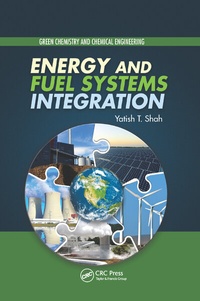
Energy and Fuel Systems Integration
1st Edition
Published on 23. October 2019
Book
Paperback/Softback
450 pages
978-0-367-37734-2 (ISBN)
Description
Energy and Fuel Systems Integration explains how growing energy and fuel demands, paired with the need for environmental preservation, require different sources of energy and fuel to cooperate and integrate with each other rather than simply compete. Providing numerous examples of energy and fuel systems integration success stories, this book:
Discusses the use of different mixtures of fuels for combustion, gasification, liquefaction, pyrolysis, and anaerobic digestion processes
Describes the use of hybrid nuclear and renewable energy systems for power and heat cogenerations with nonelectrical applications
Details the holistic integration of renewable, nuclear, and fossil energy systems by gas, heat, and smart electrical grids
Energy and Fuel Systems Integration emphasizes the many advantages of these integrated systems, including sustainability, flexibility for optimization and scale-up, and more efficient use of storage, transportation, and delivery infrastructures.
Discusses the use of different mixtures of fuels for combustion, gasification, liquefaction, pyrolysis, and anaerobic digestion processes
Describes the use of hybrid nuclear and renewable energy systems for power and heat cogenerations with nonelectrical applications
Details the holistic integration of renewable, nuclear, and fossil energy systems by gas, heat, and smart electrical grids
Energy and Fuel Systems Integration emphasizes the many advantages of these integrated systems, including sustainability, flexibility for optimization and scale-up, and more efficient use of storage, transportation, and delivery infrastructures.
More details
Language
English
Place of publication
London
United Kingdom
Publishing group
Taylor & Francis Ltd
Target group
Professional and scholarly
Professional Practice & Development
Dimensions
Height: 234 mm
Width: 156 mm
Weight
453 gr
ISBN-13
978-0-367-37734-2 (9780367377342)
Copyright in bibliographic data and cover images is held by Nielsen Book Services Limited or by the publishers or by their respective licensors: all rights reserved.
Schweitzer Classification
Other editions
Additional editions
Yatish T. Shah
Energy and Fuel Systems Integration
Book
10/2015
1st Edition
CRC Press
€274.84
Article not available for order
Yatish T. Shah
Energy and Fuel Systems Integration
E-Book
10/2015
1st Edition
CRC Press
€92.49
Available for download
Yatish T. Shah
Energy and Fuel Systems Integration
E-Book
10/2015
1st Edition
CRC Press
€92.49
Available for download
Person
Yatish T. Shah received his B.Sc in chemical engineering from the University of Michigan, Ann Arbor, USA, and MS and Sc.D in chemical engineering from the Massachusetts Institute of Technology, Cambridge, USA. He has more than 40 years of academic and industrial experience in energy-related areas. He was chairman of the Department of Chemical and Petroleum Engineering at the University of Pittsburgh, Pennsylvania, USA; dean of the College of Engineering at the University of Tulsa, Oklahoma, USA, and Drexel University, Philadelphia, Pennsylvania, USA; chief research officer at Clemson University, South Carolina, USA; and provost at Missouri University of Science and Technology, Rolla, USA, the University of Central Missouri, Warrensburg, USA, and Norfolk State University, Virginia, USA. He was also a visiting scholar at University of Cambridge, UK, and a visiting professor at the University of California, Berkley, USA, and Institut fuer Technische Chemie I der Universitaet Erlangen, Nuernberg, Germany. Currently, he is a professor of engineering and co-director of the Hodge Institute of Entrepreneurship at Norfolk State University. Dr. Shah has written five books related to energy. He has also published more than 250 refereed reviews, book chapters, and research technical publications in the areas of energy, environment, and reaction engineering. He is an active consultant to numerous industries and government organizations in the energy areas.
Content
Introduction. Heat and Power by Co-Combustion. Synthetic Gas Production by Co-Gasification. Synthetic Liquid Production by Co-Processing. Co-Pyrolysis. Methane Production by Anaerobic Co-Digestion of Biomass and Waste. Hybrid Nuclear Energy Systems. Hybrid Renewable Energy Systems. Energy and Fuel Systems Integration by Gas, Heat, and Electricity Grids. Multifuel, Hybrid, and Grid-Integrated Vehicles: A Case Study.