

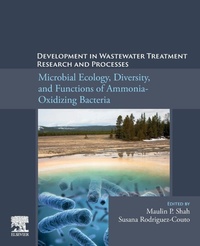
Development in Wastewater Treatment Research and Processes
Microbial Ecology, Diversity and Functions of Ammonia Oxidizing Bacteria
Published on 16. May 2022
Book
Paperback/Softback
486 pages
978-0-323-91901-2 (ISBN)
Description
Development in Wastewater Treatment Research and Processes: Microbial Ecology, Diversity and Functions of Ammonia Oxidizing Bacteria covers up-to-date research on ammonia oxidizing bacteria and their application for the removal of ammonia nitrogen from wastewater treatment plants (WWTPs), discussing remaining gaps in their biology and functions. In this sense, this book features the application of the newly developed omics tools in order to develop less energy intensive and cost-effective biological processes for nitrogen removal from WWTPs. This makes this book an essential and unique book for advanced students, research scientists, environmental agencies and industries involved in wastewater treatment.
More details
Language
English
Place of publication
Philadelphia
United States
Target group
Professional and scholarly
Engineers, scientists and managers who require an excellent introduction and basic knowledge to the principles of microbial ecology, diversity and functions of ammonia oxidizing bacteria;Different professionals working or interested in the Environmental Microbiology, Bioremediation and Environmental Genomics fields.
Product notice
Paperback (trade)
Dimensions
Height: 235 mm
Width: 191 mm
Thickness: 25 mm
Weight
832 gr
ISBN-13
978-0-323-91901-2 (9780323919012)
Copyright in bibliographic data and cover images is held by Nielsen Book Services Limited or by the publishers or by their respective licensors: all rights reserved.
Schweitzer Classification
Other editions
Additional editions
Maulin P. Shah | Susana Rodriguez-Couto
Development in Wastewater Treatment Research and Processes
Microbial Ecology, Diversity and Functions of Ammonia Oxidizing Bacteria
E-Book
05/2022
Elsevier
€200.00
Available for download
Persons
Dr. Maulin P. Shah is a distinguished environmental scientist, academician, and globally recognized expert in the fields of environmental biotechnology and sustainable
wastewater treatment. He has made significant contributions to advancing eco-friendly
technologies for pollution control, particularly through innovative biological treatment processes. Dr. Shah holds extensive academic and research experience, with a strong focus on
industrial wastewater treatment, bioremediation, and microalgae-based technologies. His work emphasizes the integration of sustainability principles with practical engineering solutions, helping industries reduce their environmental footprint.
Remarkably, Dr. Shah has edited over 300+ books covering a wide spectrum of cutting-edge domains, including industrial wastewater microbiology, bioremediation, biodegradation, algal biotechnology, biofuel, bioenergy, circular economy, metagenomics related to wastewater treatment, and enzyme engineering. This exceptional editorial contribution reflects his deep expertise and unparalleled commitment to advancing global knowledge in environmental science.
Over the years, he has also authored and contributed to numerous high-impact
research papers and scholarly books published by reputed international publishers. His
publications are widely cited and serve as essential references for researchers, academicians, and industry professionals worldwide.
He is actively associated as an Editorial Board Member in more than 30 high-reputed
international journals affiliated with leading organizations and publishers such as
International Water Association, American Chemical Society, Royal Society of Chemistry,
Elsevier, Springer, Taylor & Francis, Wiley, IOP Publishing, Apple Academic Press,
Scrivener Publishing, and Bentham Science Publishers. His extensive editorial involvement
highlights his leadership and recognition in the global scientific community.
Dr. Shah is widely recognized for his collaborative research with leading scientists
across the globe, promoting interdisciplinary solutions to complex environmental challenges.
His work effectively bridges the gap between fundamental research and real-world industrial
applications. In addition to his research excellence, he has been invited as a keynote speaker at numerous national and international conferences, where he shares valuable insights on sustainable development, wastewater management, and environmental innovation. He is also deeply committed to mentoring students and young researchers, fostering academic growth and inspiring future leaders in environmental science and engineering.
Beyond academia, Dr. Shah contributes to industry-oriented solutions and policy-
relevant research aimed at environmental protection, resource recovery, and sustainable
development. Through his relentless dedication and visionary approach, Dr. Maulin P. Shah
has established himself as a leading authority in environmental sustainability, committed to
building a cleaner, greener, and more sustainable future. Susana Rodriguez-Couto is a professor in biological water treatment at LUT University, Finland. She got her B.Sc. and M.Sc. in Chemistry (Industrial Chemistry) from the University of Santiago de Compostela in 1992 and her Ph.D. in Chemistry in 1999 from the University of Vigo, obtaining the maximal grade (magna cum laude) and, in addition, she was awarded with the Extraordinary Prize for Doctoral Thesis in Chemistry. She worked as an Associate Professor and an Isidro Parga Pondal Senior Researcher at the University of Vigo (2000-2004), as a Ramon y Cajal Senior Researcher at Rovira i Virgili University (2004-2008) and as an Ikerbasque Research Professor (2009-2019). She has also worked as an Invited Researcher at the Institute from Environmental Biotechnology, Graz University of Technology (Austria) and at the Department of Biological Engineering, University of Minho (Portugal). In 2008, she received the I3 Professor from the Spanish Ministry of Science and Education to the recognition of an outstanding research activity. She has published more than 140 articles in highly reputed international journals (h index 42). She is editor of several journals (3Biotech, Frontiers) and 14 Elsevier books.
wastewater treatment. He has made significant contributions to advancing eco-friendly
technologies for pollution control, particularly through innovative biological treatment processes. Dr. Shah holds extensive academic and research experience, with a strong focus on
industrial wastewater treatment, bioremediation, and microalgae-based technologies. His work emphasizes the integration of sustainability principles with practical engineering solutions, helping industries reduce their environmental footprint.
Remarkably, Dr. Shah has edited over 300+ books covering a wide spectrum of cutting-edge domains, including industrial wastewater microbiology, bioremediation, biodegradation, algal biotechnology, biofuel, bioenergy, circular economy, metagenomics related to wastewater treatment, and enzyme engineering. This exceptional editorial contribution reflects his deep expertise and unparalleled commitment to advancing global knowledge in environmental science.
Over the years, he has also authored and contributed to numerous high-impact
research papers and scholarly books published by reputed international publishers. His
publications are widely cited and serve as essential references for researchers, academicians, and industry professionals worldwide.
He is actively associated as an Editorial Board Member in more than 30 high-reputed
international journals affiliated with leading organizations and publishers such as
International Water Association, American Chemical Society, Royal Society of Chemistry,
Elsevier, Springer, Taylor & Francis, Wiley, IOP Publishing, Apple Academic Press,
Scrivener Publishing, and Bentham Science Publishers. His extensive editorial involvement
highlights his leadership and recognition in the global scientific community.
Dr. Shah is widely recognized for his collaborative research with leading scientists
across the globe, promoting interdisciplinary solutions to complex environmental challenges.
His work effectively bridges the gap between fundamental research and real-world industrial
applications. In addition to his research excellence, he has been invited as a keynote speaker at numerous national and international conferences, where he shares valuable insights on sustainable development, wastewater management, and environmental innovation. He is also deeply committed to mentoring students and young researchers, fostering academic growth and inspiring future leaders in environmental science and engineering.
Beyond academia, Dr. Shah contributes to industry-oriented solutions and policy-
relevant research aimed at environmental protection, resource recovery, and sustainable
development. Through his relentless dedication and visionary approach, Dr. Maulin P. Shah
has established himself as a leading authority in environmental sustainability, committed to
building a cleaner, greener, and more sustainable future. Susana Rodriguez-Couto is a professor in biological water treatment at LUT University, Finland. She got her B.Sc. and M.Sc. in Chemistry (Industrial Chemistry) from the University of Santiago de Compostela in 1992 and her Ph.D. in Chemistry in 1999 from the University of Vigo, obtaining the maximal grade (magna cum laude) and, in addition, she was awarded with the Extraordinary Prize for Doctoral Thesis in Chemistry. She worked as an Associate Professor and an Isidro Parga Pondal Senior Researcher at the University of Vigo (2000-2004), as a Ramon y Cajal Senior Researcher at Rovira i Virgili University (2004-2008) and as an Ikerbasque Research Professor (2009-2019). She has also worked as an Invited Researcher at the Institute from Environmental Biotechnology, Graz University of Technology (Austria) and at the Department of Biological Engineering, University of Minho (Portugal). In 2008, she received the I3 Professor from the Spanish Ministry of Science and Education to the recognition of an outstanding research activity. She has published more than 140 articles in highly reputed international journals (h index 42). She is editor of several journals (3Biotech, Frontiers) and 14 Elsevier books.
Content
1. Ammonia oxidizing bacteria: a model for molecular microbial ecology
2. The lithoautotrophic ammonia oxidizing bacteria
3. Diversity of ammonia oxidizing bacteria
4. Abundance of ammonia oxidizing bacteria in industrial wastewater treatment systems
5. Population ecology of nitrifying bacteria in wastewater treatment systems.
6. Ammonia oxidation kinetics & its application in wastewater treatment.
7. Autotrophic nitrification in bacteria
8. Ecology, Diversity and Functions of Anammox process in Modified Ludzack Ettinger Process (MLE)
9. Ammonia oxidizing bacterial community analysis in activated sludge process
10. Growth, activity and temperature responses of ammonia-oxidizing archaea and bacteria in soil microcosms.
11. Aerobic and anaerobic ammonia oxidizing bacteria.
12. Genomics of ammonia oxidizing bacteria and denitrification in wastewater treatment plants.
13. Nitrification by chemolithotrophic bacteria.
14. Ammonium removal by the oxygen limited autotrophic nitrification denitrification system.
15. An overview of the Anammox process.
16. Key physiology of anaerobic ammonium oxidation.
17. Completely autotrophic nitrogen removal over nitrite under ammonia limitation
18. Diversity study of nitrifying bacteria in sewage and industrial wastewater treatment plant
2. The lithoautotrophic ammonia oxidizing bacteria
3. Diversity of ammonia oxidizing bacteria
4. Abundance of ammonia oxidizing bacteria in industrial wastewater treatment systems
5. Population ecology of nitrifying bacteria in wastewater treatment systems.
6. Ammonia oxidation kinetics & its application in wastewater treatment.
7. Autotrophic nitrification in bacteria
8. Ecology, Diversity and Functions of Anammox process in Modified Ludzack Ettinger Process (MLE)
9. Ammonia oxidizing bacterial community analysis in activated sludge process
10. Growth, activity and temperature responses of ammonia-oxidizing archaea and bacteria in soil microcosms.
11. Aerobic and anaerobic ammonia oxidizing bacteria.
12. Genomics of ammonia oxidizing bacteria and denitrification in wastewater treatment plants.
13. Nitrification by chemolithotrophic bacteria.
14. Ammonium removal by the oxygen limited autotrophic nitrification denitrification system.
15. An overview of the Anammox process.
16. Key physiology of anaerobic ammonium oxidation.
17. Completely autotrophic nitrogen removal over nitrite under ammonia limitation
18. Diversity study of nitrifying bacteria in sewage and industrial wastewater treatment plant