

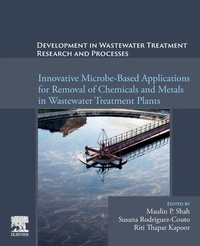
Development in Wastewater Treatment Research and Processes
Innovative Microbe-Based Applications for Removal of Chemicals and Metals in Wastewater Treatment Plants
Published on 21. October 2021
Book
Paperback/Softback
502 pages
978-0-323-85657-7 (ISBN)
Description
Development in Waste Water Treatment Research and Processes: Innovative Microbe-Based Applications for Removal of Chemicals and Metals in Wastewater Treatment Plants focuses on the exploitation of various biological treatment technologies and their use to treat toxic and hazardous contaminants present in industrial effluent and restore the contaminated sites, a topic which lacks discussion in existing titles on the global market. This book encompasses advanced technologies and updated information as well as future directions for young researchers and scientists who are working in the field of wastewater treatment or effluent treatment plants and biodegradation of environmental contaminants for environmental safety and sustainable development.
More details
Language
English
Place of publication
Philadelphia
United States
Target group
Professional and scholarly
Primary: bioengineers, environmental scientists , chemists in academia and corporate research.
Secondary: Different professionals, managers working or interested in the Water treatment
Product notice
Paperback (trade)
Dimensions
Height: 235 mm
Width: 191 mm
Thickness: 26 mm
Weight
859 gr
ISBN-13
978-0-323-85657-7 (9780323856577)
Copyright in bibliographic data and cover images is held by Nielsen Book Services Limited or by the publishers or by their respective licensors: all rights reserved.
Schweitzer Classification
Other editions
Additional editions
Maulin P. Shah | Susana Rodriguez-Couto | Riti Thapar Kapoor
Development in Wastewater Treatment Research and Processes
Innovative Microbe-Based Applications for Removal of Chemicals and Metals in Wastewater Treatment Plants
E-Book
10/2021
Elsevier
€200.00
Available for download
Persons
Dr. Maulin P. Shah is a distinguished environmental scientist, academician, and globally recognized expert in the fields of environmental biotechnology and sustainable
wastewater treatment. He has made significant contributions to advancing eco-friendly
technologies for pollution control, particularly through innovative biological treatment processes. Dr. Shah holds extensive academic and research experience, with a strong focus on
industrial wastewater treatment, bioremediation, and microalgae-based technologies. His work emphasizes the integration of sustainability principles with practical engineering solutions, helping industries reduce their environmental footprint.
Remarkably, Dr. Shah has edited over 300+ books covering a wide spectrum of cutting-edge domains, including industrial wastewater microbiology, bioremediation, biodegradation, algal biotechnology, biofuel, bioenergy, circular economy, metagenomics related to wastewater treatment, and enzyme engineering. This exceptional editorial contribution reflects his deep expertise and unparalleled commitment to advancing global knowledge in environmental science.
Over the years, he has also authored and contributed to numerous high-impact
research papers and scholarly books published by reputed international publishers. His
publications are widely cited and serve as essential references for researchers, academicians, and industry professionals worldwide.
He is actively associated as an Editorial Board Member in more than 30 high-reputed
international journals affiliated with leading organizations and publishers such as
International Water Association, American Chemical Society, Royal Society of Chemistry,
Elsevier, Springer, Taylor & Francis, Wiley, IOP Publishing, Apple Academic Press,
Scrivener Publishing, and Bentham Science Publishers. His extensive editorial involvement
highlights his leadership and recognition in the global scientific community.
Dr. Shah is widely recognized for his collaborative research with leading scientists
across the globe, promoting interdisciplinary solutions to complex environmental challenges.
His work effectively bridges the gap between fundamental research and real-world industrial
applications. In addition to his research excellence, he has been invited as a keynote speaker at numerous national and international conferences, where he shares valuable insights on sustainable development, wastewater management, and environmental innovation. He is also deeply committed to mentoring students and young researchers, fostering academic growth and inspiring future leaders in environmental science and engineering.
Beyond academia, Dr. Shah contributes to industry-oriented solutions and policy-
relevant research aimed at environmental protection, resource recovery, and sustainable
development. Through his relentless dedication and visionary approach, Dr. Maulin P. Shah
has established himself as a leading authority in environmental sustainability, committed to
building a cleaner, greener, and more sustainable future. Susana Rodriguez-Couto is a professor in biological water treatment at LUT University, Finland. She got her B.Sc. and M.Sc. in Chemistry (Industrial Chemistry) from the University of Santiago de Compostela in 1992 and her Ph.D. in Chemistry in 1999 from the University of Vigo, obtaining the maximal grade (magna cum laude) and, in addition, she was awarded with the Extraordinary Prize for Doctoral Thesis in Chemistry. She worked as an Associate Professor and an Isidro Parga Pondal Senior Researcher at the University of Vigo (2000-2004), as a Ramon y Cajal Senior Researcher at Rovira i Virgili University (2004-2008) and as an Ikerbasque Research Professor (2009-2019). She has also worked as an Invited Researcher at the Institute from Environmental Biotechnology, Graz University of Technology (Austria) and at the Department of Biological Engineering, University of Minho (Portugal). In 2008, she received the I3 Professor from the Spanish Ministry of Science and Education to the recognition of an outstanding research activity. She has published more than 140 articles in highly reputed international journals (h index 42). She is editor of several journals (3Biotech, Frontiers) and 14 Elsevier books. Dr. Riti Thapar Kapoor is Professor in Amity Institute of Biotechnology, Amity University Uttar Pradesh, Noida, India. Dr. Kapoor received her Ph.D from University of Allahabad and worked as post - doctoral fellow at Banaras Hindu University, Varanasi, India. Dr. Kapoor has fourteen years of teaching and research experience and her area of specialization is environmental biotechnology, bioremediation, wastewater treatment and abiotic stresses. Dr. Kapoor has published 11 books and over 105 research papers in various journals of national and international repute. Dr. Kapoor has visited 8 countries for participation in different academic programmes. Dr. Kapoor has received prestigious travel award from Bill & Melinda Gates Research Foundation under CGIAR project for participation in International training programme held at International Rice Research Institute (IRRI), Manila, Philippines in 2010. She is also recipient of DST travel grant for participation in International Conference held at Sri Lanka in 2013. Dr. Kapoor has been awarded with Teacher's Research Fellowship from Indian Academy of Sciences, Bengaluru in 2019. She has supervised and mentored a number of research projects sanctioned by different government funding agencies such as DAE, DST and UPCST etc. She has successfully supervised three research students for Ph.D. degree besides several (more than 80) masters and graduate students for their dissertation thesis.
wastewater treatment. He has made significant contributions to advancing eco-friendly
technologies for pollution control, particularly through innovative biological treatment processes. Dr. Shah holds extensive academic and research experience, with a strong focus on
industrial wastewater treatment, bioremediation, and microalgae-based technologies. His work emphasizes the integration of sustainability principles with practical engineering solutions, helping industries reduce their environmental footprint.
Remarkably, Dr. Shah has edited over 300+ books covering a wide spectrum of cutting-edge domains, including industrial wastewater microbiology, bioremediation, biodegradation, algal biotechnology, biofuel, bioenergy, circular economy, metagenomics related to wastewater treatment, and enzyme engineering. This exceptional editorial contribution reflects his deep expertise and unparalleled commitment to advancing global knowledge in environmental science.
Over the years, he has also authored and contributed to numerous high-impact
research papers and scholarly books published by reputed international publishers. His
publications are widely cited and serve as essential references for researchers, academicians, and industry professionals worldwide.
He is actively associated as an Editorial Board Member in more than 30 high-reputed
international journals affiliated with leading organizations and publishers such as
International Water Association, American Chemical Society, Royal Society of Chemistry,
Elsevier, Springer, Taylor & Francis, Wiley, IOP Publishing, Apple Academic Press,
Scrivener Publishing, and Bentham Science Publishers. His extensive editorial involvement
highlights his leadership and recognition in the global scientific community.
Dr. Shah is widely recognized for his collaborative research with leading scientists
across the globe, promoting interdisciplinary solutions to complex environmental challenges.
His work effectively bridges the gap between fundamental research and real-world industrial
applications. In addition to his research excellence, he has been invited as a keynote speaker at numerous national and international conferences, where he shares valuable insights on sustainable development, wastewater management, and environmental innovation. He is also deeply committed to mentoring students and young researchers, fostering academic growth and inspiring future leaders in environmental science and engineering.
Beyond academia, Dr. Shah contributes to industry-oriented solutions and policy-
relevant research aimed at environmental protection, resource recovery, and sustainable
development. Through his relentless dedication and visionary approach, Dr. Maulin P. Shah
has established himself as a leading authority in environmental sustainability, committed to
building a cleaner, greener, and more sustainable future. Susana Rodriguez-Couto is a professor in biological water treatment at LUT University, Finland. She got her B.Sc. and M.Sc. in Chemistry (Industrial Chemistry) from the University of Santiago de Compostela in 1992 and her Ph.D. in Chemistry in 1999 from the University of Vigo, obtaining the maximal grade (magna cum laude) and, in addition, she was awarded with the Extraordinary Prize for Doctoral Thesis in Chemistry. She worked as an Associate Professor and an Isidro Parga Pondal Senior Researcher at the University of Vigo (2000-2004), as a Ramon y Cajal Senior Researcher at Rovira i Virgili University (2004-2008) and as an Ikerbasque Research Professor (2009-2019). She has also worked as an Invited Researcher at the Institute from Environmental Biotechnology, Graz University of Technology (Austria) and at the Department of Biological Engineering, University of Minho (Portugal). In 2008, she received the I3 Professor from the Spanish Ministry of Science and Education to the recognition of an outstanding research activity. She has published more than 140 articles in highly reputed international journals (h index 42). She is editor of several journals (3Biotech, Frontiers) and 14 Elsevier books. Dr. Riti Thapar Kapoor is Professor in Amity Institute of Biotechnology, Amity University Uttar Pradesh, Noida, India. Dr. Kapoor received her Ph.D from University of Allahabad and worked as post - doctoral fellow at Banaras Hindu University, Varanasi, India. Dr. Kapoor has fourteen years of teaching and research experience and her area of specialization is environmental biotechnology, bioremediation, wastewater treatment and abiotic stresses. Dr. Kapoor has published 11 books and over 105 research papers in various journals of national and international repute. Dr. Kapoor has visited 8 countries for participation in different academic programmes. Dr. Kapoor has received prestigious travel award from Bill & Melinda Gates Research Foundation under CGIAR project for participation in International training programme held at International Rice Research Institute (IRRI), Manila, Philippines in 2010. She is also recipient of DST travel grant for participation in International Conference held at Sri Lanka in 2013. Dr. Kapoor has been awarded with Teacher's Research Fellowship from Indian Academy of Sciences, Bengaluru in 2019. She has supervised and mentored a number of research projects sanctioned by different government funding agencies such as DAE, DST and UPCST etc. She has successfully supervised three research students for Ph.D. degree besides several (more than 80) masters and graduate students for their dissertation thesis.
Editor
Environmental Microbiology Consultant, Gujarat, India
Full Professor (Biological Water Treatment), Department of Separation Science, LUT School of Engineering Science, LUT University, Finland
Centre for Plant and Environmental Biotechnology, Amity Institute of Biotechnology, Amity University Uttar Pradesh, Noida, Uttar Pradesh, India
Content
1. A comparative study between physicochemical and biological methods for effective removal of textile dye from wastewater
2. An approach towards developing clean green techniques to deal with heavy metal toxicity using the microbiome
3. Microbial degradation of Pesticides- Microbial potential for Degradation of Pesticides
4. Bio-Degradation and Photo-Catalysis of Pharmaceuticals in wastewater
5. Recent Trends in the Microbial Degradation and Bioremediation of Emerging pollutants in Wastewater Treatment System
6. Biological Methods for Textile Dyes Removal from Wastewaters
7. Importance and applications of biofilm in microbe assisted bioremediation
8. Microorganism: An eco-friendly tool for waste management and environmental safety
9. Microbial degradation of lignin: conversion, application, and challenges
10. Ligninolytic Enzymes: A Promising Tools for Bioremediation of Wastewater
11. Bioaccumulation and detoxification of Heavy Metals: An Insight into the Mechanism
12. Membrane Proteins Mediated Microbial Electrochemical Remediation Technology
13. Bioremediation Strategies to Overcome Heavy Metals and Radionuclides from the Environment
14. Microbial remediation of tannery wastewater
15. Biological Methods for Degradation of Textile Dyes from Textile Effluent
2. An approach towards developing clean green techniques to deal with heavy metal toxicity using the microbiome
3. Microbial degradation of Pesticides- Microbial potential for Degradation of Pesticides
4. Bio-Degradation and Photo-Catalysis of Pharmaceuticals in wastewater
5. Recent Trends in the Microbial Degradation and Bioremediation of Emerging pollutants in Wastewater Treatment System
6. Biological Methods for Textile Dyes Removal from Wastewaters
7. Importance and applications of biofilm in microbe assisted bioremediation
8. Microorganism: An eco-friendly tool for waste management and environmental safety
9. Microbial degradation of lignin: conversion, application, and challenges
10. Ligninolytic Enzymes: A Promising Tools for Bioremediation of Wastewater
11. Bioaccumulation and detoxification of Heavy Metals: An Insight into the Mechanism
12. Membrane Proteins Mediated Microbial Electrochemical Remediation Technology
13. Bioremediation Strategies to Overcome Heavy Metals and Radionuclides from the Environment
14. Microbial remediation of tannery wastewater
15. Biological Methods for Degradation of Textile Dyes from Textile Effluent