

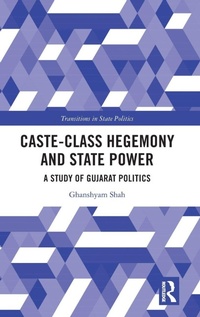
Caste-Class Hegemony and State Power
A Study of Gujarat Politics
1st Edition
Will be published approx. on 21. November 2025
Book
Hardback
268 pages
978-1-032-70023-6 (ISBN)
Description
The book analyses the politics and socio-cultural forces in Gujarat over the last five decades. It examines the trajectory of Hindu nationalism, explores the catalytic factors behind its growth and shows how the middle class plays an important role in electoral politics in India. It argues that the elite of the middle class - who led the freedom movement and are at the forefront of all political parties in the post-independence era - in collusion with the upper class and classes control and manage the avenues of production of information and knowledge and also agencies for the dissemination of information media as well as the education system enabling Brahmanic hegemony.
A comprehensive analysis of the state level political process of the growth of ethnic nationalism in India, the volume will be of great interest to scholars and researchers of politics, especially political sociology and South Asian studies.
A comprehensive analysis of the state level political process of the growth of ethnic nationalism in India, the volume will be of great interest to scholars and researchers of politics, especially political sociology and South Asian studies.
Reviews / Votes
"Ghanshyam Shah's book covers in detail many facets of the Gujarati public life, ranging from the social dynamics, including the transformation of the caste system, to the political trajectory - with special references to the electoral scenario. This multifaceted study is conducted with great historical depth, harking back to the birth of the province and even before. A great achievement!"Christophe Jaffrelot, Research Director at CERI-Sciences Po/CNRS, Professor of Indian Politics and Sociology at King's College London
"Do you wish to understand the phenomenon of Narendra Modi's ascendance to power in India? Here is the answer by one of India's most prominent social scientists giving a deeper socio-economic explanation through a detailed analysis of Modi's Gujarat years as Chief Minister when he perfected his political strategy that combined the vikas (development) agenda with Hindutva and Asmita (identity). Keeping the full backing of the corporate houses and upper castes with him while mobilising the OBC masses through welfare measures and splitting the subalterns proved to be Modi's winning formula. On methods of assuming supremacy in a political party, using institutions of state and creating campaign waves as well as on handling caste-class-identity interface, the veteran scholar Ghanshyam Shah provides valuable theoretical and practical insights. This work is going to be a landmark contribution to the study of Indian politics."
Manoranjan Mohanty, Professor of Political Science (Retd), University of Delhi
"Gujarat in West India has been a driving force of the transformations taking place in the world's most populous country comprising 1.50 billion people. It was the setting from which Mahatma Gandhi addressed in the late colonial era not only its citizens but humanity at large with his mission of a global future shaped in inclusiveness, equality and social justice for all. Having monitored the political economy for more than five decades and from close by, Ghanshyam Shah discusses how the socio-cultural order has remained embedded in a caste-class fabric of dominance versus subalternity. Both components have under the spell of neoliberal capitalism solidified rather than eroded each other."
Jan Breman, Professor Emeritus of Comparative Sociology at the University of Amsterdam
More details
Series
Language
English
Place of publication
London
United Kingdom
Publishing group
Taylor & Francis Ltd
Target group
College/higher education
Professional and scholarly
Postgraduate
Illustrations
17 s/w Zeichnungen, 17 s/w Tabellen, 17 s/w Abbildungen
17 Tables, black and white; 17 Line drawings, black and white; 17 Illustrations, black and white
Dimensions
Height: 240 mm
Width: 161 mm
Thickness: 20 mm
Weight
596 gr
ISBN-13
978-1-032-70023-6 (9781032700236)
Copyright in bibliographic data and cover images is held by Nielsen Book Services Limited or by the publishers or by their respective licensors: all rights reserved.
Schweitzer Classification
Other editions
Additional editions
E-Book
11/2025
CRC Press
€60.49
Available for download
E-Book
11/2025
CRC Press
€60.49
Available for download
Person
Ghanshyam Shah is retired Professor, Jawaharlal Nehru University, New Delhi, India. He was formerly Director and Professor at the Centre for Social Studies, Surat, India; Dr. Ambedkar Chair Professor at L.B. Shastri National Academy, Mussoorie, India; Fellow in Residence at the Netherlands Institute of Advanced Study, Wassenaar; and National Fellow of the Indian Council of Social Science Research and the Indian Institute of Advanced Study, Shimla, India. The books he has authored or edited include Caste Association and Political Process (1975), Caste and Democratic Politics in India (2001 and 2004), Democracy, Civil society and Governance (2019) and (with Jan Breman) Gujarat, Cradle and Harbinger of Identity Politics (2022).
Content
1. Introduction 2. Dominance and hegemony under the Colonial State 3. Gujarat Congress system and consolidation of dominant caste-classes 4. Radical Populist vs Moralist Politics 5. KHAM (OBCs) and Samrasta (Assimilation) politics 6. Naya Gujarat: Vikas, Asmita and Militant Hinduism 7. BJP's victory and intra-party power struggle 8. Emergence of the Hindu Hardya Samrat 9. Vikas Purush: Hindutva-Vikas Synergy 10. Consolidation of power and marketing Gujarat model 11. Partisan State: Patidar and Dalit agitations 12. Triumph of Samrasta and Vikas electoral politics 13. Epilogue